
In brief: a wholesale custom 2 slot 3 ml vial case is a made-to-order secondary paper package with two engineered insert cavities, not simply a retail travel organizer. To source it correctly, give the converter a physical vial or controlled drawing, the closure and label configuration, artwork, order quantity, distribution route, pack-out method, and written acceptance criteria. The supplier should then prototype the exact vial-to-insert-to-box system before mass production.
The phrase 3 ml describes nominal capacity, not a universal outside size. One official ISO 2R example is 16 mm in body diameter and 35 mm high, while another 3 mL serum-vial example is 17 mm by 38 mm. Therefore, a buyer should never approve a dieline or foam cutout from capacity alone.
A custom 2 slot 3 ml vial case for wholesale packaging is different from a compact retail travel case. B2B buyers usually need a branded secondary package with precision-fit inserts, controlled artwork, production sampling, measurable quality criteria, and a pack-out plan suited to the intended distribution route. This guide explains how to specify and source that complete packaging system, from vial measurement and insert engineering to sampling, inspection, and shipment approval. For wider background, see GPLPAK's peptide vial packaging design guide.
Before discussing board thickness or foam density, define which package is actually being purchased. A B2C organizer, a branded secondary box, a parcel shipper, and a validated thermal system solve different problems. Calling all four a “vial case” creates inaccurate quotations and, more seriously, unsupported protection or temperature claims.
| Package type | Primary job | Typical construction | What it does not prove |
|---|---|---|---|
| Retail organizer | Personal storage and portability | Molded or 3D-printed hard shell | Custom brand presentation or validated distribution performance |
| Custom secondary package | Hold, present, identify, and organize two vials | Rigid box or folding carton plus insert | Sterility, drug stability, or cold-chain performance |
| Distribution shipper | Protect packed units through a defined route | Corrugated case, dividers, cushioning, closures | Temperature control unless designed and qualified for it |
| Thermal shipper | Maintain a specified payload temperature profile | Insulation, refrigerants, payload layout, outer shipper | Suitability outside its qualified lane and operating procedure |
A B2B RFQ should state “custom printed secondary package for two vials,” then identify whether a separate overpack will provide transit or thermal protection. This wording keeps the manufacturer focused on the actual deliverable and prevents a presentation box from being confused with a travel organizer, distribution shipper, or qualified thermal system.
Nominal fill volume cannot define an insert cavity. The converter needs the maximum physical envelope of the finished component: total height including closure, widest body diameter, cap or crown diameter, label overlap, and any sleeve or tamper feature. Measurements should come from approved production components, not from a generic online chart.
| Official example | Nominal capacity | Body diameter | Overall height | Packaging implication |
|---|---|---|---|---|
| West / Stevanato SG EZ-fill ISO 2R | 3 mL | 16 mm | 35 mm | A useful reference, but the buyer's closure and label still govern fit |
| DWK clear serum vial listing | 3 mL | 17 mm | 38 mm | The same stated capacity can require a larger cutout and taller box |
Those examples differ by 1 mm in diameter and 3 mm in height. That is enough to change insertion force, rattle, top clearance, and outer dimensions. In a two-cavity layout, the effect also reaches the bridge between cavities and the box wall. A small assumption repeated across tooling, samples, and mass production becomes an expensive revision.
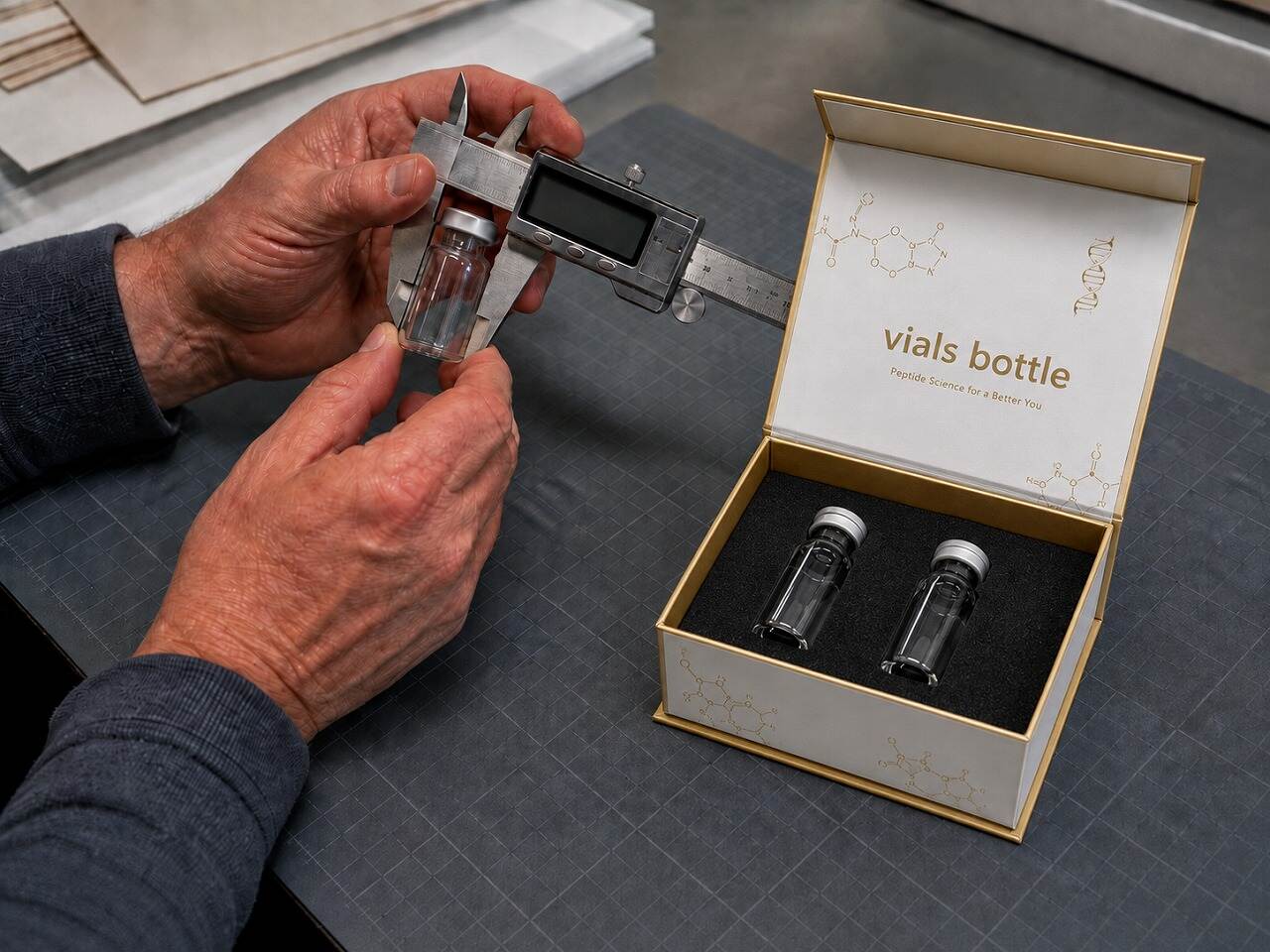
Fit engineering starts with the finished vial, closure, and label configuration, then moves to a physical two-cavity prototype.
Practical measurement rule: record the maximum and minimum from several production-representative vials. Include the cap and label. State the measuring method and orientation. Then ask the insert supplier to declare the proposed cavity size and tolerance rather than using an unexplained “standard 3 ml” cutout.
The insert must retain both vials without making removal awkward or pressing on vulnerable components. A useful design begins with a controlled product envelope and a defined retention strategy. A friction fit around the glass body behaves differently from a shoulder feature under the cap; a full-depth pocket behaves differently from a shallow presentation recess.
Start with a nominal cavity, then test the real tolerance stack: vial variation, foam recovery, cutting variation, lamination, humidity, and assembly placement. The bridge between the two slots should remain wide enough to resist tearing or permanent deformation. Outside walls need enough material to stop the cavity from breaking through the insert edge. Finger notches should let a user remove one vial without lifting the second.
There is no responsible universal clearance number for every foam and vial. A preliminary drawing may begin with a small diametral allowance, but the physical fit sample must decide the production value. The goal is repeatable insertion and removal, minimal glass-to-box contact, no pressure on the cap, and no uncontrolled movement under the agreed handling check.
Decide whether the vials stand upright, lie horizontally, or sit at a presentation angle. Upright layouts can minimize footprint but need adequate top clearance. Horizontal layouts can expose more of the label but may lengthen the box. If labels carry variable data, determine whether they must remain visible without removing the vial. Also reserve space for leaflets or accessories only when they are truly part of the pack-out; adding an unconfirmed compartment changes tooling and box size.
Structure should follow channel, handling, brand position, sustainability targets, and automation. GPLPAK's current product information supports custom sizing and insert options such as EVA, soft foam, paperboard, blister trays, and paper pulp. Those are capabilities, not proof that one material is best for every vial. Buyers can compare broader formats on the packaging structure page and review rigid box examples.
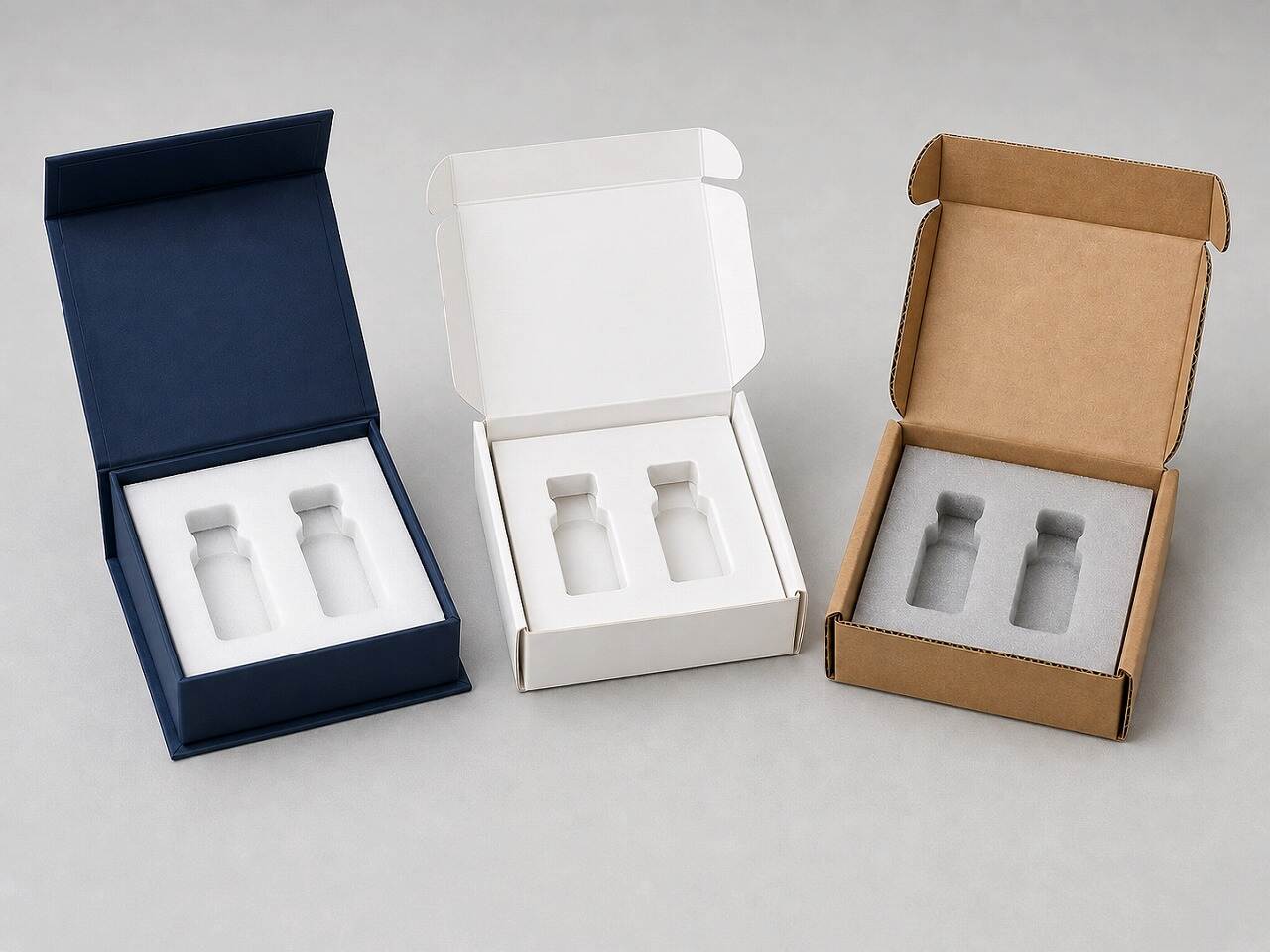
Rigid, folding-carton, and corrugated formats solve different presentation, cost, and distribution problems.
| Insert option | Strength | Watch item | Good RFQ question |
|---|---|---|---|
| EVA 거품 | Crisp cavity edges and premium presentation | Density, odor, color rub, recovery, disposal route | What grade, density, thickness, and cutting process will be sampled? |
| PE or EPE foam | Lightweight cushioning and moisture resistance | Appearance, compression set, recycling availability | How will retention change after compression and aging? |
| PU sponge foam | Soft conformability for delicate surfaces | Low rigidity, dust, odor, long-term set | What cleanliness and appearance limits apply? |
| Die-cut paperboard | Paper-based story, flat shipping, efficient printing | Spring-back, tabs, glass contact, humidity | Can the vial be retained without scuffing its label? |
| Molded pulp | Fiber-based form and tactile sustainability cue | Tooling, surface variation, moisture response | What dimensional and cosmetic tolerances are achievable? |
For a premium two-vial launch kit, a rigid book-style or lid-and-base box can create a deliberate reveal; the lid-and-base category shows related structures. For higher-volume retail, a folding carton and paperboard insert may reduce material, weight, and assembly time. For direct distribution, the retail unit still needs a shipper designed around the packed product and route.
Decoration should support identification and brand hierarchy without interfering with variable information. The art brief should separate fixed graphics from batch, date, serialization, regulatory, or market-specific content. A neutral zone for later labeling can prevent obsolete printed inventory when SKUs or destinations change.
Common paper-box options include process printing, Pantone matching, matte or soft-touch lamination, hot foil, embossing, debossing, and spot gloss. Each adds a control point. Metallic foil needs approved color, position, coverage, and edge quality. Embossing needs a signed depth and registration expectation. Lamination needs scuff, adhesion, and color-shift review. GPLPAK's foil-finished rigid box example illustrates the type of details a finish brief should include.

Approve finish standards under controlled viewing conditions, not only from a screen rendering.
A window can reveal the vial or label, but it also changes structure, material separation, and scuff risk. If visibility is important, review GPLPAK's peptide packaging with window design, then specify film material, window position, adhesion, and what happens if the vial rotates. Never describe a visual window or premium finish as evidence of medical performance.
A reliable quotation is a configuration, not a single “price per box.” Unit cost changes with board and wrap, insert material and yield, printing method, finish count, tooling, assembly, inspection, pack-out, order quantity, shipment terms, and destination. Even the same drawing can price differently when the distribution carton or packing density changes.
| Cost driver | Why it changes price | Buyer control |
|---|---|---|
| Structure and board | Rigid boxes use heavier board and more converting and assembly than simple cartons | Compare formats against channel needs, not appearance alone |
| Insert and cavity cutting | Material grade, thickness, nesting yield, CNC or die tooling, and lamination affect cost | Freeze the vial and cavity before requesting production pricing |
| Print and finishes | Every ink, plate, foil, coating, and registration step adds setup and inspection | Use one purposeful focal finish instead of stacking effects |
| Quantity and SKU mix | Setup is spread across units, but artwork or insert changes may reset setup | Ask for quantity breaks using the same specification and Incoterm |
| Packing and freight | Rigid volume, master-carton utilization, pallet pattern, and route drive landed cost | Compare landed scenarios and carton efficiency before approval |
MOQ is likewise configuration-specific. A public site-wide number or a past order does not guarantee the MOQ for a new two-slot design. Ask the manufacturer to identify which process sets the minimum: printed sheet, greyboard conversion, foam sheet, molded component, foil plate, or assembly batch. Separate one-time tooling from recurring unit price and request re-order terms. That makes supplier quotations comparable and prevents a low headline price from hiding tooling, sampling, or packing charges.
A digital rendering can approve appearance but cannot prove vial fit, removal force, box closure, odor, scuffing, or transit behavior. Use staged approvals so each sample answers a defined question. GPLPAK's public information notes white mock-ups, digital print samples, and offset print samples; the correct sequence depends on risk and schedule.
Freeze inputs. Send production-representative vials, closures, labels, artwork, quantity, pack-out direction, and route. Identify which files and physical samples are controlled.
Approve a structural white sample. Check both cavities, removal access, lid clearance, hinge or lid fit, insert placement, and the actual pack-out motion. Record findings with photographs.
Approve color and finish standards. Use a contract proof, material swatches, foil samples, or a printed prototype suitable for the process. State which visual reference controls production.
Approve a pre-production sample. It should combine the intended structure, materials, insert, artwork, and finishes closely enough to assess the whole system. Sign, date, and retain the approved standard.
Release mass production with a change rule. No substitution of board, foam, adhesive, finish, cavity geometry, or packing method without documented review. Revalidate changes that can affect performance.
Sampling is not an obstacle to speed; it is the fastest place to find a wrong assumption. Ask who measures the sample, which dimensions are critical, how deviations are recorded, and whether the final production line uses the same materials and processes. If a sample is made with substitute materials, label it clearly and do not treat untested characteristics as approved.
“High quality” cannot be inspected. Convert it into observable criteria: critical dimensions, vial retention, removal, box operation, insert adhesion and position, print color, registration, foil transfer, scuffing, corner appearance, cleanliness, odor, count, and master-carton condition. Define sampling level and disposition before shipment, especially for defects that cannot be reworked.
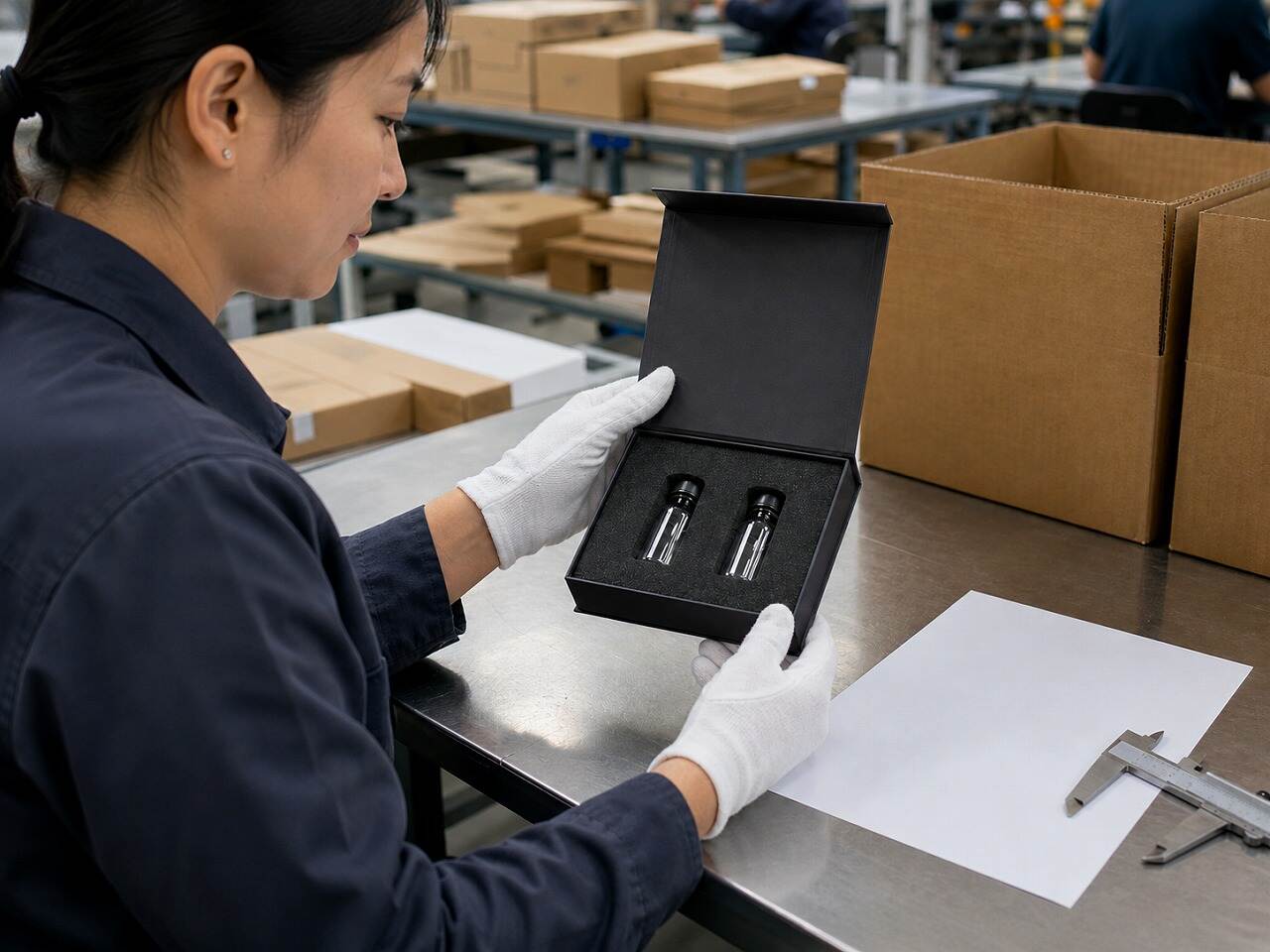
QC should compare production against signed dimensions, physical standards, and written defect definitions.
Critical fit: both approved vials seat correctly, do not contact each other, and can be removed without damaging the label or closure.
구조: lid, hinge, drawer, or magnets operate consistently; corners and wraps meet the agreed visual limit; the insert stays in its defined position.
Decoration: color is judged against the approved standard under agreed light; foil and embossing meet registration, adhesion, and coverage limits.
Pack-out: unit count, orientation, polybag or tissue use, master-carton marking, carton strength, closure method, pallet pattern, and edge protection match the packing specification.
| Checkpoint | Example evidence | Acceptance decision |
|---|---|---|
| Vial-to-insert fit | Approved vials, cavity drawing, fit check method, recorded result | Pass only when both slots meet retention and removal criteria |
| Visual quality | Signed sample, color standard, defect boundary photos | Classify critical, major, and minor defects before inspection |
| Packaged-product test | Defined route, protocol version, representative samples, pre-set damage criteria | Pass or fail against criteria established before testing |
| Shipment release | Inspection report, packing list, carton photos, approved deviations | Release, rework, sort, concession, or reject with authority named |
ISTA emphasizes choosing a procedure based on the actual distribution system. For example, its current descriptions distinguish parcel, LTL, unitized truckload, distribution-center-to-retail, e-commerce, and thermal contexts. Test the complete packaged-product configuration, not an empty presentation box, and set product damage and package degradation criteria before the test. A change to the product, package, interior packaging, closure, or distribution system may require retesting.
The vial and closure are primary packaging because they directly contain the product. A decorative rigid paper box with foam is normally secondary packaging. ISO describes ISO 15378:2017 as an application standard for the design, manufacture, and supply of primary packaging materials for medicinal products; ISO reports that the 2017 edition was confirmed in 2023 and remains current, with an amendment published in 2024. Citing that scope does not make a secondary paper box, its foam, or its manufacturer “ISO 15378 compliant.”
Similarly, ISTA procedures evaluate packaged-product performance under defined distribution conditions. A material name or a drop made in the factory is not automatically an ISTA test. The selected protocol, representative samples, test sequence, laboratory status where certification is sought, and pre-defined acceptance criteria all matter.
Claim boundary: this custom paperboard case can be engineered to organize, present, and help protect two vials as part of a specified packaging system. It is not sterile packaging, not a drug-contact container, and not a cold-chain shipper unless a separately designed and qualified system establishes those functions. “Pharmaceutical-style,” “medical-grade,” “temperature-controlled,” and “compliant” should not be used without a precise, supportable definition.
Ask for material declarations, certificates, or test reports only when they connect to a written requirement. Verify issuer, scope, site, material, product, standard edition, and validity date. If a market requires legal labeling or regulatory review, the brand owner should obtain advice for the actual product and destination rather than relying on a packaging supplier's generic template.
A strong RFQ lets capable suppliers quote the same job. It also reveals whether a manufacturer asks engineering questions or simply repeats the product name and promises a fit. Send controlled inputs and request a line-by-line response, exclusions, assumptions, tooling ownership, sample route, production schedule, and quotation validity.
Product: physical production vials or dimensioned drawing; vial and closure manufacturer and item; total height, maximum diameter, cap diameter, weight, label, and tolerance.
Package: exactly two slots; preferred orientation; box structure options; insert candidates; removal access; leaflet or accessory needs; target dimensions if constrained.
Artwork: editable files, colors, finishes, variable-information zones, languages, barcode requirements, and the party responsible for regulatory text.
Commercial: annual and release quantities, SKU count, destination, Incoterm, desired launch date, packing format, pallet limits, and re-order forecast.
Quality: critical dimensions, defect classes, sampling plan, approved standards, required documents, distribution route, test objective, and pass/fail criteria.
Evaluate the response for clarity. A credible supplier should distinguish capacity from dimensions, ask for real vials, state material grades, explain the prototype sequence, identify subcontracted processes, and define change control. It should also separate the presentation box from the distribution or thermal shipper. Before sending final files, use GPLPAK's contact and quote page to structure project details.
Promising a perfect fit based only on the stated 3 ml capacity, without requesting a vial sample or dimensional drawing.
Providing a low unit price while excluding tooling, sampling, insert specifications, packing, or freight terms.
Describing secondary paper packaging as sterile, cold-chain qualified, or compliant without supporting evidence.
Refusing to define measurable tolerances, approval samples, inspection criteria, or change-control procedures.
No. Capacity does not define the external envelope. Official 3 mL examples already differ in diameter and height, and closures, labels, and tolerances add more variation. Approve the insert using the exact finished vial.
Send several production-representative vials with final caps and labels, or a controlled drawing with tolerances. Add artwork, quantity, pack-out method, distribution route, and acceptance criteria. Identify any sample that is not production-equivalent.
No. EVA can provide crisp cutouts and a premium look, but paperboard, PE foam, PU foam, molded pulp, or a formed tray may better match cost, recovery, disposal, appearance, and automation requirements. Test the shortlisted material with real components.
Not by itself unless it is part of a separately designed and qualified thermal system. A decorative paperboard box and foam presentation insert do not establish payload temperature control. Define the full thermal shipper, refrigerants, payload, lane, profile, conditioning, and operating procedure.
MOQ depends on printing, board conversion, insert process, tooling, finish, assembly, and SKU mix. Ask for quantity breaks against one frozen specification and have the supplier name the process that sets the minimum. Do not treat a general website number as a guaranteed project MOQ.
Timing depends on structure, material availability, finish, tooling, approval rounds, quantity, inspection, and freight. Request a dated critical path that separates input review, white sample, printed sample, approval, material procurement, production, inspection, and shipment. Confirm the schedule again after final specification approval.
Select the test from the real route, package type, weight, and objective. Parcel, LTL, unitized truckload, retail replenishment, e-commerce, and thermal distribution are not interchangeable. Consult the current full procedure and establish product damage and package degradation criteria before testing.
The same controlled vial, drawing, materials, dimensions, insert, artwork, finishes, quantity, sampling, inspection, packing, Incoterm, destination, and tooling basis. Ask both suppliers to list assumptions and exclusions. Compare landed cost and risk, not only the printed unit price.
Share the finished vial or drawing, artwork, quantity, distribution route, and acceptance criteria. GPLPAK can review structure, insert, finish, sample path, and quotation assumptions for your project.
Request a Project ReviewExplore Packaging Options 핫 뉴스
핫 뉴스2026-09-23
2026-09-22
2026-09-21
2026-09-18
2026-09-17
2026-09-17
2026-09-16
2026-09-09
2026-08-31
2026-08-26
Dongguan Xinglan Packaging Products Co., Ltd.의 프리미엄 포장 솔루션을 발견하십시오.
 영어
영어  EN
EN  RU
RU  ES
ES  KO
KO  JA
JA  PT
PT  IT
IT  DE
DE  FR
FR  NL
NL 








.jpg)
