
In brief: Engineer a custom coin presentation box from the complete packed item: the capsule's maximum outside diameter and height, the insert material and extraction method, the certificate's finished size, and the intended opening sequence. Approve fit before decorative finishes. A reliable design holds the capsule during normal handling, allows deliberate removal, keeps the lid clear, and presents the Certificate of Authenticity without bending or hiding critical information.
A box can look premium in a rendering and still fail at packing. The capsule may rattle, the finger notch may expose too much of the insert, the certificate may bow against the lid, or a multi-coin tray may arrive with every capsule rotated differently. This guide gives mints, numismatic publishers, museums, corporate recognition programs and packaging buyers a practical engineering sequence for turning the coin, holder and COA into one approvable paper-wrapped rigid-box system.
The engineering object is not the coin alone. It is the complete packed item that touches or controls the presentation box: coin, capsule or slab, insert surface, extraction feature, certificate, booklet, protective tissue and any accessory. Starting from a nominal coin diameter ignores the capsule rim, lid overlap, hinge tab, label or protective film that may become the maximum dimension.
If you have not yet selected an outer structure, first compare the opening formats in GPLPAK's guide to commemorative coin presentation box styles. Structure and fit are linked: a hinged box places the certificate in a natural viewing plane, while a drawer box may need a separate reveal sequence and a different tray extraction method.
| Component | Engineering Input | Failure if Omitted |
|---|---|---|
| Coin or medal | Diameter, thickness, mass, edge profile and intended orientation | Incorrect holder or insufficient support |
| Capsule or slab | Maximum outside width, height, total thickness, rim, hinge and opening tab | Rattle, proud fit or difficult removal |
| COA or booklet | Finished size, stock, page count, fold, serial field and reading order | Bending, concealment or version mix-up |
| Box and insert | Opening style, cavity count, surface material, removal method and box orientation | Unstable presentation or poor packing sequence |
| Distribution pack | Unit protection, carton arrangement, route and pass/fail criteria | A beautiful unit box that is not protected in transit |
Control the reference: A physical capsule sample is stronger than a marketplace listing. If only a drawing is available, identify the revision and maximum dimensions. Do not let an unapproved holder substitution become a silent production change.
The insert opening must be based on the part that actually enters it. A capsule sold for a 30 mm coin will normally be larger than 30 mm because the shell surrounds the coin. The official Lighthouse capsule tables, for example, list coin diameter and capsule outside diameter as different fields. That is useful evidence of the principle, but it is not a substitute for measuring the exact holder chosen for your project.
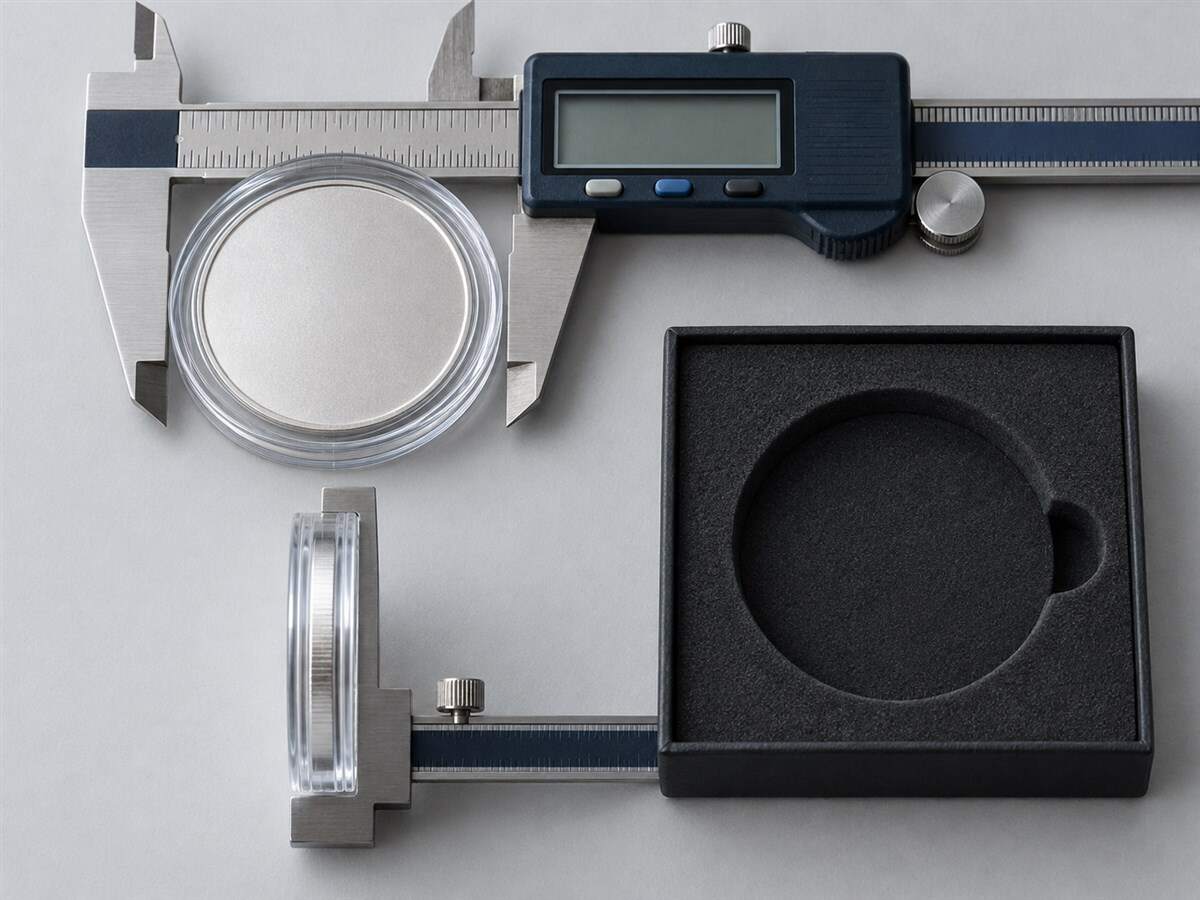
Measure the holder's maximum outside envelope in both plan and side views; record rim and opening features separately.
Maximum outside diameter or width: rotate the part and record the largest value, not the most convenient one.
Overall height: include both capsule halves, raised rims, labels and protective film that remains during packing.
Rim and step profile: a stepped edge can control how the holder seats and where the insert surface supports it.
Opening feature: record a hinge, tab or pry point so it does not collide with the cavity wall.
Mass and centre of gravity: heavier medals and multi-capsule sets may need deeper support or a stronger tray.
Measurement conditions: identify the instrument, unit, sample count and date so later revisions can be compared.
Do not copy a generic web dimension without confirming the model. The current Lighthouse catalogue shows multiple outside diameters across its GRIPS range, demonstrating that similar coin sizes can sit in different external envelopes. For the production brief, record the approved supplier, capsule model and revision or provide a controlled physical sample.
A cavity size is the result of several variables, not one universal tolerance. The stack includes actual capsule variation, cutting accuracy, material recovery, surface covering, adhesive build, temperature and humidity during production, and the removal experience you want. A nominal CAD opening that equals the measured capsule diameter may become too tight after flocking or too loose after repeated compression.
For multi-coin layouts, also control cavity pitch, edge distance and visual alignment. The first cavity may fit perfectly while accumulated positional variation causes the last capsule to look off-centre. Define a datum on the tray drawing and inspect the complete pattern, not only individual holes.
Keep component measurements and finished-package requirements in separate but connected records. The component record identifies the approved capsule, sample quantity, measured maximums, unusual features and revision. The packaging record identifies the cavity target, insert build, datum, opening orientation and inspection method. This prevents a buyer's capsule measurement from being mistaken for the insert dimension and makes later substitutions visible.
For a collector series, add a configuration matrix. Each row should identify the edition, capsule model, visible face, cavity position and matched certificate version. If two capsule suppliers are allowed, treat them as separate approved configurations until the sample proves that one insert can accept both. A statement such as “fits 40 mm capsules” is too weak when rim shape, overall height or opening tab differs.
Also define which surface controls presentation height. A capsule can sit on its lower rim, on a stepped shoulder or on a soft base layer. That support choice changes how much of the rim remains visible and whether the lid contacts the holder. The drawing and sample should show the support plane clearly.
Engineering rule: Express the drawing as a target geometry with agreed acceptance criteria, then prove it with the actual capsule and insert material. Avoid publishing a single “standard clearance” as though it applies to every foam, covering and cutting process.
The insert is both a fixture and a visible design surface. Choose it according to the packed-set mass, cavity geometry, finish expectation, removal method, sustainability brief and evidence required for any preservation claim. “Foam insert” is not a complete specification: material family, color, thickness, surface treatment, lamination and bonding all matter.
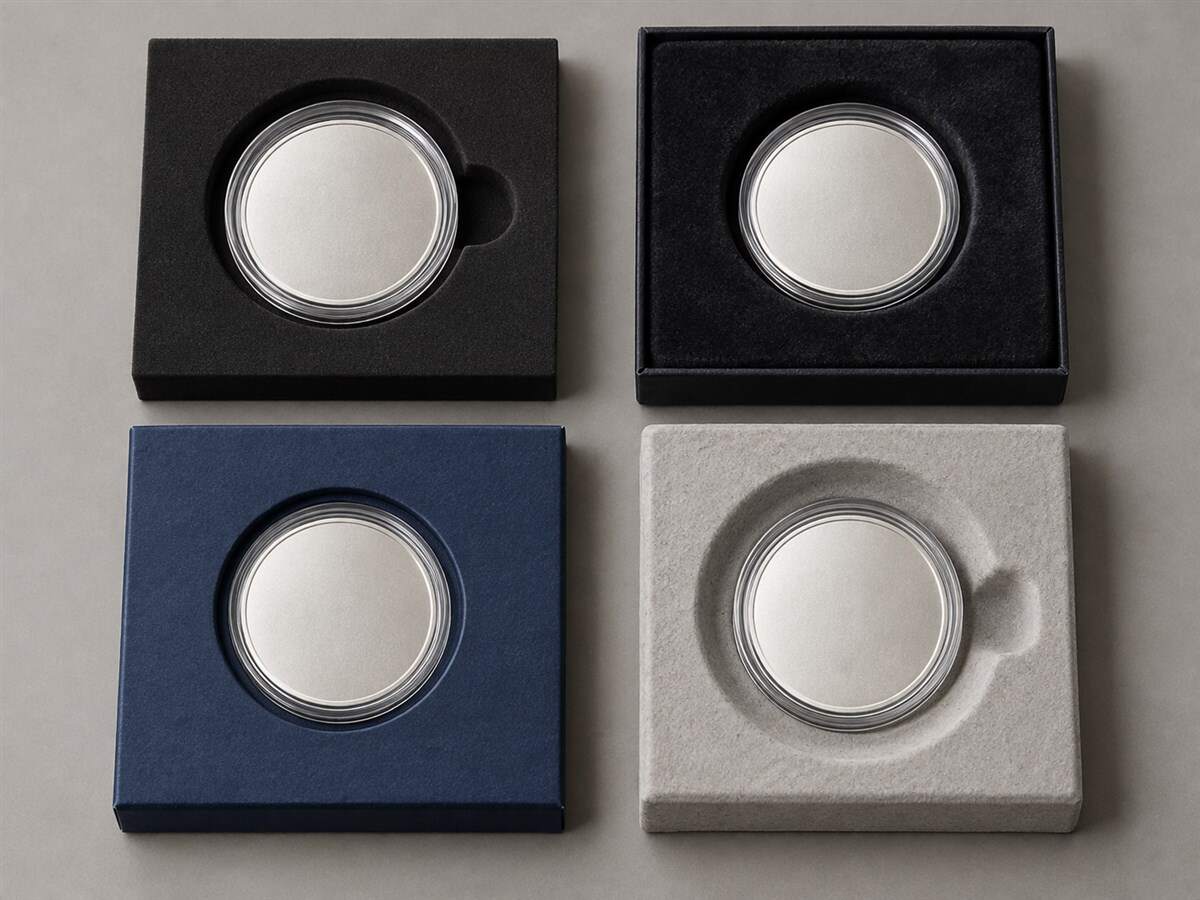
Insert materials change cavity definition, surface character, recovery and the way a capsule is removed.
| 삽입 옵션 | Strength | Watch Point | Best Starting Use |
|---|---|---|---|
| Precision-cut EVA | Clean repeatable cavities and layered construction | Specify grade, thickness, color, odor and surface covering | Single capsules and multi-coin grids |
| Engineered foam with flocked or paper surface | Soft premium appearance and controlled color | Covering thickness changes fit; inspect shedding, seams and glue | Collector editions where interior appearance is central |
| Folded paperboard platform | Paper-forward construction and integrated graphics | Reinforce the opening and avoid exposed cut edges or spring-back | Lighter capsules, retail programs and printed storytelling |
| Molded fiber | Formed support and a visibly fiber-based material story | Draft, texture, dimensional variation and minimum radii affect fit | Programs that accept a natural fiber surface and simpler geometry |
For preservation-sensitive objects, do not infer chemical suitability from color or marketing language. The Canadian Conservation Institute guidance for coins and medals recommends that holders and contact materials should not cause physical or chemical harm and advises obtaining clear material information from suppliers. If your buyer requires “archival” performance, define the exact materials, contact path, storage environment and evidence; standard retail presentation packaging alone does not establish that claim.
A tight cavity is not automatically a good cavity. It can stress the capsule, show compression marks or force the user to pry at a clear edge. A loose cavity can let the item rotate or strike the lid. The removal feature should therefore be designed at the same time as the recess.
| Removal Method | 장점 | Approval Focus |
|---|---|---|
| Finger notch | Simple, visible and easy to understand | Notch position, exposed area and ability to grip without touching the coin |
| Ribbon lift | Clean surface with controlled lifting action | Ribbon strength, length, anchoring and packer's placement |
| Removable tray | Creates a second layer for COA or accessories | Tray stiffness, lift point and protection of contents below |
| Controlled push access | Useful in selected paperboard or two-part structures | No contact with the exposed coin face; sufficient support after repeated use |
Orient every notch and ribbon consistently across a set. In a two-row tray, mirrored notches may look balanced but create an inconsistent packing motion. The production drawing should show orientation, ribbon color, free length and anchoring, not simply state “ribbon included.”
The Certificate of Authenticity is not leftover paperwork. It may carry the issuing authority, edition number, specification, provenance, care instructions or verification method. Its position should support the opening story while keeping the certificate flat, removable and matched to the correct edition.
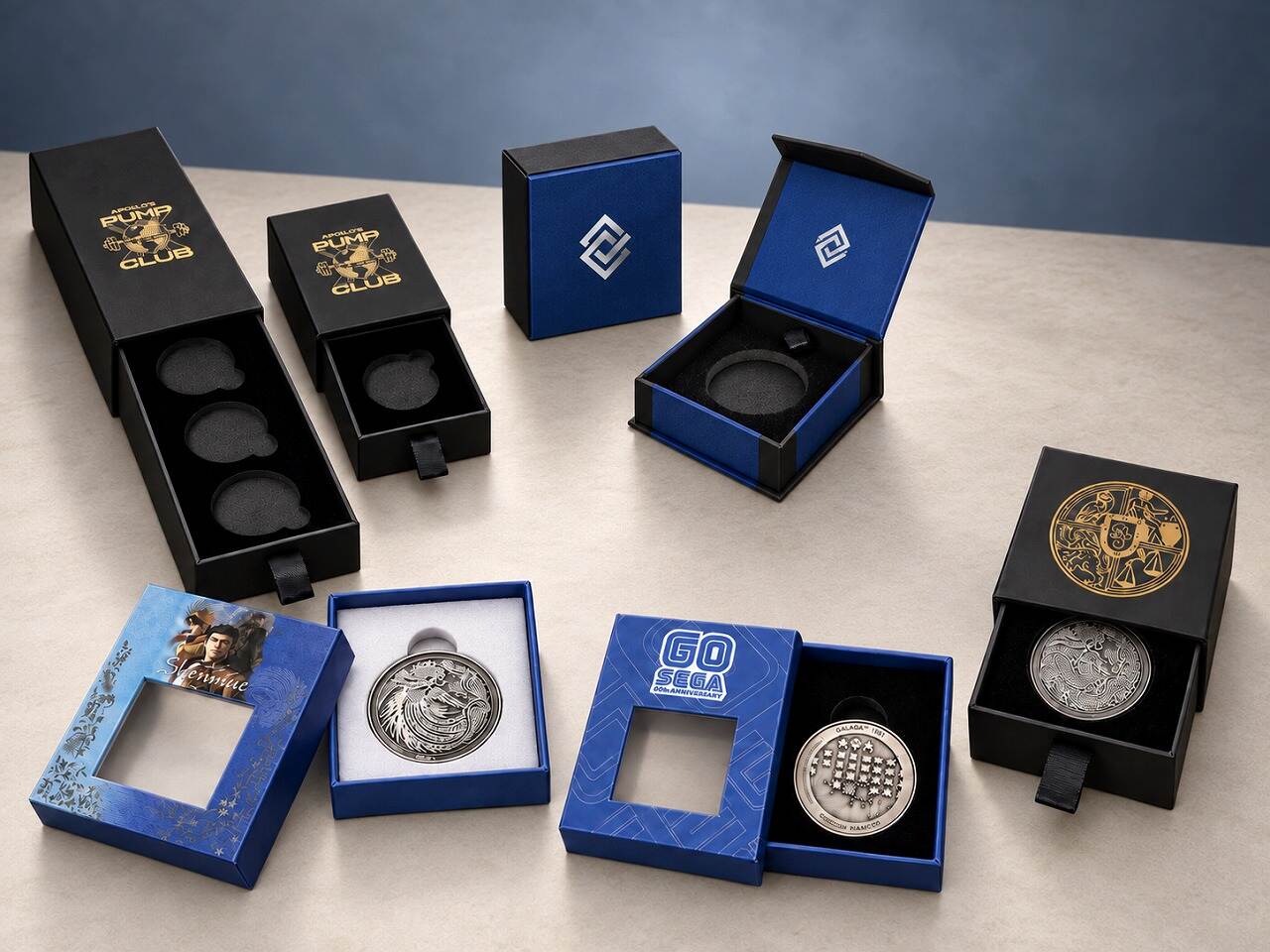
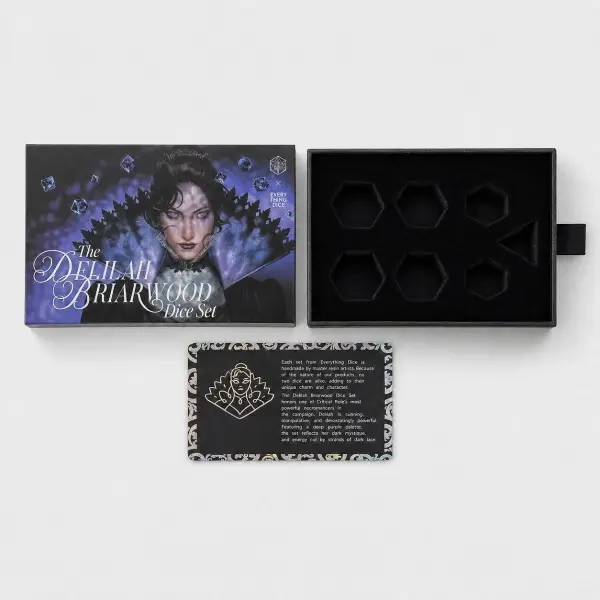
Inside-lid pockets, ribbon-retained cards and under-tray compartments create different reading and packing sequences.
| COA Position | Opening Experience | Engineering Risk | Best Fit |
|---|---|---|---|
| Inside-lid pocket | Certificate and capsule appear together | Pocket depth, card bowing and lid clearance | Hinged and book-style boxes |
| Ribbon-retained panel | Formal facing-page presentation | Ribbon position can cover serial or verification data | Editorial collector editions |
| Recessed well beside coin | Both components read as one set | Larger footprint and visible card-edge tolerance | Wide single-layer boxes |
| Under removable tray | Second reveal keeps the main surface clean | Certificate can be missed; tray must lift safely | Multi-piece sets and booklets |
| Separate envelope or sleeve | Flexible for documents and multilingual sets | Easy to separate from the matched coin if not controlled | Institutional documentation packs |
Finished width, height, thickness, fold direction and corner shape.
Portrait or landscape orientation and the intended first-reading face.
Location of serial number, signature, QR code or verification field.
Variable-data workflow, version count and method for matching the card to the coin.
Required visible area after the card enters a pocket or sits under ribbons.
Removal direction, finger access and the maximum acceptable card curl.
그것은Library of Congress paper-care guidance explains appropriate protective enclosures, while its preservation FAQ notes that “archival” is not, by itself, a defined guarantee for storage supplies. If long-term certificate preservation is part of your brief, request material declarations appropriate to the document and avoid letting decorative adhesive, elastic or unverified plastic touch critical printed areas.
Fit decisions change the artwork. Increasing the cavity pitch can move a title panel; adding an under-tray COA compartment can increase box depth; changing from a lid-and-base structure to a book-style box creates a spine and hinge zone that need separate artwork control. Freeze the packed-item layout before finalizing foil dies and print plates.
Keep critical copy away from folds, turned edges and magnetic locations. Foil or fine type crossing a hinge can crack or become visually uneven.
Show insert and COA geometry on the artwork review. The buyer should see which information remains visible after assembly.
Separate fixed and variable information. Edition-specific serial data needs a controlled print and reconciliation process.
Use finish hierarchy. One primary foil or embossing feature is usually easier to control than multiple competing effects on small panels.
Approve inside and outside orientation together. A certificate can appear upside down if the artwork team and structural team use different opening views.
GPLPAK's design validation for manufacturing그리고product development pages describe the broader transition from design intent to production-ready construction. For structure-specific references, review current book-style boxes, drawer boxes그리고lid-and-base boxes.
One beautiful printed sample should not be asked to answer every engineering question at once. A staged sequence isolates risk early, when changes are cheaper and easier to understand.
Confirm the capsule, COA, count, orientation, box style, route and acceptance criteria.
Verify cavity, extraction, lid clearance, tray stiffness and packing sequence before decoration.
Approve wrap, color, print, foil, relief, certificate readability and assembled orientation.
Freeze revision, materials, packed configuration and measurable inspection points.
Pack every cavity with approved components and confirm visual alignment.
Open, close, remove and repack the set repeatedly using the intended user motion.
Check whether the capsule marks the insert, whether fibers transfer, and whether the clear shell becomes scratched.
Close the lid with the thickest approved COA and confirm no pressure mark or bulge.
Perform a documented handling check in every relevant orientation; define what movement is acceptable.
Pack the unit box into its actual protective sleeve, mailer or master carton before distribution testing.
GPLPAK's factory services page describes development sampling as a pre-production decision step. If formal transport testing is required, specify the complete packaged-product and route. ISTA's current procedure descriptions distinguish screening tests from general simulations, and ISTA separately states that procedures apply to packaged-product systems rather than certification of an individual material. Select a procedure according to the distribution environment and record the exact test configuration.
“Same as sample” is useful as a visual reference but incomplete as a production specification. Translate the approved result into characteristics that a factory and buyer can inspect consistently. Prioritize features that affect function, edition identity and the first opening experience.
| Inspection Area | What to Define | Practical Check |
|---|---|---|
| Capsule fit | Approved holder model, cavity geometry and acceptable movement | Pack approved samples; inspect retention, removal and lid clearance |
| Insert assembly | Material, layer order, bonding, position and exposed edges | Check lift, gaps, glue transfer, surface marks and orientation |
| COA control | Artwork revision, count, orientation, serial reconciliation and visible area | Verify card-to-edition match and removal without damage |
| 엄밀한 상자 | Finished dimensions, squareness, wrap, corners, hinge and closure | Measure and compare opening action with the approved reference |
| Print and finishes | Color reference, foil position, relief, rub and visible defects | Use approved color and finish references under agreed viewing conditions |
| Pack-out | Protection sequence, unit count, carton layout and labeling | Audit a complete sealed carton against the packing instruction |
Do not assign arbitrary tolerances simply to make the document look technical. Connect each limit to function, process capability and inspection method. Record the approved measuring location because a soft or wrapped structure may give different results at an edge, centre or compressed surface.
A useful RFQ separates known inputs from supplier recommendations. It should let a converter identify missing information, propose a sampling sequence and quote equivalent options without silently changing the functional brief.
Copy-ready RFQ input list
Program name and market; coin or medal dimensions and mass; capsule supplier, model, maximum outside dimensions and samples; quantity per box; cavity layout and orientation; preferred rigid-box style; insert construction and surface; finger notch, ribbon or tray-lift requirement; COA finished size, stock, artwork versions and serial workflow; booklet or accessory dimensions; outer wrap and finish direction; order quantity by artwork; destination and required date; packing route; inspection points; sample approvals; and any route-specific test requirement.
Ask the supplier to identify assumptions in the quotation. If EVA grade, certificate stock or capsule model is not fixed, the quote should say so. Tooling, sampling, print process, artwork versions, insert lamination and pack-out can all change cost; minimum order quantity and lead time should therefore be confirmed against the final project specification rather than copied from another product.
For early feasibility discussion, use GPLPAK's packaging consultation service or review the company's broader rigid box capabilities. Send physical components whenever practical so the quotation and sample are based on the same reference.
Technical references used for decision boundaries
Lighthouse 2026 coin capsule catalogue for the distinction between coin and capsule outside diameter; Canadian Conservation Institute guidance for holder and contact-material boundaries; Library of Congress paper-care guidance for document housing context; and ISTA test procedure descriptions for packaged-product distribution testing.
Send the approved capsule or controlled dimensions, COA specification, set layout, preferred opening style, artwork scope, quantity and destination. GPLPAK can review the fit inputs and define the next structural sample.
© 2026 GPLPAK — Custom Paper Packaging Manufacturer in China
 핫 뉴스
핫 뉴스2026-09-22
2026-09-21
2026-09-18
2026-09-17
2026-09-17
2026-09-16
2026-09-09
2026-08-31
2026-08-26
2026-08-21
Dongguan Xinglan Packaging Products Co., Ltd.의 프리미엄 포장 솔루션을 발견하십시오.
 영어
영어  EN
EN  RU
RU  ES
ES  KO
KO  JA
JA  PT
PT  IT
IT  DE
DE  FR
FR  NL
NL 






.jpg)
