 EM
 EN
 RU
 ES
 KO
 JA
 PT
 IT
 DE
 FR
 NL
Links Rápidos
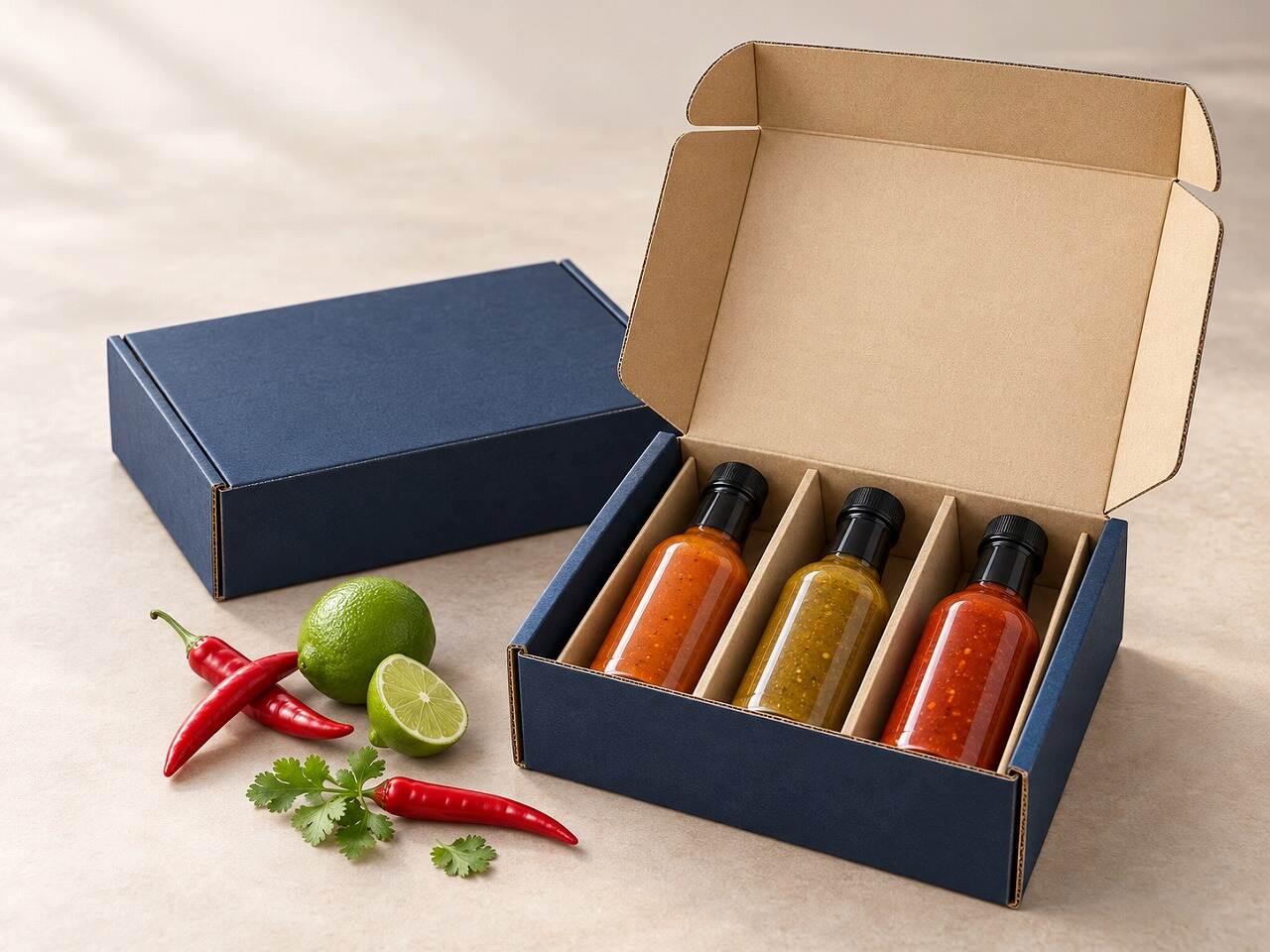
In brief: Custom hot sauce packaging should be specified around the finished bottle, sales channel and distribution route, not around nominal fill volume or a reference photo. For a sealed three-bottle gift set, a printed corrugated mailer with two correctly positioned dividers can combine presentation and bottle separation, but it is not automatically a parcel shipper until the complete packed system is tested for the intended route.
A useful quotation therefore starts with physical bottles or controlled drawings, filled weight, closure details, bottle count, artwork, quantity tiers, pack-out method and written acceptance criteria. The sections below turn those inputs into a specification that a buyer can compare across suppliers.
Searches for custom hot sauce packaging mix several different needs: labels for a primary bottle, single-bottle retail cartons, tasting-set gift boxes, corrugated ecommerce packs and wholesale transit cases. Those products do not have the same job. This guide focuses on custom secondary paper and corrugated packaging for sealed bottles, especially one-, two- and three-bottle retail or gift sets. It also explains when a separate distribution shipper is still required.
For brands, co-packers and distributors, the objective is a repeatable pack that fits the actual bottles, presents the range clearly and prevents glass-to-glass contact. Structure, material, print and price should be judged against that result.
A bottle, a retail box and a shipping case are three different packaging levels. The bottle and closure contain the sauce. A printed carton or corrugated gift box groups, identifies and presents sealed bottles. A distribution shipper protects packed units during pallet, courier or less-than-truckload handling. One structure may perform more than one role, but that must be demonstrated rather than assumed.
| Packaging level | Primary job | Typical buyer decision | What it does not prove |
|---|---|---|---|
| Primary bottle and closure | Contain the sauce and maintain seal integrity | Glass or plastic, capacity, cap, orifice reducer, tamper feature and label | That the secondary box can survive distribution |
| Single-bottle retail carton | Present, identify and provide an information surface | Folding carton, light corrugated sleeve or small mailer | Courier protection without an outer pack |
| Multi-bottle presentation box | Organize flavors and prevent bottle-to-bottle contact | Corrugated mailer, paperboard carton or premium rigid structure with insert | Validated performance for every route |
| Distribution shipper | Protect packed units through a defined logistics route | Board grade, case style, dividers, void fill, closures and pallet pattern | Retail presentation quality unless designed for both roles |
Write the intended job in one sentence before requesting design work. For example: “A printed three-bottle corrugated presentation box for sealed glass bottles, packed into a master case for wholesale delivery,” or “A direct-to-consumer three-bottle pack intended to travel without an additional overbox.” The second requirement is much more demanding and changes the board, closure, scuff allowance, label area and validation plan.
If the structure has not yet been decided, GPLPAK's consulta embalagem process can be used to convert the channel, bottle count, budget and brand brief into a short list of manufacturable options. The important point is to define what will be purchased before comparing appearance or unit price.
The most efficient structure depends on whether the pack is a shelf carton, a gift set, a subscription pack or a wholesale case. A thin folding carton can work well around one bottle, while a multi-bottle set needs separation and bottom support. A rigid hand-finished box can create a premium presentation, but its packed volume, assembly labor and need for an outer shipper may make it unsuitable for an everyday ecommerce bundle.
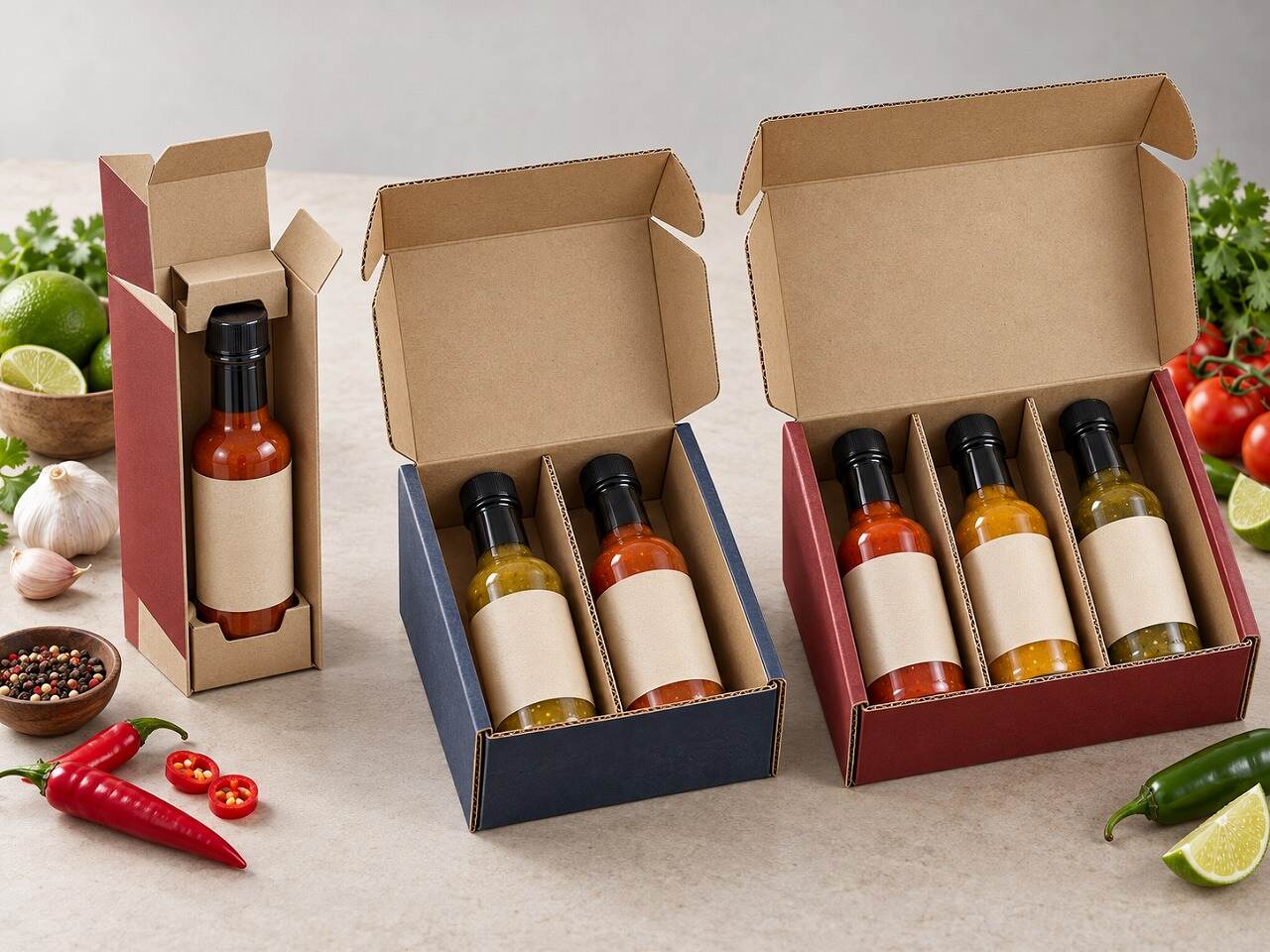
Single-, two- and three-bottle formats solve different merchandising and protection tasks. The final design must be fitted to the actual bottle.
| Format | Best suited to | Strengths | Approval focus |
|---|---|---|---|
| Folding carton with paperboard fitment | One sealed bottle for retail display | Ships flat, efficient print area, lower packing volume | Neck restraint, bottom lock, crease quality and carton squareness |
| Corrugated mailer with dividers | Two- or three-bottle gift sets and ecommerce presentation | Good stiffness, integral lid, printable inside and outside, paper-based separation | Divider height, end clearance, sidewall crush, closure and packed-system testing |
| Rigid lid-and-base or book-style box | High-value gifting and limited editions | Strong presentation and a wide choice of wrapping papers and finishes | Insert fit, hand-assembly consistency, outer protection and freight cube |
| Regular or die-cut corrugated shipper | Wholesale cases and distribution protection | Efficient stacking, dividers, case sealing and palletization | Case style, flute and liners, compression requirement and route simulation |
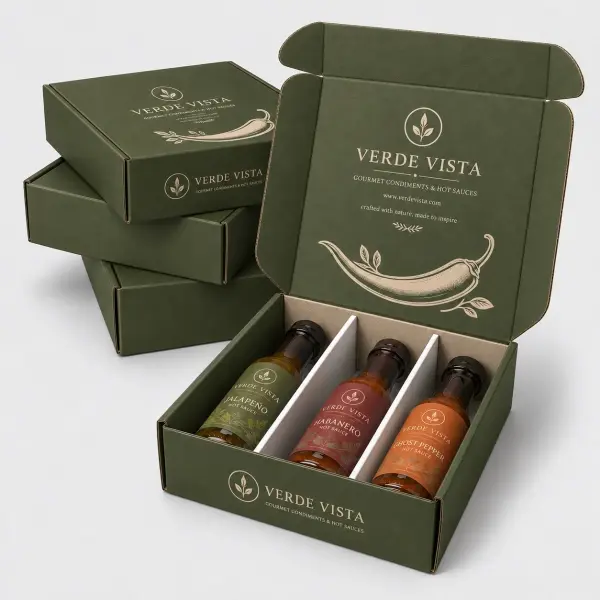
For the three-bottle pack shown in this guide, a die-cut corrugated mailer is a practical starting point because the lid, tray and presentation surface can be cut from one blank, while two vertical dividers create three separate cells. It can be printed directly or produced with a printed liner. However, the correct board combination cannot be selected from bottle capacity alone. Filled weight, box span, stacking, humidity and distribution method all matter.
Use the corrugated box range as a structural reference, then ask for a custom dieline based on your pack-out. The internationally used FEFCO design code can help buyers and converters communicate common corrugated styles, but a custom die-cut mailer or fitment may still sit outside a simple catalog description.
“Five ounces” or “150 milliliters” describes nominal contents, not the external dimensions of a packaged bottle. Bottles with the same fill volume can differ in body diameter, shoulder profile, base ring, total height, cap diameter and tamper band. Labels, shrink sleeves and neck seals can add thickness or create surfaces that should not be rubbed by an insert.
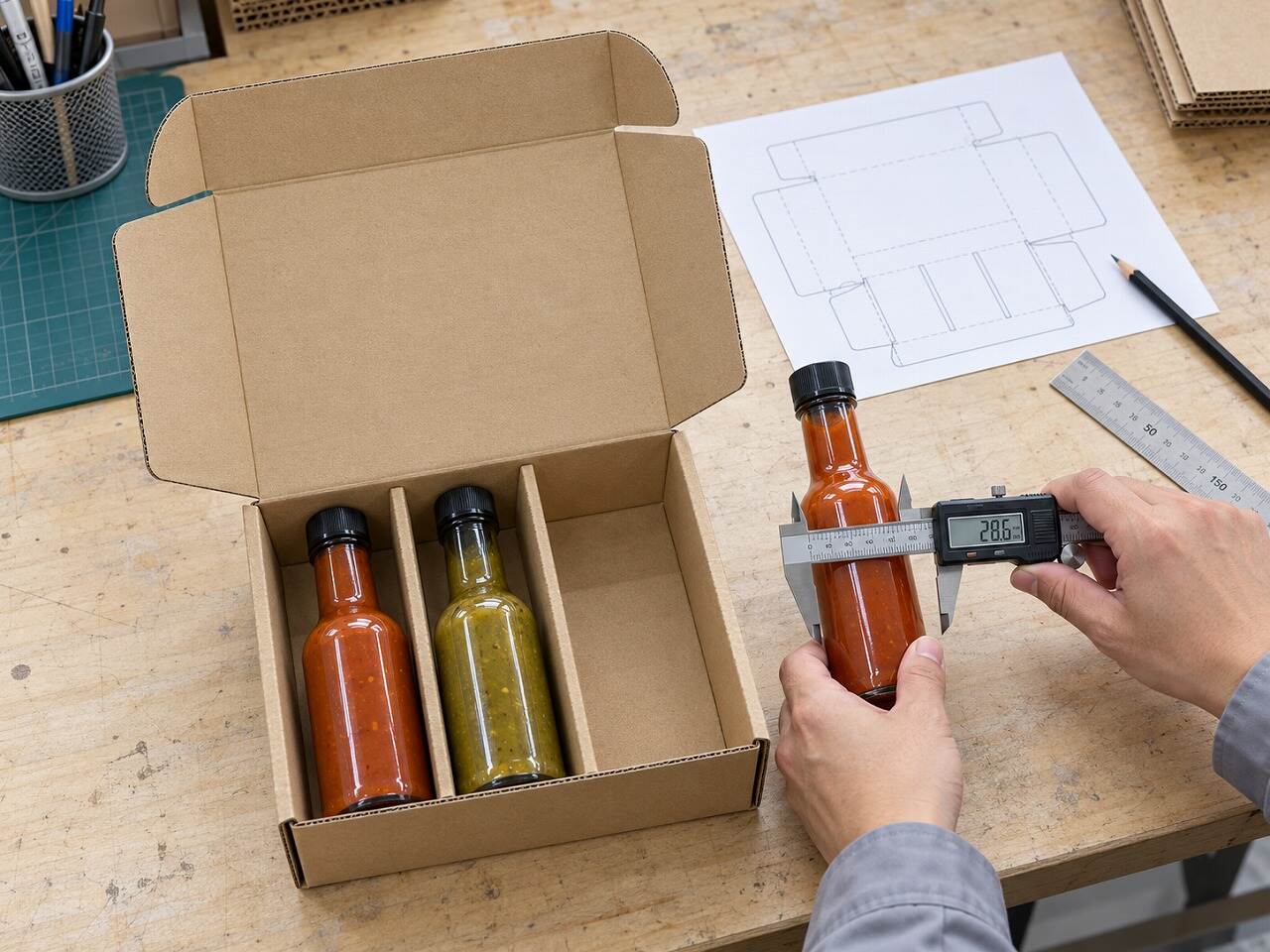 | Provide a complete bottle envelope
|
The safest development input is a physical production bottle with the final closure and decoration. When that is not available, use a controlled drawing from the bottle supplier and identify which dimensions are maximum values. A rendering is useful for visual communication but is not a fit specification.
Clearance is a design variable, not a universal number. Too little can scuff labels or slow packing; too much lets the bottle accelerate before striking a divider. The supplier should set and prove clearance with a plain fit sample.
In a three-bottle corrugated mailer, two divider walls are not merely visual separators. They control lateral movement, keep labels apart and help transmit load from the lid to the base. Their height, grain or flute direction, locking tabs and relationship to the sidewalls affect how the pack behaves when carried, stacked or dropped.
A good paper-based fitment supports robust areas of the bottle and avoids concentrating force on fragile features. Neck restraints can reduce movement, but they should not load a pump, tamper band or cap edge. Bottom pads can distribute weight, while end blocks can limit vertical travel. If the bottles have different diameters or shoulder shapes, equal-looking cells may not provide equal restraint.
| Observed failure | Likely design cause | Engineering response | How to verify |
|---|---|---|---|
| Bottles strike one another | Divider too low, too flexible or poorly locked | Increase divider engagement or add neck and base control | Shake check followed by route-appropriate packed testing |
| Labels scuff during packing | Cell clearance too tight or exposed cut edge contacts decoration | Move contact points, cover the edge or revise clearance | Repeated pack-and-unpack trial using finished labels |
| Front wall bows | Filled weight exceeds panel stiffness or divider does not brace tray | Change board combination, panel geometry or internal locking | Loaded hold test and stacking evaluation |
| Lid opens in handling | Tuck depth, tab geometry or board recovery is insufficient | Revise closure or specify an approved seal for the route | Repeated closure cycles and packed handling test |
| Bottle base breaks through | Concentrated bottom load or inadequate base construction | Add a pad, reinforce the base or use a suitable outer shipper | Packed drop sequence selected for the distribution route |
Paperboard and corrugated dividers are usually the first options to evaluate when the buyer wants a paper-based pack. Molded pulp can suit higher-volume projects with a stable bottle geometry. Foam can provide precise presentation, but it changes recycling, material disclosure and cost considerations. The selection should follow protection and end-of-life objectives, not a generic hierarchy of “premium” materials.
When the package must be developed from an idea rather than an existing dieline, GPLPAK's product development service covers structural layouts, fit, prototypes and production-ready drawings. Existing agency artwork or structural concepts can instead go through design validation for manufacturing before tooling.
Board descriptions such as “E-flute,” “kraft” or “white corrugated” are incomplete purchasing specifications. A corrugated board is a combination of liners and medium. The basis weights, recycled content, surface smoothness, flute profile and moisture condition influence print quality, scoring, edge crush and panel stiffness. The converter should propose a combination against the packed weight and route, then identify it on the approved specification.
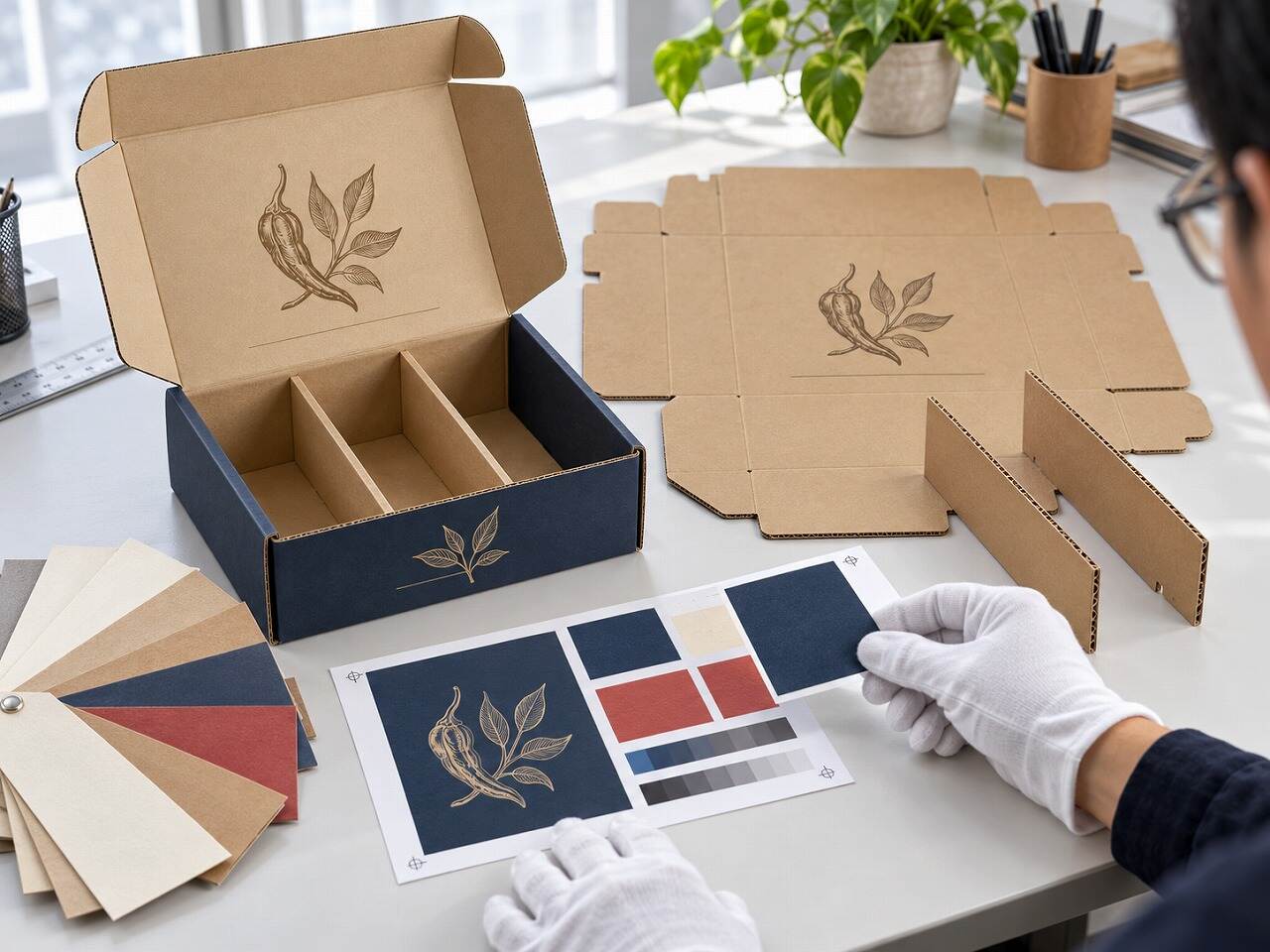
Board, divider geometry, print proof and surface color should be approved together because a material change can affect both appearance and fit.
Direct flexographic print can be efficient for simpler graphics and production volumes suited to plate setup. Fine detail depends on the board surface and press capability.
Litho-laminated corrugated combines a high-quality printed sheet with corrugated board. It can support detailed retail graphics, but lamination, scoring and alignment must be controlled.
Digital corrugated print supports artwork changes and shorter runs without conventional printing plates. Color and finish still require a defined proof and production tolerance.
Printed folding carton plus corrugated shipper separates retail presentation from transport protection when one material cannot efficiently satisfy both jobs.
Coatings should be selected for the actual risk: scuffing, incidental moisture, condensation, grease exposure or required visual finish. Aqueous or dispersion coatings may suit many paper-based projects, while film lamination can improve surface resistance but may alter recyclability claims. Do not describe any option as universally recyclable or food safe without checking the exact construction and the rules of the destination market.
For U.S. projects, buyers can use the FDA's overview of food packaging and food-contact substances to frame supplier questions. Final compliance decisions remain the responsibility of the brand and its qualified regulatory advisers. A packaging converter can provide material declarations and manufacturing data but should not replace market-specific legal review.
Packaging should distinguish heat level, flavor and bottle count at a glance. Build one stable brand architecture, then assign variable areas for each SKU to reduce unnecessary structural versions.
Keep type and barcodes away from cut edges, slots and heavy creases. Inside-lid storytelling can add value, but ink coverage, rubbing and possible closure contact must be checked during proofing.
Front panel: brand, range name, flavor or heat identifier, and a hierarchy that still works in a thumbnail.
Side panels: orientation marks, concise product story, legal business information or retail-facing claims approved by the brand.
Back or base: barcode, recycling guidance appropriate to the market, lot-label area and any pack-specific instructions.
Inside lid: serving ideas, gift message or range map, provided the print remains protected from abrasion and unintended contact.
Master case: SKU, quantity, gross weight, orientation and logistics markings agreed with the warehouse or distributor.
The outer box should not be assumed to replace mandatory information on the primary bottle. Labeling requirements vary by destination and product, so the brand should confirm which information must remain on the bottle and which may be repeated on secondary packaging. The converter's role is to reserve usable space and reproduce approved artwork accurately.
Request a dieline with clearly identified cut, crease, glue and safe areas, then perform a production-readiness review before final artwork release. The approval should include outside panels, inside print, divider orientation and any marks needed by packing staff. That process is more reliable than approving a flat artwork PDF without a folded sample.
Two quotations can use the same title and still describe materially different packaging. Board combination, blank size, print process, ink coverage, divider construction, tooling, assembly, packing method and quantity tier all affect cost. Freight cube also matters: a one-piece mailer may ship flat, while an assembled rigid box occupies its full volume.
| Quotation line | What the buyer should require | Why it matters |
|---|---|---|
| Structure and size | Internal dimensions, board build, dieline revision and divider count | Prevents a cheaper but weaker or smaller structure from appearing equivalent |
| Impressão | Process, sides printed, color references, coating and approved proof type | Separates decoration cost from structural cost |
| One-time charges | Cutting die, print plates, sample, testing and any development fee | Clarifies first-order cost versus repeat-order cost |
| Quantity tiers | Identical specification at realistic forecast volumes | Shows setup amortization without hiding a specification change |
| Packing and logistics | Flat or assembled, units per export carton, carton dimensions and gross weight | Allows landed-cost and warehouse-labor comparison |
| Quality basis | Approved sample, tolerances, inspection plan and remedy for nonconformity | Makes the quoted product measurable |
There is no responsible universal MOQ or unit price for “custom hot sauce packaging.” Minimums depend on board sourcing, printing setup, tooling, assembly and the supplier's production route. Ask for project-specific tiers rather than publishing a target quantity first. A structurally standardized box with variable printed labels or sleeves may be useful during early market tests; direct custom printing can become more efficient when artwork and demand stabilize.
Cost reduction should protect the package's main functions. Good questions include whether the print can be simplified, whether several flavors can share one structure, whether inside print adds enough value, whether a paper divider can replace a more complex insert and whether flat shipment reduces freight. Reducing board strength or cell control without retesting is not a reliable saving.
A controlled sample sequence catches different risks at different stages. A plain structural sample is useful for bottle fit and packing ergonomics. A color proof tests artwork direction. A production-representative sample brings structure, board, print, coating and assembly together. Keep one approved sample and the signed specification as the reference for bulk inspection.
| Stage | Primary questions | Suggested approval record |
|---|---|---|
| Plain fit prototype | Do all bottle variations load, close and remain separated? | Signed dimensions, bottle IDs, photos and revision number |
| Artwork proof | Are content, orientation, color targets and finishing positions correct? | Approved PDF or physical proof with dated sign-off |
| Production-representative sample | Does the final material convert, print, fold and pack as expected? | Golden sample plus defect and tolerance list |
| Packed-system test | Does the complete pack survive the hazards of the intended route? | Test plan, sample configuration, results and acceptance criteria |
| Bulk inspection | Does production match the approved sample and specification? | Incoming, in-process and final inspection records |
Testing should match the distribution route. The International Safe Transit Association distinguishes screening tests from general simulation and focused simulation. Its 3-Series procedures are intended to simulate damage-producing motions, forces and conditions across distribution environments. That does not mean every hot sauce gift box should use the same procedure. The buyer and test provider must select the protocol and acceptance criteria for the actual packed product, weight and route. Review the current ISTA procedure descriptions before specifying a test.
A presentation box that passes a fit check is not therefore “shipping certified.” If it will travel inside an overbox, test the overpacked configuration. If it will receive a carrier label directly, test that configuration. Include actual bottles, closures, filled weight or a justified simulant, dividers, seals and any void fill. Record what constitutes failure: broken glass, leakage, closure movement, unacceptable scuffing, crushed panels or inability to open and present the product.
GPLPAK's amostragem de desenvolvimento page describes how a physical sample can be used to approve fit, materials and production details. For supplier capability and process context, review manufacturing and the company's packing approach. Project-specific testing and acceptance criteria should still be written into the purchase specification.
A strong RFQ reduces quotation ambiguity and makes technical discussion faster. It should be short enough to use but complete enough that a supplier cannot substitute an easier structure without disclosure.
Physical bottle samples or controlled drawings, including closure and decoration
Filled weight, bottle count and whether flavors share one envelope
Sales channel, pack-out method, master case and distribution route
Desired box type, reference images and features that are mandatory or optional
Artwork status, print coverage, color references and finish preferences
Forecast quantity tiers, launch window and delivery destination
Sustainability, documentation and market-specific requirements
Sample stages, testing responsibility, tolerances and written acceptance criteria
Score whether the supplier asks for the right bottle data, links board and divider choices to the route, states quotation assumptions and provides controlled sampling. A plain prototype that exposes an incorrect fit is more valuable than a polished rendering. Also confirm ownership of dielines and tooling, revision control and final inspection records.
Communication quality is part of technical capability. The supplier should distinguish presentation packaging from distribution protection, state where testing is required and avoid promising compliance from a generic material name. When the final construction is agreed, place the dieline revision, material build, approved proof, golden sample, packing method and acceptance criteria under change control.
Send GPLPAK your finished bottle or controlled drawing, bottle count, artwork status, quantity tiers, distribution route and acceptance requirements. The team can propose a paper-based structure, develop a fit sample and itemize the quotation before mass production.
Request a Packaging ReviewReview the Sampling Process| Custom corrugated box structures | Packaging product development |
| Design validation for manufacturing | Digital samples and offset samples |
| Packaging consultation | GPLPAK custom packaging manufacturer |
 Notícias quentes
2026-10-16
2026-10-12
2026-10-07
2026-09-30
2026-09-23
2026-09-22
2026-09-21
2026-09-18
2026-09-17
2026-09-17
Discover premium packaging solutions from Dongguan Xinglan Packaging Products Co., Ltd. Specializing in innovative, durable, and custom packaging products for diverse industries.
A GPLPAK está comprometida com a excelência na manufatura.