
 EN
EN  EN
EN  RU
RU  ES
ES  KO
KO  JA
JA  PT
PT  IT
IT  DE
DE  FR
FR  NL
NL Quick Links
Peptide-based products require packaging that goes far beyond standard retail boxes. From temperature stability and moisture resistance to child-resistant closures and premium brand presentation, custom peptide packaging boxes must balance regulatory compliance, product protection, and striking visual appeal. This guide walks you through every stage of the journey — from initial design concept through final delivery.
Whether you are launching a new peptide supplement line, a skincare serum, or a pharmaceutical-grade peptide kit, understanding the packaging workflow helps you avoid costly mistakes, shorten lead times, and create packaging that earns customer trust at first glance.
Peptides are sensitive biomolecules that demand precise environmental control. Unlike standard consumer goods, peptide products are vulnerable to moisture, heat, light, and oxygen. A custom peptide packaging box is not just a container — it is the first line of defense for product integrity.
The packaging must address several unique challenges:
Moisture barrier — Peptides can degrade rapidly when exposed to humidity above 40%. High-quality packaging incorporates moisture-resistant coatings, desiccant integration, and foil laminates.
Light protection — UV exposure accelerates peptide oxidation. Specialized UV-blocking inks and opaque box constructions are essential for peptide products with light-sensitive formulations.
Tamper evidence — Regulatory bodies often require tamper-evident features for peptide supplements and pharmaceutical products. Breakaway seals, shrink bands, and RFID authentication are common solutions.
Temperature consideration — Some peptides require cold-chain packaging. Insulated box structures with ice pack compartments may be needed for temperature-sensitive peptide shipments.
Premium perception — Peptide products are typically high-value. The packaging must reflect the premium nature of the contents through quality materials, precise craftsmanship, and elegant design finishes.
💡 Tip: Start your packaging project by listing all environmental stressors your specific peptide product faces during its supply chain. This list directly informs material selection and structural design choices later in the process.
Before any design work begins, a thorough assessment of your product and brand needs sets the foundation for successful packaging. This discovery phase typically covers five critical areas.
Define the exact dimensions, weight, and form of your peptide product — whether it is a vial, bottle, blister pack, or powder pouch. Include secondary components such as mixing syringes, desiccant packets, medicine cups, and instruction inserts. The packaging must accommodate every component with a snug, protective fit.
Different markets impose different labeling and safety requirements. The FDA in the US, EMA in Europe, and NMPA in China all have specific rules for peptide product packaging. Your custom peptide packaging boxes must accommodate required labeling space, warning symbols, ingredient declarations, lot numbers, and expiration dates.
Is your peptide brand positioned as a premium clinical product, a wellness supplement, or a cosmeceutical line? Each positioning dictates different packaging approaches — from minimalist luxury with hot foil stamping to informational clinical designs with clear dosage windows. Gather your brand guidelines, color palette, typography, and logo files before engaging with packaging designers.
Be realistic about your order quantities. Small-batch runs (500–2,000 units) suit startups and limited editions but cost more per unit. Medium-volume production (5,000–50,000 units) offers the best balance of customization and cost efficiency. High-volume runs (100,000+) can leverage automated production lines for maximum economy.
⚠️ Important: Many peptide brands underestimate lead times at this stage. Custom tooling, die-cutting molds, and foil stamping dies typically add 7–14 days to the production timeline. Plan ahead.
Material selection is arguably the most consequential decision in peptide packaging. The wrong material can compromise product stability or fail to communicate quality. Here is a comparison of common material options:
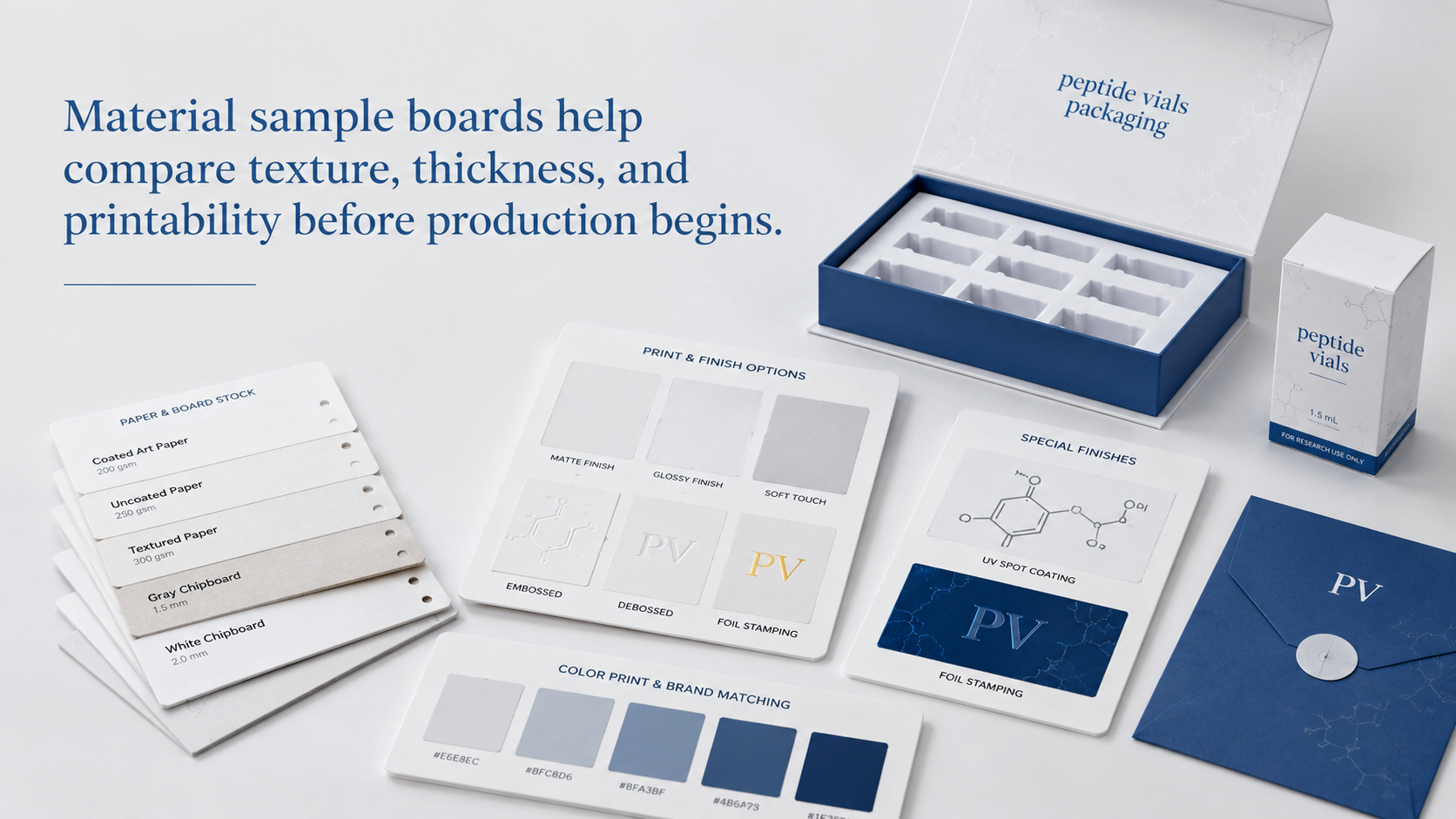
Material sample boards help compare texture, thickness, and printability before production begins.
| Material | Best For | Moisture Barrier | Cost Level |
|---|---|---|---|
| Rigid Paperboard (1.5–3mm) | Premium vials, gift sets | Medium (with coating) | $$$ |
| Corrugated Kraft + Foil Laminate | Shipping, cold-chain | High | $$ |
| PET Plastic + Aluminum Foil | Moisture-sensitive peptides | Very High | $$$ |
| Eco-friendly Biodegradable Pulp | Sustainable brands | Low–Medium | $$ |
| Acrylic / Polycarbonate | Display, luxury retail | Medium | $$$$ |
For most peptide product lines, a combination of rigid paperboard outer packaging with a foil-laminated inner compartment offers the best balance of premium appearance, product protection, and cost. Eco-conscious brands can explore biodegradable pulp trays inside recyclable paperboard sleeves.
Once materials are selected, structural design translates your requirements into a physical box. This phase involves creating die-line drawings, 3D mockups, and prototype samples. Here are the key structural elements to consider:
Every fold, crease, and cut must be engineered to within ±0.5mm tolerance. Poor die-lines cause misaligned graphics, loose fits, and structural weakness.
Magnetic snap closures, ribbon pulls, tuck flaps, and child-resistant locks each serve different retail and safety requirements for peptide products.
Custom foam, velvet, or molded pulp inserts hold peptide vials securely, prevent breakage during transport, and create a premium unboxing experience.
Design your box dimensions to maximize shelf and shipping container space efficiency. Modular sizing also reduces custom tooling costs.
Always request physical prototypes (also called "samples" or "mockups") before approving mass production. A digital 3D render cannot reveal fit issues, paper grain direction problems, or assembly difficulty that a physical prototype exposes immediately.
The visual treatment of your custom peptide packaging boxes is what captures attention on retail shelves and in unboxing videos. Modern printing technology offers a palette of techniques to create memorable brand experiences.
Offset printing delivers superior color accuracy and sharpness for large runs (2,000+ units), while digital printing offers lower setup costs and faster turnaround for small batches. Many peptide brands use digital for initial market testing, then transition to offset at scale.
Hot Foil Stamping — Metallic gold, silver, rose gold, or holographic foil adds a luxurious tactile element. Ideal for brand logos and product names on peptide packaging.
Spot UV Coating — Glossy raised coating on select design elements creates a striking contrast against matte backgrounds. Popular for highlighting safety seals and dosage instructions.
Embossing & Debossing — Raised or recessed design elements add a tactile dimension that signals quality. Combined with foil stamping, the effect is particularly powerful.
Matte Lamination — A soft-touch matte finish feels premium and reduces glare for easy reading of regulatory information and dosage charts.
QR Codes & NFC Tags — Embedded smart tags link customers to authentication pages, usage videos, and reorder portals — a growing trend in peptide brand engagement.
For peptide products, quality control in packaging is not optional — it is a regulatory and brand safety imperative. A comprehensive QC protocol covers multiple dimensions.
| QC Check | Method | Acceptance Criteria | Frequency |
|---|---|---|---|
| Moisture Vapor Transmission | MVTR test (ASTM F1249) | less than 0.5 g/m²/day | Every batch |
| Print Color Accuracy | Spectrophotometer (Delta E) | Delta E less than 2.0 | First & last 100 units |
| Structural Integrity | Drop test (1.2m, 3 angles) | No visible damage | Random 5 per pallet |
| Label Legibility | Visual inspection + barcode scan | 100% scannable | 100% of production |
A reputable packaging manufacturer will provide QC documentation including material certifications, test reports, and batch traceability records. Always request these documents — they are essential for your own regulatory audits and customer compliance requirements.
Understanding the packaging timeline helps you plan product launches, seasonal promotions, and inventory replenishment. Here is a typical project timeline for custom peptide packaging boxes:
Share product specs, brand guidelines, budget, and target timeline with your packaging partner. The more detail you provide, the fewer revision rounds you will need.
Engineers create precise die-line drawings and 3D structural mockups. 2–3 revision rounds typically occur at this stage.
Designers apply your branding, product information, regulatory text, and finishing specifications to the approved die-line. Pre-press proofing ensures color accuracy.
Physical hand samples are produced using actual materials and finishes. You can test fit, feel, and appearance before mass production begins.
Full production run including printing, die-cutting, folding, gluing, and finishing. Regular QC checkpoints throughout the production process.
Final inspection, palletization, and shipment via sea (25–35 days) or air freight (5–8 days) depending on your location and urgency.
Total estimated timeline: 40–55 working days for standard production. Expedited service can compress this to 25–35 days with additional fees.
Packaging costs for peptide products vary widely based on materials, complexity, order volume, and finishing requirements. A transparent cost breakdown helps you allocate budget effectively:
| Cost Component | Typical Share | Notes |
|---|---|---|
| Design & Engineering | 5–10% | One-time fee; complex structures cost more |
| Tooling & Dies | 5–8% | Includes cutting dies, foil stamping dies, embossing plates |
| Raw Materials | 30–40% | Board, lining, inserts, adhesives, coatings |
| Printing & Finishing | 20–30% | Foil stamping and spot UV add 20–40% to printing cost |
| Assembly & Packing | 10–15% | Hand assembly for complex boxes costs more |
| Quality Control | 3–5% | In-line and final inspection |
| Shipping & Logistics | 8–15% | Varies by destination and shipping method |
For a typical medium-volume order of custom peptide packaging boxes (5,000 units), expect total per-unit costs in the range of $0.80–$3.50 depending on complexity. Higher volumes drive the per-unit cost down significantly — a 50,000-unit order can reduce costs by 30–40% compared to a 5,000-unit run.
Selecting the right manufacturer for your custom peptide packaging boxes is as important as the design itself. Here are the criteria to evaluate potential partners:
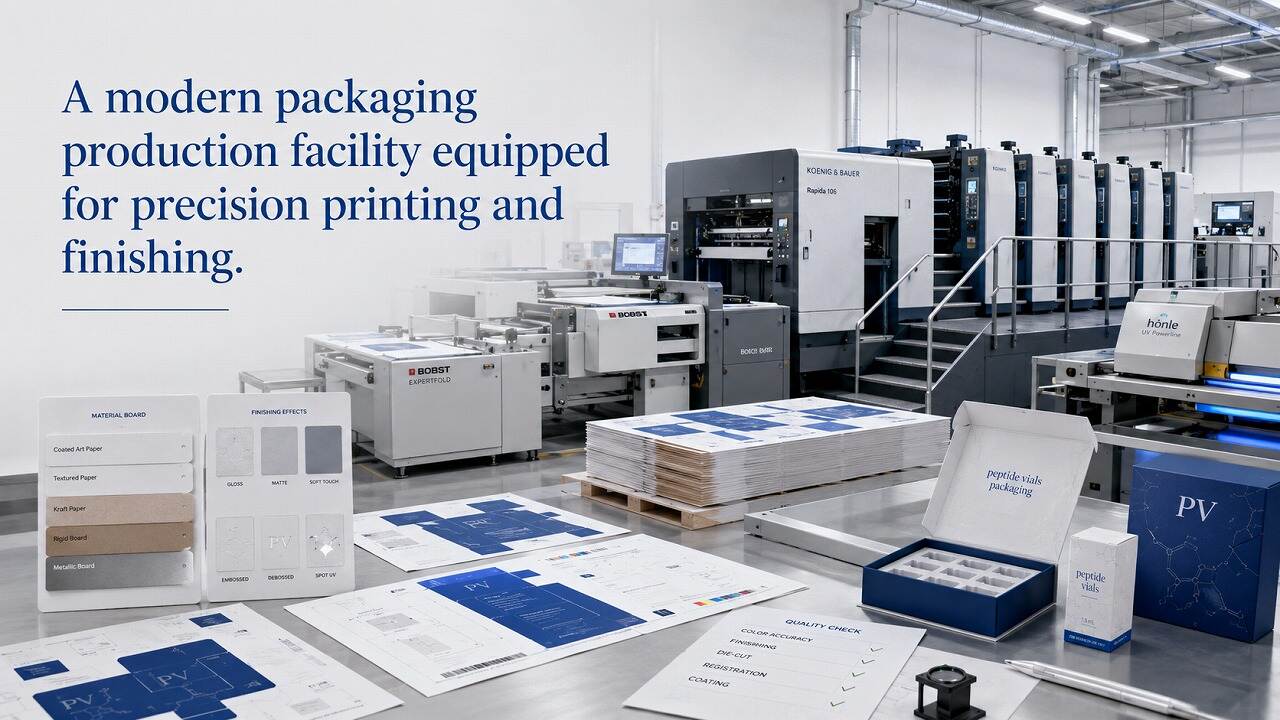
A modern packaging production facility equipped for precision printing and finishing.
Industry Experience — Look for a manufacturer with proven experience in peptide, pharmaceutical, or nutraceutical packaging. They will understand regulatory requirements and material compatibility issues from the start.
Quality Certifications — ISO 9001, ISO 14001, and GMP certifications indicate a commitment to quality management. For peptide packaging, FSC certification for sustainable materials is also valuable.
Sample Quality — Request physical samples before committing. Evaluate the precision of folds, uniformity of printing, and feel of materials. A manufacturer's sample quality reflects their production quality.
Communication & Support — English proficiency, response time, design support capabilities, and project management tools matter enormously when coordinating complex packaging projects across time zones.
Production Capacity — Ensure the manufacturer can handle your order volume within your required timeline. Ask about current production load and availability of parallel production lines.
MOQ Flexibility — Minimum order quantities vary dramatically — from 500 units for simple rigid boxes to 5,000+ for complex boxes with custom tooling. Find a partner whose MOQ aligns with your budget and market testing needs.
💡 Tip: Ask potential partners for case studies or references from peptide or supplement brands they have worked with. Real client examples reveal more about manufacturing capability than any marketing claim.
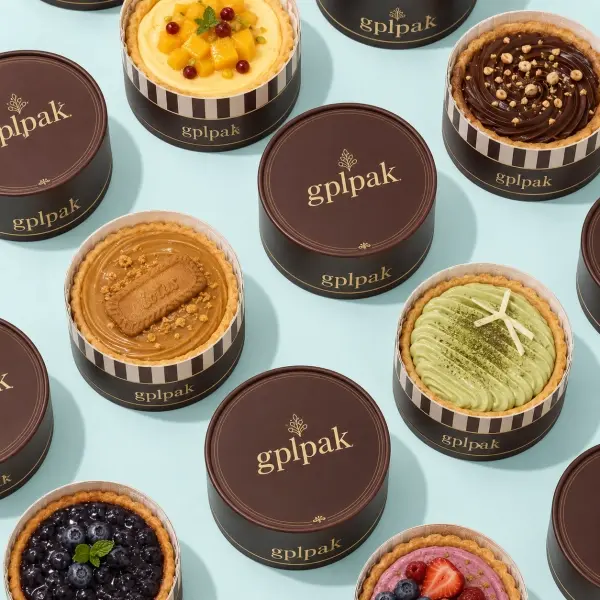
From moisture-resistant rigid boxes to luxury gift sets with custom foam inserts and hot foil stamping — GPLPAK delivers premium custom peptide packaging boxes tailored to your brand and product requirements.
© 2026 GPLPAK - China's Professional Custom Packaging Manufacturer
 Hot News
2026-10-07
2026-09-30
2026-09-23
2026-09-22
2026-09-21
2026-09-18
2026-09-17
2026-09-17
2026-09-16
2026-09-09
Discover premium packaging solutions from Dongguan Xinglan Packaging Products Co., Ltd. Specializing in innovative, durable, and custom packaging products for diverse industries.
GPLPAK is committed to delivering manufacturing excellence.

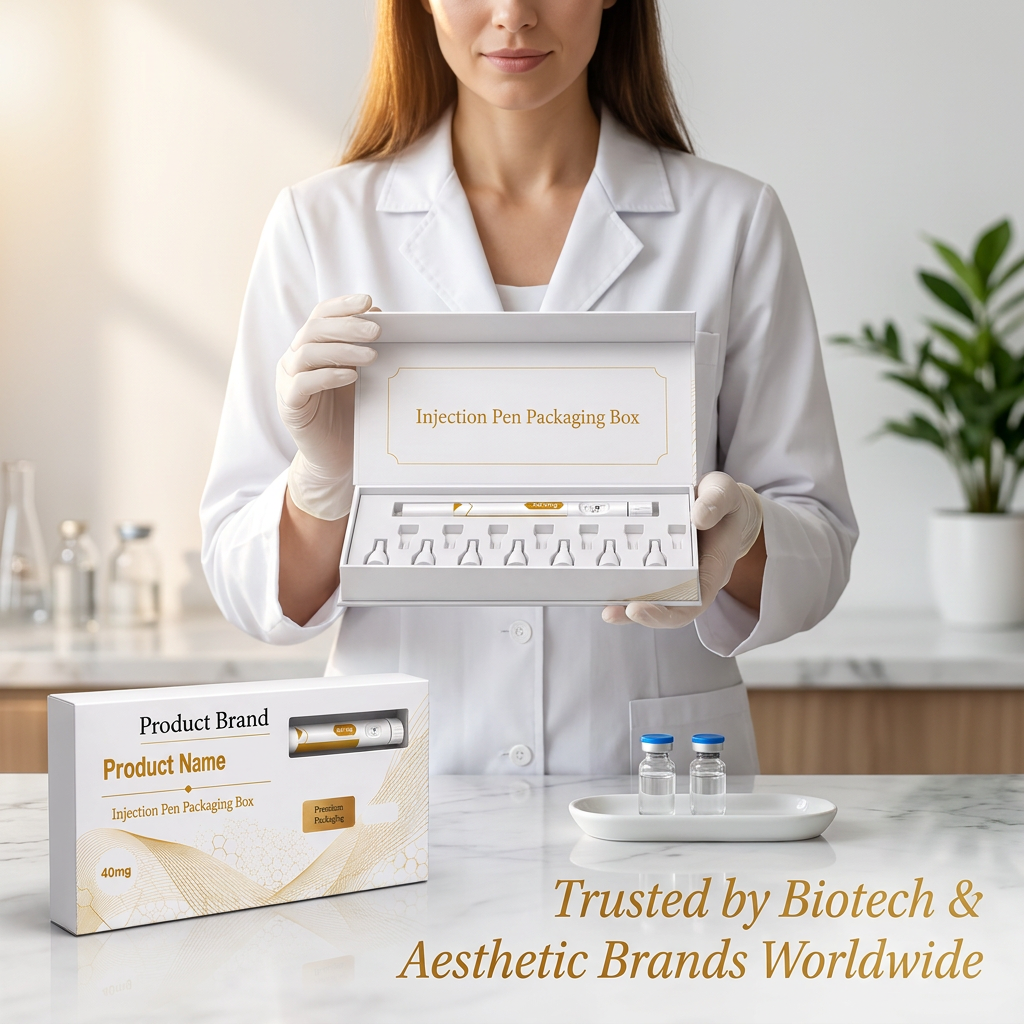

.jpg)