
 EN
EN  EN
EN  RU
RU  ES
ES  KO
KO  JA
JA  PT
PT  IT
IT  DE
DE  FR
FR  NL
NL Quick Links
In brief: The best premium commemorative coin presentation box is selected from the complete packed system—not the coin diameter alone. A hinged rigid box is a strong starting point for a single encapsulated coin; drawer, book-style and multi-cavity formats suit collector sets that need more storytelling space. Final selection should be confirmed with the actual capsule, certificate, packed-set weight, distribution route and a production-intent sample.
For mints, numismatic publishers, museum retail programs and corporate recognition buyers, the box has three jobs: organize the coin or capsule, present the edition information and provide secondary physical protection. It is not a substitute for a qualified coin holder or an outer shipping pack. This guide compares six manufacturable paper-wrapped rigid structures and shows how to specify the insert, certificate position, finishes and approval criteria without making unsupported preservation claims.
A premium commemorative coin presentation box is a paper-wrapped rigid box: a greyboard core wrapped in printed or specialty paper, assembled with turned edges and a hinged or magnetic closure. This definition matters because searches for "commemorative coin box" return a confusing mix of product categories, and buyers often compare apples to oranges.
Metal-shell cases — hinged metal or aluminium shells. They belong to a different material, tooling and freight category.
Wooden boxes - solid wood or MDF presentation boxes, often with a sliding lid or a routed recess. Heavier and freight-intensive.
Plastic presentation boxes - moulded or floating acrylic display cases. They show the coin, but rarely carry custom branding well.
Paper-wrapped rigid boxes - the focus of this guide: printed paper, specialty paper, or linen wraps over greyboard, with fully customizable internal fittings.
This guide covers paper-wrapped rigid presentation boxes - custom coin display boxes built around commemorative coins, proof coins, medals, challenge coins, and limited-edition collector sets. They can be designed around a bare coin, a coin capsule, or a graded slab, and they function as both a selling tool and a secondary protection layer for the coin inside.
Protection boundary: A paper-wrapped rigid box is a presentation and secondary mechanical-protection component, not an archival vault. Do not claim it is airtight, moisture-proof or capable of guaranteeing long-term anti-oxidation unless the complete packed system has documented materials and relevant test evidence.
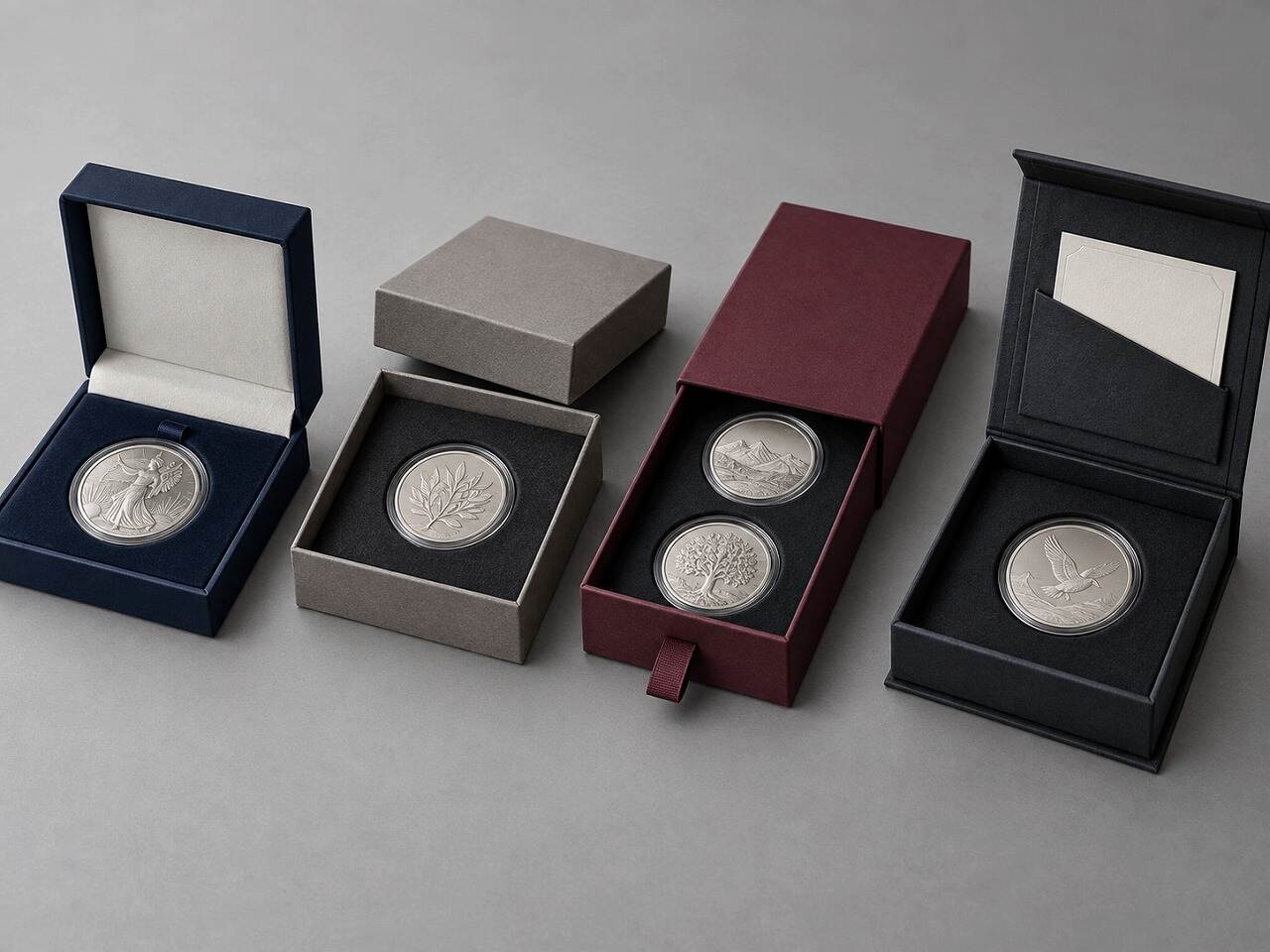
The fastest way to shortlist a structure is to start from the program type rather than the box. Each commemorative program has a natural box shape, an obvious internal configuration, and a predictable production cost. Use the table below as a starting map, then confirm dimensions with a structural sample.
| Program Type | Recommended Structure | Internal Configuration |
|---|---|---|
| Single commemorative coin | Hinged-lid rigid box | Central capsule recess |
| Proof coin release | Book-style or hinged box | Capsule plus COA pocket |
| Two-coin anniversary set | Lid-and-base box | Dual fitted cavities |
| Multi-coin collector series | Drawer or book-style box | Numbered multi-cavity tray |
| Corporate recognition coin | Magnetic closure box | Coin recess plus message panel |
| Museum retail edition | Sleeve-and-tray box | Coin, story card and barcode area |
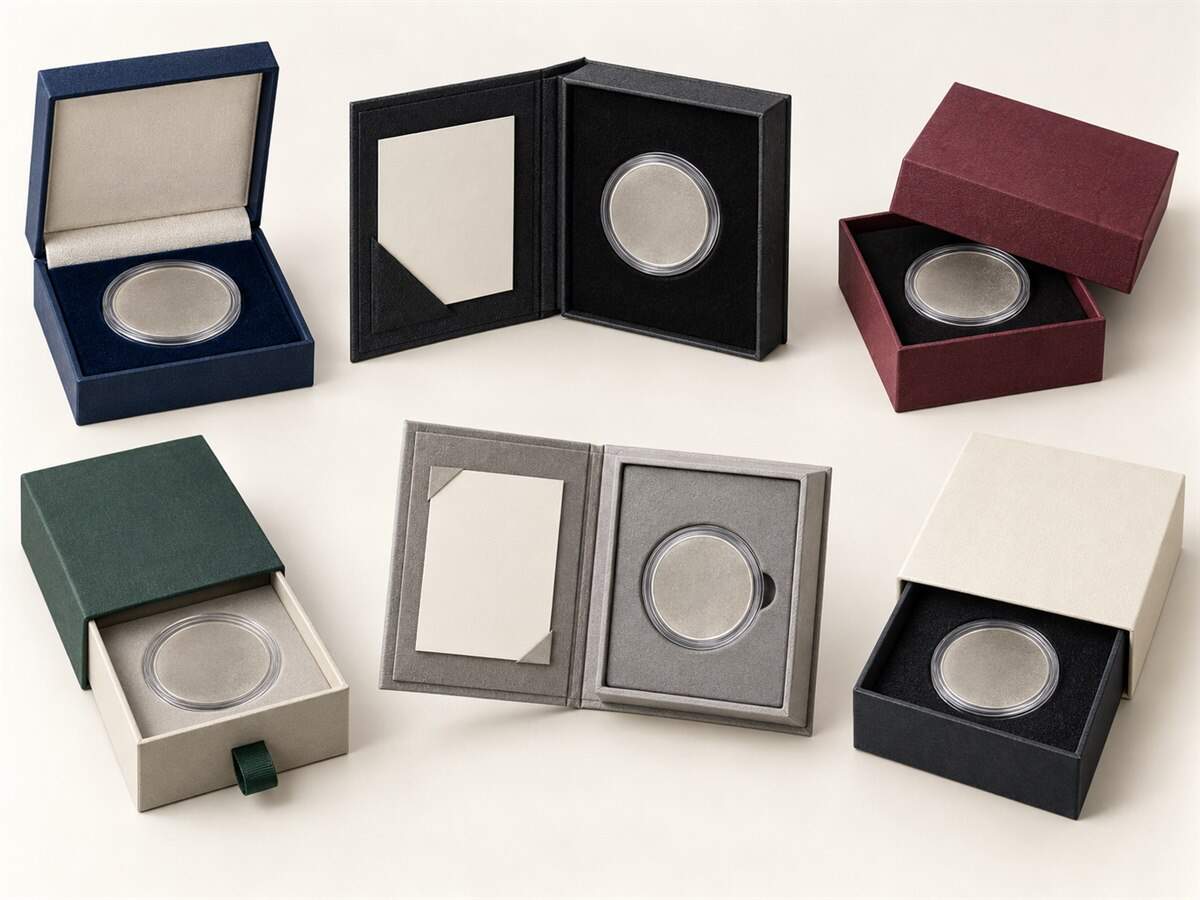
Hinged, book-style, two-piece, drawer and sleeve-based structures create different opening sequences and information areas.
Fit principle: Design the cavity around the maximum outside dimensions of the actual holder, including its rim, flange, hinge or opening tab—not the nominal coin diameter. That difference changes the insert geometry, box footprint and quotation.
These six paper-wrapped rigid structures are practical starting points for numismatic and collectible programs. Each is compared against the same criteria: opening experience, application, insert compatibility, certificate placement, packing complexity, shipping volume, relative cost and sourcing risk.
The classic single-coin box. The lid is attached to the base by a wrapped paper hinge, so the box opens like a book and holds its shape when displayed.
Opening experience: Smooth, familiar, and ceremonial - the lid stays open on the table.
Best use: Single commemorative coins and proof releases.
Insert compatibility: EVA foam, molded pulp, or die-cut paperboard with one central recess.
Certificate placement: Inside lid or under the insert tray.
Packing complexity: Low - a single-piece structure.
Shipping volume: Moderate; ships assembled and closed.
Cost level: $$ - the most efficient premium structure.
Sourcing risk: Low, but hinge strength depends on wrap quality - specify the paper grade.
A rigid box with hidden magnets in the lid and base that snap shut. It reads as high-end and is the go-to structure for corporate recognition and gift coins.
Opening experience: A firm magnetic pull and a clean, flat opening.
Best use: Corporate awards, sponsor gifts, premium retail singles.
Insert compatibility: Excellent - supports deep inserts plus a message or certificate panel.
Certificate placement: Dedicated side pocket or under-lid panel.
Packing complexity: Medium - magnet seating must be aligned and glued precisely.
Shipping volume: Moderate; slightly heavier than a hinged box.
Cost level: $$$ - magnets and assembly add cost.
Sourcing risk: Low to medium — confirm magnet position, closure alignment and opening force on the approved sample.
A separate lid that lifts off a base - the simplest rigid structure with a genuine "reveal" moment.
Opening experience: A deliberate two-hand lift, ideal for unveiling ceremonies.
Best use: Anniversary sets, awards, and larger medals.
Insert compatibility: Broad - dual cavities and large recesses fit easily.
Certificate placement: Under the lid or beneath the tray.
Packing complexity: Low to medium - two separate components to handle.
Shipping volume: Usually governed by the assembled box footprint and the protective pack-out.
Cost level: $$ - competitive, driven by board weight.
Sourcing risk: Medium - lid fit must be tuned; a loose lid reads as cheap.
An outer sleeve with an inner tray that slides out, often finished with a ribbon pull. The drawer box is the strongest structure for multi-coin collector series.
Opening experience: A sliding reveal that keeps multiple coins hidden until drawn out.
Best use: Numbered series, proof set collections, prestige editions.
Insert compatibility: Excellent - multi-cavity trays, layered trays, or book inserts inside the drawer.
Certificate placement: A recessed slot above or below the coin tray.
Packing complexity: High - two-part construction plus tray fitting.
Shipping volume: Moderate; sleeves protect the tray in transit.
Cost level: $$$ - more components and assembly.
Sourcing risk: Medium to high - drawer fit and slide smoothness are common failure points.
Built like a hardcover book: a spine, two covers, and an internal tray. It gives numismatic publishers a structure that carries real editorial content.
Opening experience: A page-turn feel that suits storytelling and history-led editions.
Best use: Proof coin releases, commemorative books, museum editions.
Insert compatibility: Strong - a tray in one half, printed content in the other.
Certificate placement: A pocket or a dedicated page facing the coin.
Packing complexity: Medium to high - spine wrapping requires care.
Shipping volume: Moderate; a sleeve adds protection.
Cost level: $$$ - printing volume on the interior raises cost.
Sourcing risk: Medium - spine alignment and page-edge printing must be proofed.
A rigid tray that slides inside a printed outer sleeve. It offers a direct shelf-facing surface and a simple sliding reveal, while the final cost depends on tray depth, sleeve construction, materials and order quantity.
Opening experience: A simple push-out reveal; ideal for shelf display and gift shops.
Best use: Museum retail, tourist editions, entry-level collectibles.
Insert compatibility: Good - single or dual recess, plus a story card area.
Certificate placement: Behind the tray or in a sleeve cut-out.
Packing complexity: Low - two components, easy to assemble.
Shipping volume: Low - sleeves nest and store flat before assembly.
Cost level: $$ - strong value for retail volume.
Sourcing risk: Low to medium — agree the sleeve-to-tray fit and sliding feel through a physical sample instead of applying a universal tolerance.
If you are weighing a hinged box against a drawer structure, compare GPLPAK's current lid-and-base boxes and drawer boxes to see how the opening direction changes the construction.
The jump from one coin to many changes almost every engineering decision. A single-coin presentation can use a simple central recess; a multi-coin series needs a cavity layout that stays readable as the collection grows.
Single-coin presentation: One centred recess, strong visual focus and the simplest cavity layout.
Matched coin set: Two or more cavities laid out symmetrically, usually for anniversaries or pairings.
Collector series: A multi-cavity layout arranged by edition sequence, often numbered.
Timeline layout: Coins positioned along a printed line of dates or milestones.
Round, square, and shaped medals: Non-round forms need custom die-cut recesses and extra corner clearance.
Future-release compatibility: Reserve empty cavities and consistent grid spacing so later editions drop into the same tray.
When you brief a supplier, use this vocabulary so the drawing is unambiguous: single-coin presentation, multi-cavity layout, matched coin set, edition sequence, and future-release compatibility. These terms describe the internal tray, not the outer shell, and they belong on the structural drawing.
Series planning: For an ongoing collection, define the cavity grid and future-release envelope early. Reusing a validated tray concept may reduce repeated tooling and approval work, provided later items stay within the agreed dimensional range.
"Rigid box" is often written as "cardboard" in loose descriptions, but the construction details are what separate a premium box from a cheap one. Four different materials are commonly confused, and they are not interchangeable.
| Material | What It Is | Typical Use in Coin Boxes |
|---|---|---|
| Folding paperboard | Single-layer printed board, scored and folded | Budget cartons, inserts, sleeves |
| Rigid greyboard | Dense paperboard core specified by finished thickness and load | The structural core of premium presentation boxes |
| Corrugated board | Fluted board with a wavy inner layer | Shipping mailers and master cartons |
| Specialty wrapping paper | Textured, linen, or soft-touch surface paper | The outer skin that communicates premium |
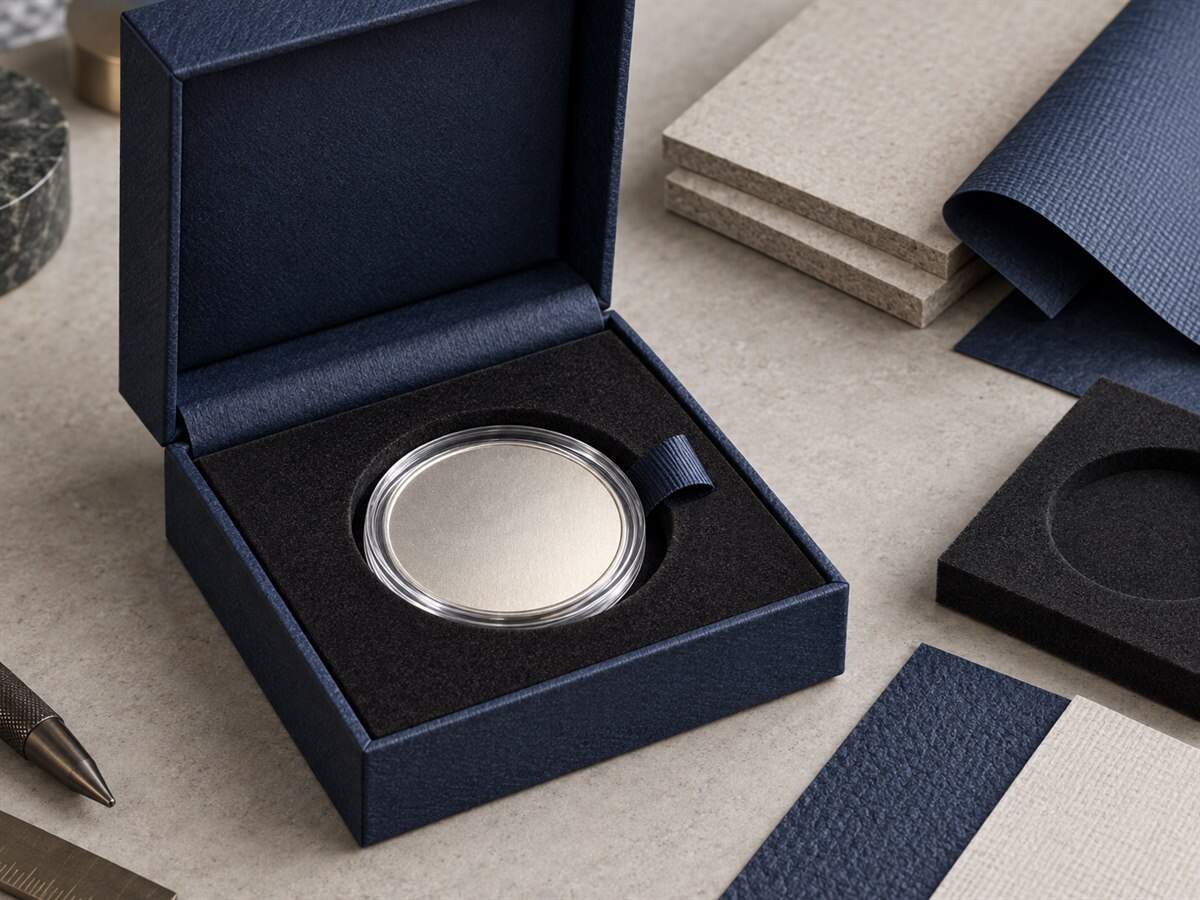
The box, insert and capsule should be reviewed as one packed system; material samples help control surface and structural expectations.
The building blocks of a paper-wrapped rigid coin box include:
Greyboard core - provides rigidity and reassures the hand.
Printed paper wrap - carries the artwork, logo, and edition details.
Specialty paper wrap - linen, leatherette, or soft-touch textures.
Turned edges - wrap folded neatly around the board edge.
Wrapped corners - folded and tucked for a clean, sharp corner.
Hinged paper joint - the wrapped connection between lid and base.
Magnetic closure - hidden magnets for a snap-shut lid.
Shoulder-and-neck construction - the inner lip that guides the lid on and holds it snug.
Outer protective sleeve - an optional printed sleeve for retail and transit.
A collector program often needs the package to carry issue information as well as the coin. Design the opening as a deliberate sequence: identify the edition, present the certificate or context, then reveal the encapsulated item. This gives the structural drawing a clear information hierarchy instead of treating the box as an empty decorated shell.
Control what the buyer sees first - brand, then certificate, then the coin.
A printed panel for history, mint marks, and design notes.
Mint or museum identity applied consistently to box, sleeve, and card.
Ribbon lift, finger notch, or removable tray for easy coin removal.
Build in these tactile details so the box feels engineered, not generic:
Edition identification - number, year, or series printed inside the lid.
Certificate placement - a stated pocket or panel, not an afterthought.
Ribbon lift - a satin or grosgrain tab to raise the tray cleanly.
Finger notch - a die-cut semicircle so the coin or capsule can be pinched safely.
Removable tray - lets the box double as a display case.
Outer sleeve — adds a retail-facing graphic surface and an extra layer against handling scuffs; cost remains specification-dependent.
Handling boundary: The U.S. Mint's collector-care guidance recommends handling coins by their edges and avoiding bare-finger contact with the face. A capsule-fit insert, finger notch or ribbon lift can reduce unnecessary handling, but the approved holder and care instructions remain part of the complete preservation system.
Finishing is where a coin box earns or loses its price-perception gap. The table below maps each common finish to where it is applied, what it does visually, and the proofing risk you should manage.
| Finish | Typical Position | Visual Role | Proofing Risk |
|---|---|---|---|
| CMYK printing | Full wrap, insert, sleeve | Photographic imagery and gradients | Color shift on uncoated paper |
| Pantone spot color | Logo, borders, key panels | Controlled brand-color target | Match under different lighting |
| Hot foil stamping | Lid, spine, title text | Gold or silver metallic highlight | Edge fill on fine type |
| Blind embossing | Lid emblem, coin motif | Raised, tactile, no ink | Die depth vs board thickness |
| Debossing | Title, edition number | Recessed, understated luxury | Shadowing on dark wraps |
| Spot UV | Logo, motif overlay | Gloss highlight against matte | Registration to printed art |
| Matte lamination | Full outer wrap | Muted surface with a smooth tactile contrast | Delamination on tight folds |
| Textured specialty paper | Full wrap or accents | Linen or leatherette premium feel | Ink absorption on texture |
| Printed interior | Inside lid, tray undersurface | Storytelling and certificate integration | Wrapping distortion on curves |
| Edge detailing | Box edge, sleeve lip | Colored or foil edge for contrast | Consistency along long runs |

Raking light reveals foil reflection, relief depth, gloss contrast and paper grain more accurately than a screen proof.
Always approve a physical foil and emboss proof on the final wrap paper. Metallic foils read very differently on coated, uncoated, and textured stock, and a screen proof will not show it.
A premium presentation box and a shipping pack perform different jobs. The rigid box provides presentation and secondary physical protection; the distribution system must manage the handling and compression risks of the selected route. Treating the retail box as the only shipper can leave corners, wraps and finishes exposed.
Presentation box — organizes and presents the packed coin while providing secondary physical protection.
Protective sleeve - a rigid printed sleeve around the box adds edge protection and branding.
E-commerce mailer - a corrugated mailer for direct-to-collector shipping.
Master carton - the bulk export carton for distributor or retailer delivery.
Before you approve an export order, define acceptance checks for coin movement inside the insert, corner compression and surface scuffing. If route testing is required, agree the packed configuration, procedure and pass/fail criteria before testing. GPLPAK's corrugated box and packing service pages provide the related shipper context.
Pack-out check: Specify unit orientation, protective layers, carton count and allowable void space. Uncontrolled movement inside the master carton is a common contributor to scuffing and corner damage.
Follow this eight-step decision flow in order. It prevents the two most expensive redesigns: discovering late that the coin does not fit the insert, and discovering at shipment that the box does not survive transit.
Diameter, thickness, and capsule flange drive the recess and box footprint.
This decides the cavity layout and whether future-release compatibility is needed.
Related: Browse Packaging Products
A COA or story booklet needs a defined pocket before the box is drawn.
Related: Packaging Consultation
Retail shelf, museum gift shop, or ceremonial award each change the structure.
Related: Shop by Industries
Decide between a magnetic snap, a slide-out drawer, or a lift-off lid.
Related: Magnetic Boxes
Air, sea, or direct-to-collector changes the sleeve and carton spec.
Related: Packing Services
Set a per-unit landed target before choosing finishes, not after.
Test the insert fit and opening feel on an unprinted sample before artwork.
Related: Development and Sampling
A complete RFQ gets you an accurate quote in one round instead of five. Send all of the following when you request pricing.
Coin type - commemorative, proof, bullion, medal, or challenge coin.
Diameter and thickness - in millimetres, for the coin as presented.
Weight - helps size the insert and board thickness.
Capsule dimensions - outer diameter and flange, if a capsule is used.
Number of coins - single, pair, or full series.
Certificate size - COA or booklet dimensions and quantity.
Preferred box style - hinged, magnetic, lid-and-base, drawer, book-style, or sleeve-and-tray.
Materials - greyboard weight, wrap paper, insert material.
Printing - CMYK, Pantone references, or both.
Finishes - foil, emboss, spot UV, lamination, texture.
Quantity per design - including any split across editions.
Destination - country and address, for landed cost and compliance.
Required date - in-hand date, not just a ship date.
Inspection criteria - dimensional tolerance, AQL level, and any buyer-specific checks.
RFQ improvement: Send the physical capsule or a controlled drawing whenever possible. A photograph beside a ruler is useful context, but it should not replace maximum dimensions, weight and closure-profile information.
Send the coin or capsule dimensions, certificate details, preferred opening style, artwork, quantity and destination. GPLPAK can review the structure, insert concept, sample scope and export pack-out requirements for your project.
© 2026 GPLPAK — Custom Paper Packaging Manufacturer in China
 Hot News
2026-09-21
2026-09-18
2026-09-17
2026-09-17
2026-09-16
2026-09-09
2026-08-31
2026-08-26
2026-08-21
2026-08-13
Discover premium packaging solutions from Dongguan Xinglan Packaging Products Co., Ltd. Specializing in innovative, durable, and custom packaging products for diverse industries.
GPLPAK is committed to delivering manufacturing excellence.





.jpg)