In brief: a successful vape cart package starts with the exact finished cartridge or its protective tube, the destination jurisdiction and the sales channel—not with a box style. The buyer must separate containment, retail presentation, child resistance, tamper evidence and distribution protection into distinct requirements. A paper converter can engineer the carton and insert, reserve artwork zones and manufacture to an approved specification, but it cannot make an untested pack “compliant” or determine the brand owner’s legal obligations.
The phrase vape cart packaging covers several products that look similar in search results but perform different jobs: a paper folding carton around a sealed cartridge tube, a lockable sleeve-and-drawer pack, a premium rigid presentation box, a multi-unit kit and a corrugated distribution shipper. Treating them as interchangeable produces inaccurate quotations and weak samples.
This guide is for regulated-product brands, hardware suppliers, licensed operators and distributors sourcing custom paper packaging. It focuses on secondary paper boxes and fitted inserts. It does not give legal advice, approve any nicotine or cannabis product, or replace review by the responsible regulatory professional in the market where the product will be sold.
Do not begin an RFQ with “one box for a 1 ml cart.” Capacity is not an outside dimension, and the word cart does not identify whether the quotation covers empty hardware, a filled nicotine product, a cannabis product, a cartridge inside a protective tube, or a cartridge paired with a battery. Those distinctions change the dimensions, artwork, closure and evidence required.
| Item being sourced | Main packaging job | Critical buyer input | What the paper box does not prove |
|---|---|---|---|
| Empty cartridge hardware | Protect and identify a component | Finished hardware drawing, cap and protective tube | Suitability for any filled formulation |
| Filled, sealed cartridge | Retail presentation and restraint | Market, product classification and approved label copy | Product authorization, leak integrity or legal compliance |
| Cartridge in protective tube | Hold the tube and preserve display orientation | Tube outside diameter, cap, flange and full height | Child resistance of the complete package |
| Multi-unit kit | Separate units and organize information | Count, mix, removal sequence and retail channel | Distribution performance without a shipper test |
In packaging terminology, “primary package” should be assigned only after the containment system is understood. For a filled cartridge, the reservoir and seals contain the product; a protective tube may add physical protection; the printed paper carton is normally a secondary presentation component. The outer paper box does not stop an internal seal from leaking, and an insert should never be used to hide an unresolved hardware problem.
Before structural work begins, ask the responsible compliance reviewer to classify the product and identify every target market. A U.S. nicotine product and a cannabis product sold under a state program do not share one universal label template. Empty hardware may be treated differently again. GPLPAK can support packaging consultation and paper-structure development, while product classification and legal approval remain with the brand owner and its advisers.
A 0.5 ml, 1 ml or 2 ml description tells the buyer about nominal fill volume, not the maximum physical envelope. Cartridge body diameter, mouthpiece form, center-post geometry, thread projection, dust cap and protective tube vary among hardware families. The converter needs a production-intent sample or a controlled drawing that matches what will actually be packed.
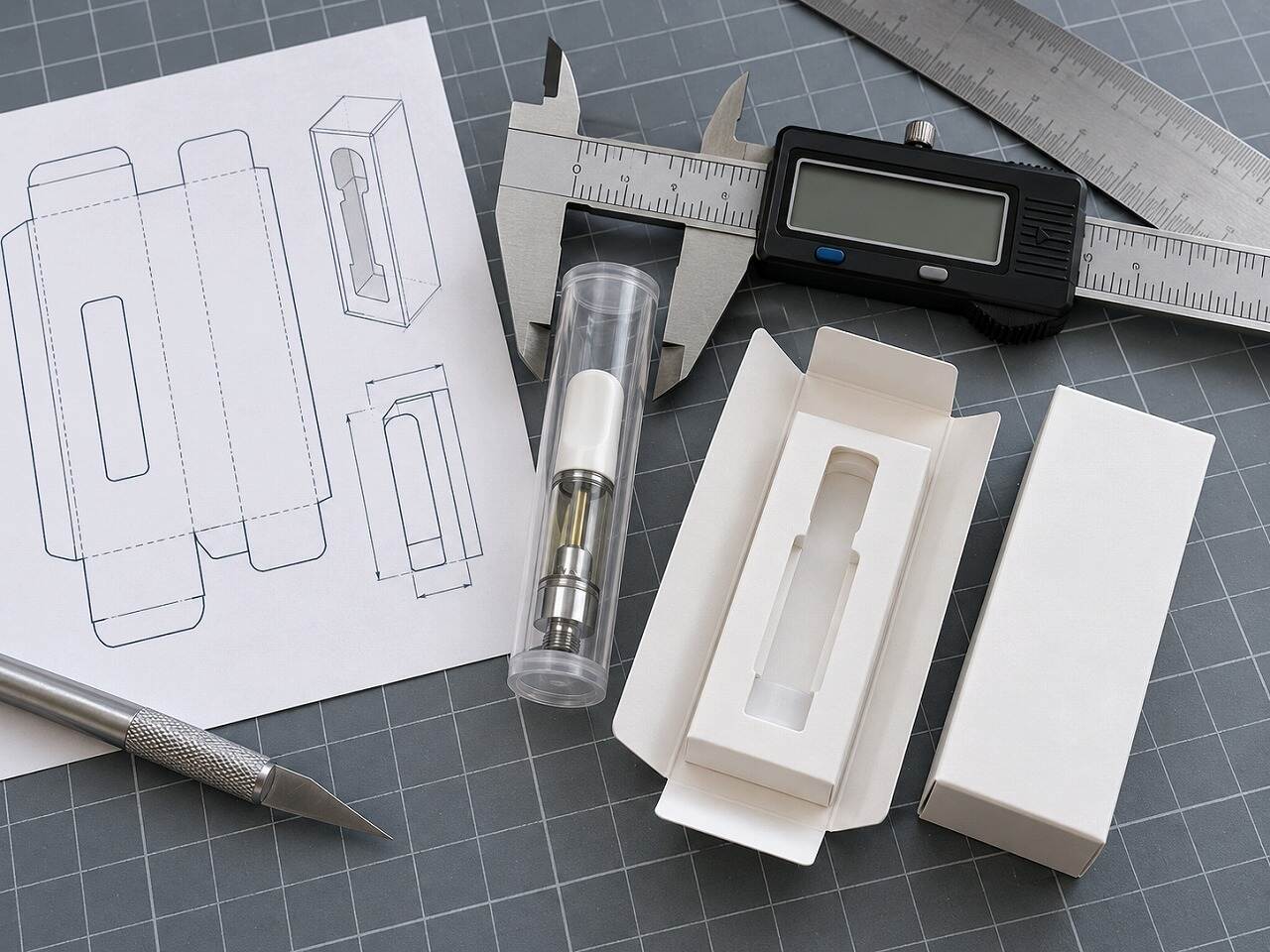
Measure the largest finished outside dimensions and prototype the insert around the final protective tube or capped cartridge.
Record these dimensions and conditions:
maximum overall height, including mouthpiece, thread, cap and any tube closure;
maximum body or tube diameter, flange diameter and widest decorative feature;
filled unit weight and the center of mass when orientation matters;
acceptable contact zones and surfaces that must not be scuffed;
lot-to-lot tolerance from the hardware supplier, not only one sample measurement;
packing orientation, removal direction and whether the unit will be packed by hand or fixture.
The fit sample should include the smallest and largest expected parts. An insert sized around one average sample can rattle with a low-limit part and grip a high-limit part too tightly. For new developments, GPLPAK’s product development그리고design validation for manufacturing pages describe the transition from concept to production-ready structure.
The most economical structure is the simplest one that meets the approved requirement. A single folding carton may be right for shelf presentation; it is not automatically a parcel mailer or a child-resistant package. A wrapped rigid box creates a stronger presentation but increases material, assembly and shipping volume. A lockable sleeve-and-drawer design should be selected only when the required opening action, evidence and user experience have been defined.
| 구조 | Appropriate use | Strength | Primary limitation |
|---|---|---|---|
| Straight or reverse tuck carton | Single unit for retail shelf | Efficient print area and flat shipment | Standard tuck closure is not a CR mechanism |
| Sleeve with inner tray | Premium single unit or paired kit | Controlled reveal and good insert integration | Tray-to-sleeve clearance needs production control |
| Press-and-slide paper pack | Projects requiring a defined two-step opening action | Integrates lock and secondary carton | CR claims require the exact configuration to be tested |
| Wrapped rigid drawer or book box | Launch kit, presentation set or multiple units | High stiffness and finish range | Higher cube, weight and hand assembly |
| Corrugated shipper | Parcel or wholesale distribution | Compression and distribution protection | Does not replace the regulated retail unit package |
For structural references, review GPLPAK’s folding boxes, drawer boxes그리고단단한 상자. These pages show manufacturing categories, not pre-approved vape packaging. The final structure still has to be engineered around the actual product, closure requirement and distribution route.
An insert is not decoration. It controls movement, separates units, manages removal and sets the visual orientation when the pack opens. The cavity should restrain the robust part of the protective tube or cartridge body rather than place concentrated force on the mouthpiece, glass tank or thread. A finger notch must allow removal without turning the product into a lever against the glass.
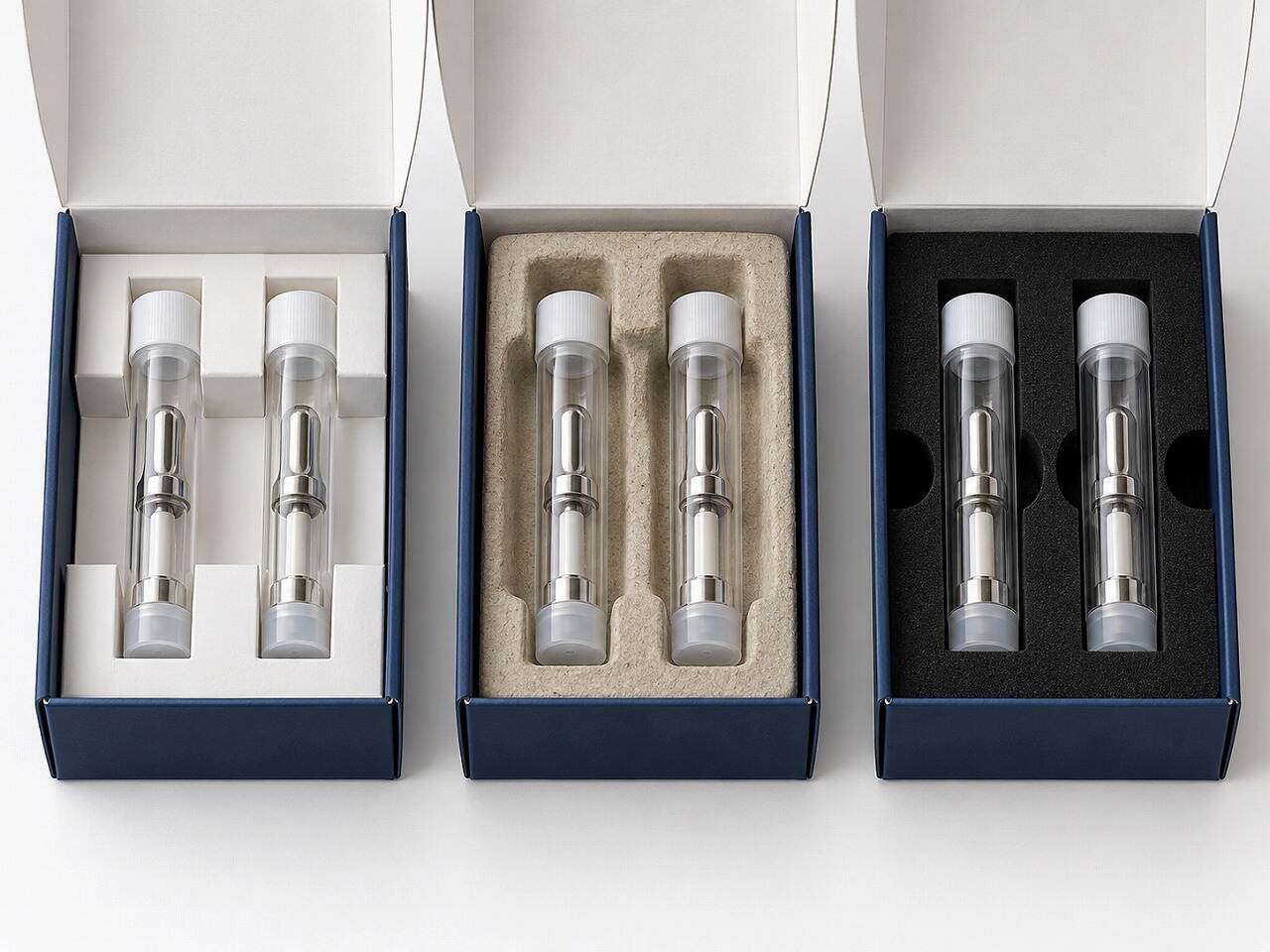
Paperboard, molded fiber and EVA can all restrain a tube; the correct choice depends on geometry, finish target, recovery route and validation results.
| 입력 | Best use | Design controls | Recovery consideration |
|---|---|---|---|
| Folded paperboard cradle | Single or small multi-pack; flat assembly | Fold spring-back, locking tabs, edge contact | Can support a paper-led design when coatings and separation are appropriate |
| Molded fiber | Rounded channels and larger repeat programs | Draft, wall thickness, surface texture and tool tolerance | Fiber composition and local acceptance must be confirmed |
| EVA 거품 | Premium kits needing precise retention | Density, thickness, odor, cut quality and compression | Mixed-material recovery is usually less straightforward |
| Thermoformed tray | High-volume, close-tolerance cavities | Resin, gauge, undercuts and static | Resin identification and collection access affect the claim |
For two or more cartridges, define the minimum web between cavities and prevent hard parts from contacting each other. If the package is displayed vertically, check whether gravity allows the product to creep. If the parcel may be inverted, add a lid pad or top restraint only after verifying that compression does not damage the mouthpiece or cap.
Use the term child-resistant, not “childproof.” A CR result belongs to a specific complete package configuration and test basis. A similar-looking lock, a tighter sleeve or a magnet does not establish performance. If a buyer needs a CR claim, the RFQ should name the applicable market, test protocol, reusable or single-use condition, product configuration and evidence expected.
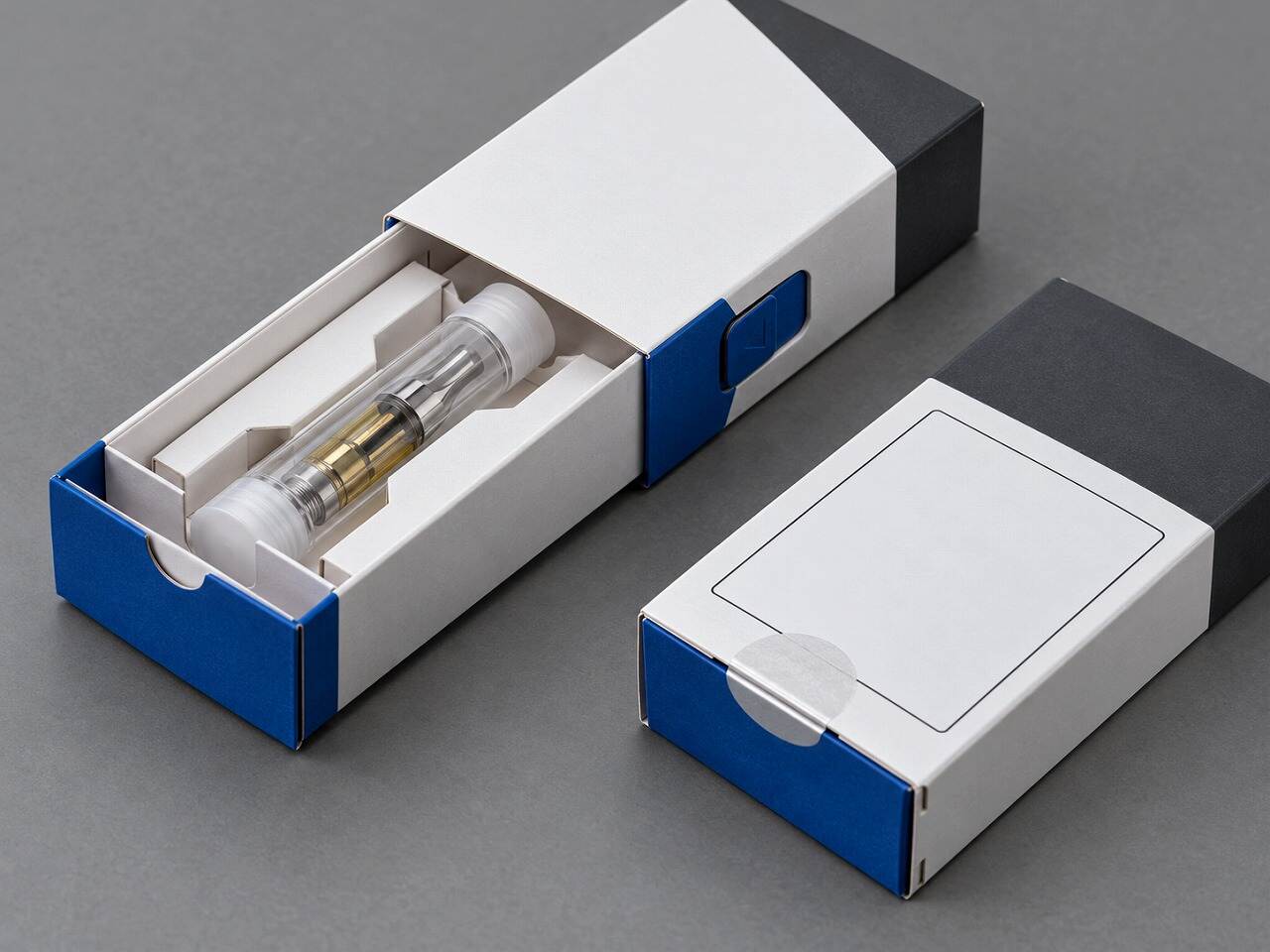
A two-step paper mechanism may be designed for testing, but its appearance alone is not evidence of child-resistant performance.
In the United States, the Child Nicotine Poisoning Prevention Act addresses liquid nicotine containers and points to the special-packaging requirements in 16 CFR 1700.15 and the test methods in 16 CFR 1700.20. That rule should not be paraphrased as “every vape cart outer carton must be CR.” The responsible party must determine whether the specific container and product are in scope and whether an outer carton forms part of the tested system. CPSC also explains certification obligations for products subject to its rules.
For U.S. covered tobacco products that contain nicotine, FDA’s current labeling page specifies the nicotine-addictiveness warning and formatting rules, including placement on the two principal display panels and a warning area comprising at least 30 percent of each panel. Small-package provisions and product-specific facts still require review. An empty cartridge component that is not made or derived from tobacco is not automatically treated the same as a pre-filled nicotine product.
Cannabis cartridge requirements vary by jurisdiction. State or national rules may address child resistance, opacity, tamper evidence, symbols, potency, batch data and universal warnings differently. Do not use a generic “U.S. compliant” artwork file. Give the converter counsel-approved copy for each SKU and market.
The dieline should separate permanent brand graphics from market-specific regulatory content. This reduces the risk of changing structural artwork when only a warning, batch field or jurisdictional panel changes. It also helps procurement compare costs for common components and late-stage variants.
A practical artwork map includes:
fixed structural zones: glue flaps, locks, thumb cuts, scores and no-print areas;
principal display panels: identified before regulatory copy is scaled;
mandatory information: supplied and approved by the brand’s compliance owner;
variable data: lot, batch, date, SKU, jurisdiction or track-and-trace fields;
print controls: Pantone references, overprint, minimum type, barcode quiet zones and finish masks;
revision identity: artwork code, version, approval date and market.
Do not place mandatory small text across a score, foil edge, emboss or high-glare varnish. A screen mock-up cannot show whether fine reverse type will fill in, whether a metallic surface will reduce contrast or whether a QR code will scan after folding. Review a physical printed proof under the intended lighting and at the final size.
GPLPAK’s role can include dieline preparation, print feasibility review and controlled pre-production samples through its 개발 샘플링 workflow. Legal copy and claims should arrive approved; the packaging file should not be used as the first place a regulatory team sees the wording.
Grammage alone does not define carton stiffness. State the board family, caliper or target stiffness where relevant, surface, fiber or certification requirement, color standard and allowable variation. A folding carton may use SBS/FBB-type paperboard; a rigid box usually combines wrapped greyboard with printed or dyed cover paper; a parcel shipper may require microflute corrugated board. The correct selection depends on span, box dimensions, insert load and route.
Select finishes deliberately. Matte aqueous coating can preserve foldability and reduce film use. Film lamination improves rub and moisture resistance but creates a mixed-material structure. Soft-touch surfaces can show scuffing on dark colors. Foil, emboss and spot gloss can support hierarchy, but they should not compete with warnings or variable data.
For the U.S. market, the FTC Green Guides explain why broad environmental claims need evidence and why recyclable claims can require qualification based on access to appropriate facilities. A paper box with a foam insert, plastic window, film laminate or hidden lock component should not be marketed as an all-paper package.
Approval should move through gates. A white structural sample answers fit and assembly questions. A printed sample answers color, text, finish and barcode questions. A pilot or production-intent pack answers repeatability questions. Combining all three into one rushed sample makes failure difficult to diagnose.
| Gate | What to check | Evidence | Release decision |
|---|---|---|---|
| 구조 | Fit range, removal, pack-out sequence, lock action | Signed sample and dimensional report | Freeze dieline and insert geometry |
| Graphics | Text, contrast, color, codes, finish registration | Approved proof and master artwork | Freeze version by market and SKU |
| Pack-out | Assembly time, orientation, damage and traceability | Pilot record with actual components | Approve work instruction |
| Distribution | Drop, vibration, compression and conditioning selected for route | Test plan, pre-set damage limits and report | Release packed system and shipper |
| Production | Critical, major and minor defects against agreed limits | Inspection record and retained samples | Ship, rework or hold |
Distribution testing must match how the product moves. ISTA distinguishes basic integrity screening, partial simulation and general simulation procedures. Selecting a procedure because its number is familiar is poor practice; first map parcel, case, pallet and environmental hazards. Define product-damage and package-damage acceptance criteria before the test starts.
Inspection sampling is also a buyer-supplier agreement. Do not write “AQL 2.5” as if it defines every defect. Establish critical defects separately—wrong warning version, mixed SKU, non-functioning lock or unreadable code may require zero acceptance—then define major and minor appearance defects, sampling basis and measurement method. GPLPAK’s 제조업그리고packing pages provide context for production and pack-out discussions.
A credible unit price cannot be published without dimensions, quantity, board, print coverage, finishes, insert, assembly state, test requirement, packing method and Incoterm. For that reason, fixed internet price ranges are not a reliable B2B benchmark. They often compare a flat folding carton with a finished rigid box or exclude tooling, packing and freight.
Normalize every quotation into the same cost model:
finished box and insert per approved construction;
one-time dies, plates, molds, gauges or development charges;
sampling, regulatory or performance testing paid to third parties;
assembly state, protective packing, units per master case and pallet configuration;
overrun/underrun allowance, payment terms and artwork revision limits;
Incoterm, origin, destination, freight, duty and tax exclusions;
sample and production timing measured from named approval milestones.
MOQ is a commercial result, not a universal capability number. Offset setup, die-cutting, hand assembly and insert tooling create different economic thresholds. A supplier may technically produce fewer units but quote a higher unit cost or a minimum run charge. Give the first-order quantity and a 12-month forecast so the supplier can propose digital, offset or component-sharing strategies honestly.
Product drawing and three representative samples; target markets and compliance brief; pack count and channel; box and insert preference; approved artwork status; order quantity and annual forecast; destination and Incoterm; required evidence; inspection standard; target launch date; written acceptance criteria.
A useful supplier does more than reproduce a reference photo. It identifies missing inputs, proposes a manufacturable insert, records approvals and tells the buyer when a requested change may affect fit, print or test evidence. Ask the same questions of every shortlisted converter.
Which component contains the product, and which component are you quoting?
What exact board, caliper, grain and insert specification will appear on the quotation?
How will you confirm the high- and low-limit cartridge or tube fit?
Which characteristics are critical to the lock, warning panel, barcode and pack-out?
If a CR report is offered, does the tested construction match the proposed production pack?
How are artwork revision, approved sample and production version linked?
What change requires buyer reapproval or renewed testing?
What is included in the case pack, export packing and Incoterm?
A quotation that omits dimensions, material construction or evidence scope is not comparable, even if the unit price is attractive. Conversely, a supplier should not be penalized for flagging a missing legal input. That is evidence of disciplined scope control. For project scoping, use GPLPAK’s contact page and include the RFQ file set above.
Send the finished cartridge or protective tube, target market, approved compliance brief, artwork status, quantity and distribution route. GPLPAK can respond with a paper-structure recommendation, insert concept and quotation scope for review.
Request a Packaging Review View Product DevelopmentRegulations and agency guidance can change. Confirm current requirements for the exact product and destination before approving artwork, claims or a test plan.
 핫 뉴스
2026-10-23
2026-10-16
2026-10-12
2026-10-07
2026-09-30
2026-09-23
2026-09-22
2026-09-21
2026-09-18
2026-09-17
Dongguan Xinglan Packaging Products Co., Ltd.의 프리미엄 포장 솔루션을 발견하십시오.
 영어
 EN
 RU
 ES
 KO
 JA
 PT
 IT
 DE
 FR
 NL