
 EN
 EN
 RU
 ES
 KO
 JA
 PT
 IT
 DE
 FR
 NL
Updated: October 31, 2026 | Reading time: 17 minutes
In brief: custom collapsible rigid boxes combine the presentation of a paper-wrapped rigid box with a flat-pack structure that is erected during pack-out. A successful project depends on more than magnets and board thickness: buyers must define the packed product, finished internal size, panel and hinge construction, corner-retention method, insert, artwork, assembly process, export packing and measurable acceptance criteria before comparing quotations.
For a B2B buyer, “collapsible,” “foldable” and “flat-pack” can describe several very different constructions. Some are genuine rigid-board presentation boxes; others are folding cartons or corrugated mailers using similar marketing language. That ambiguity creates avoidable problems: a beautiful quotation may be based on the wrong structure, a flat sample may not square correctly, or an insert may fit the product but prevent the box from collapsing.
This guide explains how to source custom collapsible rigid boxes as an engineered packaging system. It covers structure, landed-cost analysis, materials, print, inserts, sampling, quality control and supplier qualification. The objective is not to prescribe one universal specification. It is to help brand owners, importers, distributors and contract packers create a comparable RFQ and approve a box that works in production.
1. What Custom Collapsible Rigid Boxes Are—and Are Not
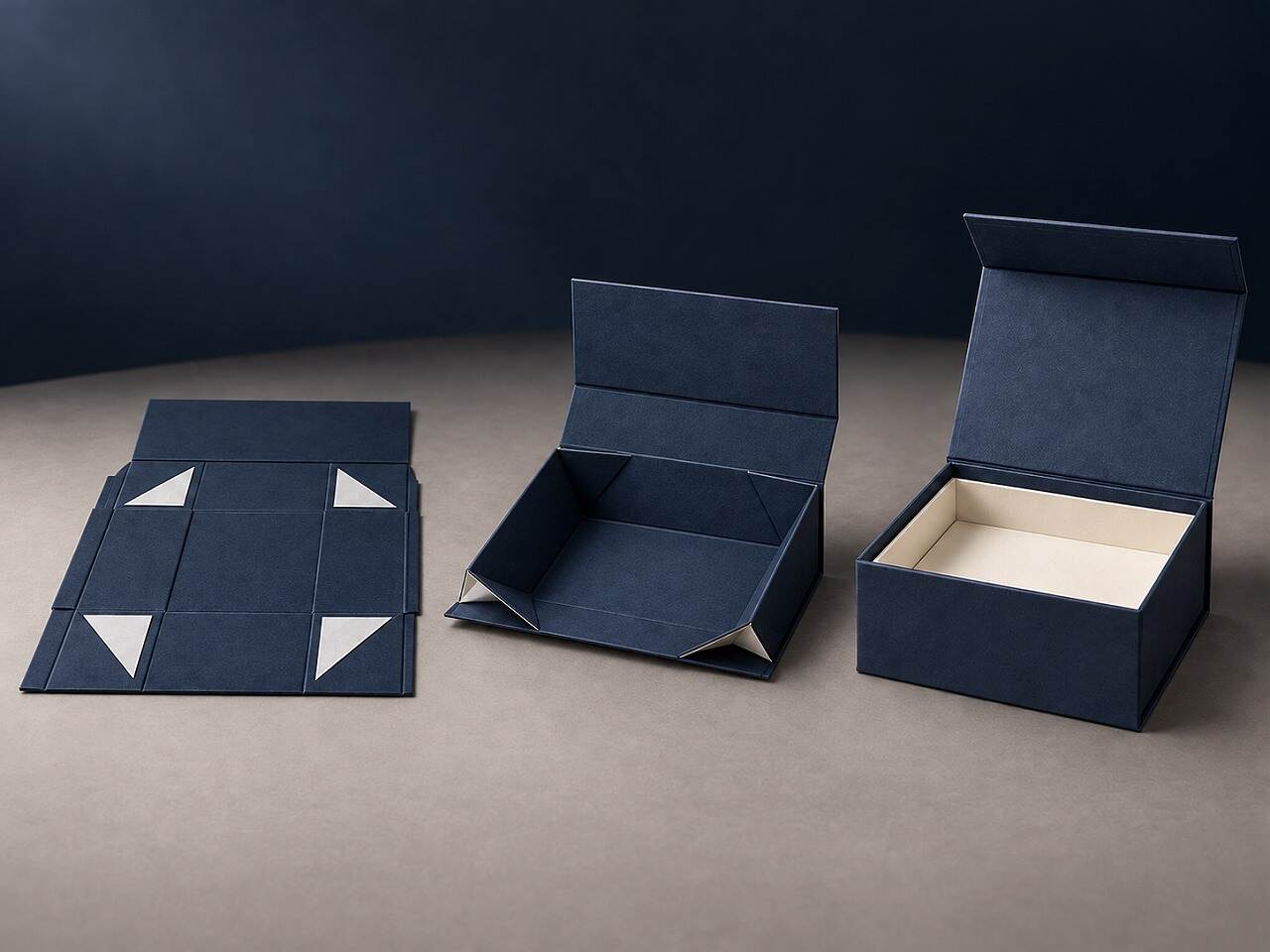
A collapsible rigid box is normally a secondary or presentation package made from separate rigid greyboard panels wrapped with printed or specialty paper. The panel arrangement allows the body to lie flat for packing and logistics, then form a squared box at the filling site. A magnetic flap is common, but magnets alone do not make the box collapsible. The design also needs a repeatable way to hold its corners after erection.
In a properly engineered structure, thick greyboard is not “creased” like a folding carton. Individual rigid panels are positioned with controlled gaps, and the wrap or inner liner bridges those gaps to create flexible hinges. The gap width, paper grain, adhesive coverage and wrapping method determine whether the hinge folds cleanly or cracks after repeated cycling.
| Format | Primary construction | Best use | Main limitation |
|---|---|---|---|
| Collapsible rigid box | Separate wrapped greyboard panels with flexible hinge gaps | Premium gift sets, ecommerce presentation and retail kits where flat supply has value | Requires controlled erection and more complex structural development |
| Fixed rigid box | Pre-formed wrapped greyboard base and lid | High presentation consistency and fast pack-out | Consumes more cube before filling |
| Folding carton | Creased paperboard blank | Lightweight retail packaging and high-speed packing | Does not provide the same rigid-wall feel |
| Corrugated mailer | Die-cut corrugated board | Parcel handling and ecommerce shipment | Different presentation, print and edge profile |
Use the phrase opvouwbare stijve doosofcollapsible magnetic gift box as a search synonym, but define the actual construction in the RFQ. Buyers comparing a flat-pack luxury box with a fixed Stijve doos, Eenmagnetic closure boxOf eenfolding carton should not assume that the same dimensions, board callout or unit price describe an equivalent package.
2. Build the Business Case: Cube, Assembly and Landed Cost
The strongest reason to choose a collapsible structure is not a generic promise of “lower freight.” It is a verified reduction in packed cube that exceeds any added cost for assembly, adhesive handling, inserts, rejects and process control. The answer depends on the finished size, how efficiently flat blanks nest, export-carton limits, pallet pattern, shipping mode and the labor rate at the packing location.
Useful comparison: landed packaging cost = box price + allocated sampling/tooling + inbound freight and duty + storage + pack-out labor + expected rework or damage. Compare this total with the fixed rigid alternative using the same destination, order quantity and acceptance criteria.
Ask each supplier for the flat packed dimensions, units per export carton, gross carton weight, export-carton dimensions and proposed palletization. Then run a short assembly trial with the same operators who will pack the product. Record median assembly time, not the fastest demonstration. Include time to peel release liners, square the walls, load the insert, inspect the closure and handle waste.
| Decision input | Evidence to request | Why it changes the result |
|---|---|---|
| Transport cube | Export-carton pack count and measured outer dimensions | Flatness is only valuable if it improves actual carton or pallet utilization |
| Assembly labor | Timed pilot with representative operators and quantity | Complex corner systems can consume the freight saving |
| Damage and rework | Pilot reject rate, hinge checks and closure inspection | Small geometry errors can affect squareness and lid alignment |
| Storage | Flat stock footprint and environmental controls | Wrapped boards can warp under poor humidity or stacking conditions |
A fixed rigid box may still be the better choice when pack-out speed, automatic loading, very tight tolerances or low local labor content matters more than inbound cube. A collapsible format earns its place when the total system—not one freight line—performs better.
3. Choose the Right Collapsible Structure
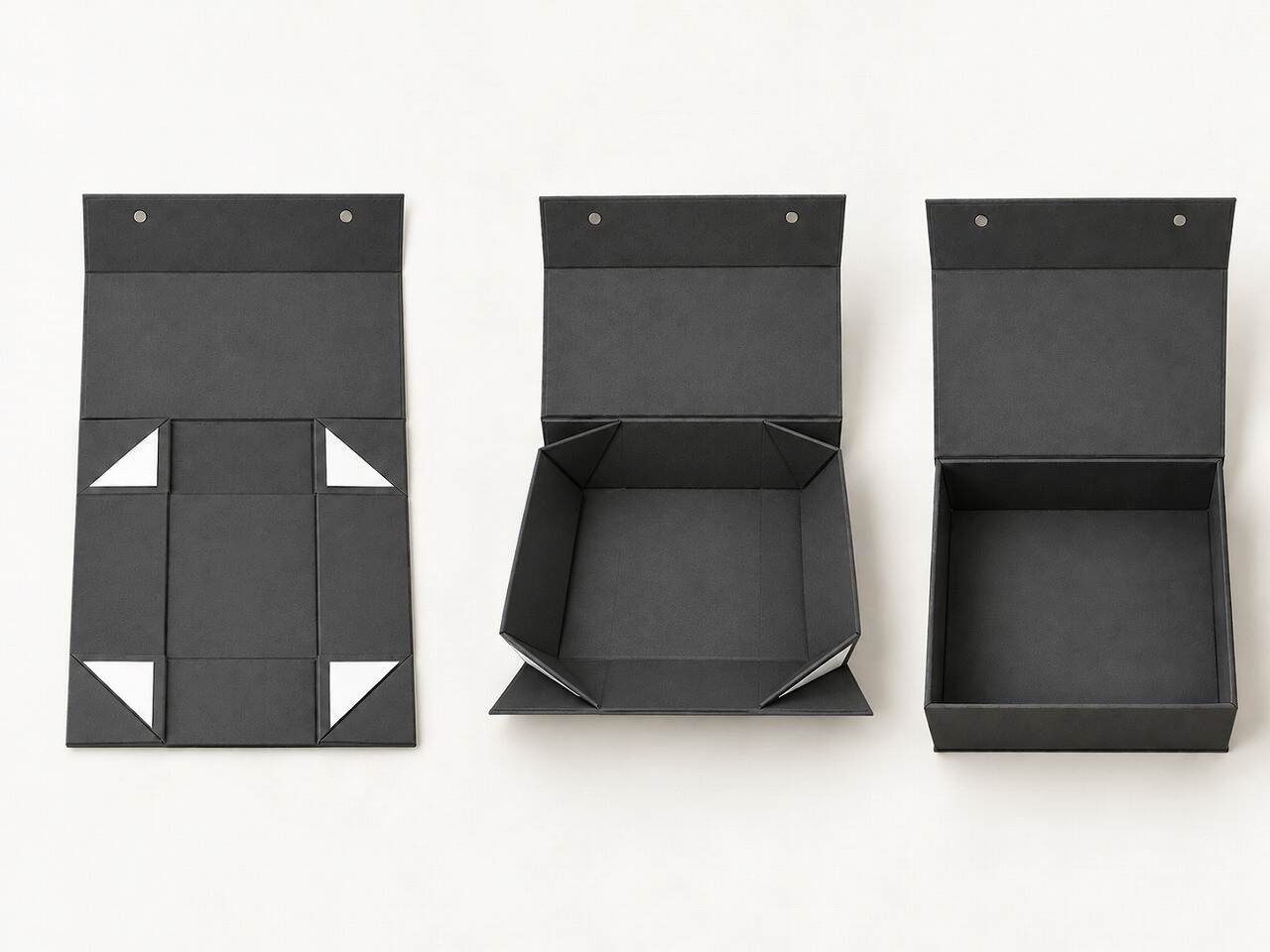
A flat-pack structure must control both the flexible panel hinges and the method that holds the erected corners.
Most sourcing problems begin when a buyer selects “magnetic box” without specifying what the magnets do. Magnets in the lid flap close the package. They do not necessarily retain the four body corners. Corner retention may use pre-applied pressure-sensitive adhesive, concealed magnetic patches, hook-and-loop components, locking tabs or a supplier-specific hybrid design.
Common corner-retention choices
Pre-applied adhesive strips: clean exterior and strong permanent erection, but the body is generally not intended to collapse again after assembly. Specify release-liner removal, adhesive shelf life and the pressure required during pack-out.
Concealed magnetic corners: reusable and quick to erect, but magnet count, polarity, position and total material composition require control. Confirm whether the corners remain square with the packed product loaded.
Hook-and-loop retention: reusable and tolerant of repeated opening, though the attachment can add thickness or sound and may not suit every luxury aesthetic.
Mechanical locking tabs: avoids adhesive activation, but can expose slots or stress the wrap if tolerances are poor.
Also decide whether the lid is a hinged book-style panel, a separate lid, or a wrap-around flap. A hinged magnetic lid is familiar for luxury gift sets, but it affects the flat blank size, magnet alignment and available print zones. For heavy products, large formats or deep boxes, ask the structural developer to evaluate wall bowing and corner peel rather than simply increasing magnet strength.
4. Specify Dimensions, Greyboard and Hinge Gaps
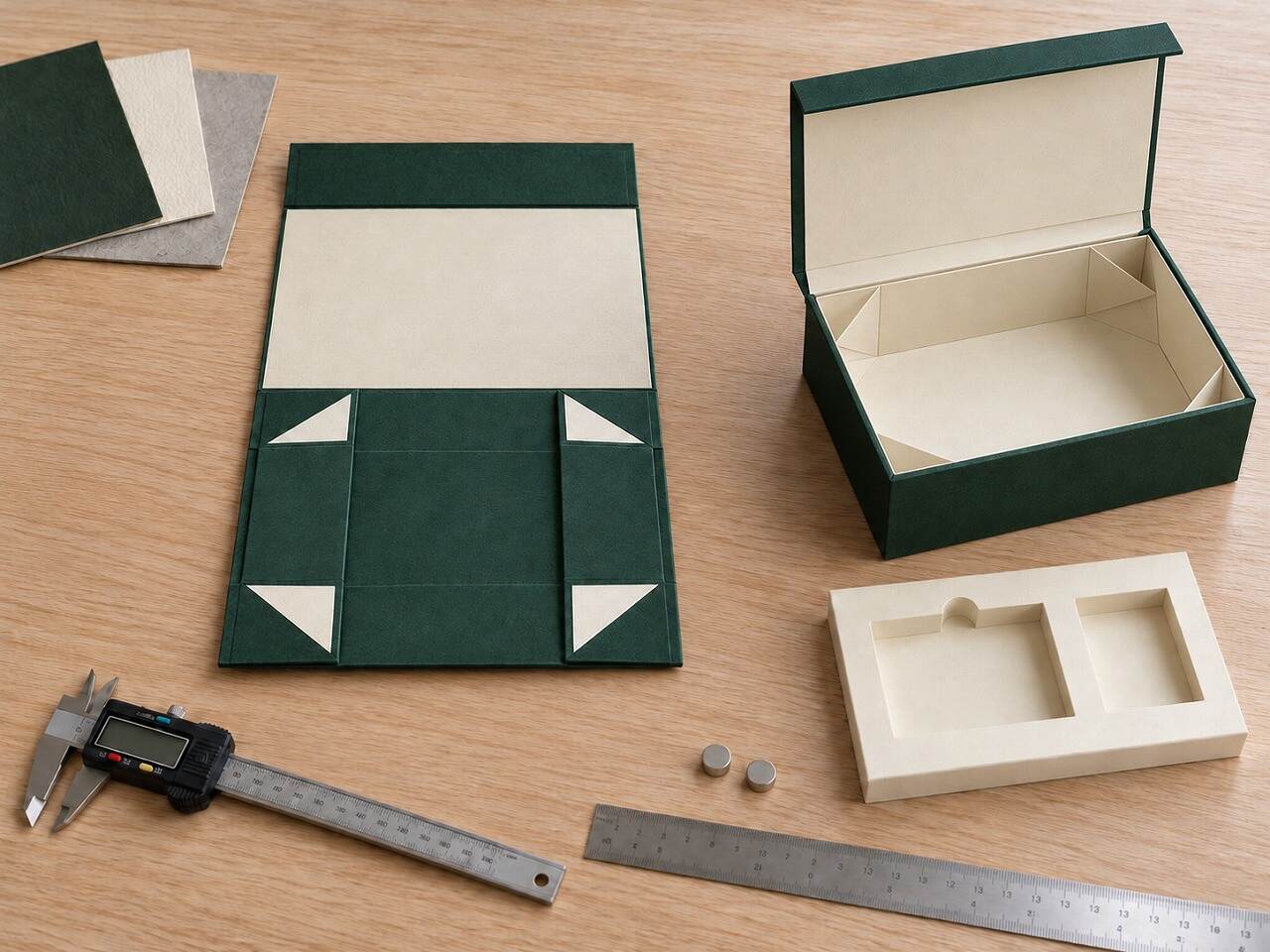
Rigid-board caliper matters, but panel layout, hinge clearance, wrap paper and the finished product envelope determine whether the box folds and squares correctly.
Start with the maximum physical envelope of the packed product, not the marketing size. Provide product samples or controlled drawings that include projections, closures, accessories and permitted orientation. If an insert is used, the internal box dimensions must be derived from the insert and clearance plan—not chosen independently.
Greyboard should be specified by an agreed measurable property such as finished caliper and acceptable tolerance, together with the approved sample. Density, moisture and recycled content can change stiffness even at the same nominal thickness. Avoid treating a single board number as a performance guarantee.
| Element | What to define | What to inspect |
|---|---|---|
| Finished size | Internal length × width × depth and measurement method | Fit, lid clearance, squareness and insert seating |
| Rigid panels | Caliper, approved board sample, tolerance and grain considerations | Stiffness, bow, edge quality and consistency |
| Hinge gaps | Gap location and approved folded sample | Free movement, no paper fracture, no exposed adhesive |
| Wrap and liner | Paper code, color, surface treatment and adhesive compatibility | Scuffing, bubbling, lift, cracking and shade variation |
| Flat-pack stack | Stack height, orientation, separators and carton count | Compression marks, warp and corner damage after storage |
A controlled hinge trial is especially important when using laminated, metallized, heavily coated or dark solid-color papers. The supplier should fold and cycle the printed construction, not just an unprinted white sample. Paper grain and ink coverage can make a design that looks correct on screen behave differently at the hinge.
5. Engineer Closures, Corner Retention and Inserts as One System
The closure, body and insert interact. A tall insert can push against the lid. A heavy product can spread the side walls. A ribbon pull can sit under the magnet and weaken closure contact. Treat these components as one assembly and approve them with the actual packed weight.
For magnets, define placement and orientation on the approved drawing, then evaluate the finished opening feel. More magnetic force is not automatically better: excessive pull can strain wrapped edges or make a large flap snap shut. Small magnets should be securely encapsulated within the construction and controlled during production. If magnets are unsuitable for the distribution or recovery plan, ask about ribbon ties, tabs or mechanical closures.
Insert selection should follow the product's protection, presentation and material requirements:
Folded paperboard: clean printed presentation and favorable material simplicity, suitable when geometry and weight allow.
Corrugated or honeycomb board: stronger paper-based support for larger or heavier products, but usually with a more visible edge profile.
Molded pulp: useful for repeatable cavities and a fiber-based story; approve surface finish, dust and dimensional tolerance.
EVA or PU foam: precise retention and premium feel for appropriate products; confirm density, odor, color transfer and recovery implications.
Thermoformed trays: accurate nests and visibility options; material choice and local recycling access must be considered.
Do not approve the insert from a CAD outline alone. Use a physical fit sample with the production product or a controlled equivalent. Check removal force, finger access, label abrasion, accessory movement and whether the insert can be loaded consistently at the planned packing rate.
6. Plan Printing, Wrapping and Surface Finishes
A collapsible box has more hinge lines, wrapped edges and moving surfaces than a conventional fixed box, so artwork needs structural awareness. Ask for a production dieline that marks visible panels, hidden glue zones, hinge gaps, magnet areas, wrap turns and critical registration zones. Do not place tiny type, foil edges or strict geometric alignment directly across an active hinge unless the printed prototype proves it works.
Offset printing is common for controlled brand color and fine imagery on coated or uncoated wrap paper. Specialty papers can be foil stamped, embossed or debossed, but their texture affects detail. Spot UV and film lamination may increase contrast or resistance, yet a brittle surface can show whitening or cracking where the box flexes. Request a folded production-material proof for dark solids and high-build finishes.
| Finish | Approval focus | Typical risk at folding areas |
|---|---|---|
| Folie stempelen | Registration, coverage, pinholes and edge definition | Foil fracture or visual misalignment across gaps |
| Relief/deboss | Depth, reverse-side show-through and panel position | Board distortion if too close to an edge or hinge |
| Matte lamination | Bond, rub resistance, fingerprinting and fold trial | Whitening, lifting or cracked film |
| Uncoated specialty paper | Shade, scuffing, fiber texture and glue response | Surface burnishing or exposed white fibers |
Color approval should identify the target, viewing condition and acceptable variation. A screen preview cannot replace an agreed physical standard. When coordinating multiple components—box, insert, sleeve, ribbon and shipping carton—define which element is the master color reference.
7. Run a Fit Sample and Approval Workflow
A useful sampling process answers one group of questions at a time. Jumping directly to a fully decorated sample can hide a structural issue behind attractive finishing. GPLPAK's product development, design validationenontwikkelingsmonsterning pages describe the corresponding project stages; the exact sequence should still be defined in the quotation.
Requirements review: confirm product samples or drawings, quantity, destination, packing method, artwork, insert, distribution route and written acceptance criteria.
White structural sample: verify internal fit, panel layout, hinge movement, corner retention, closure alignment and assembly sequence without decorative distraction.
Printed prototype: evaluate color, finish, wrapped edges, hinge behavior and visual alignment on the intended materials.
Packing trial: time erection and loading with representative operators, products and accessories. Record instructions and recurring errors.
Pre-production approval: lock the signed sample, drawing, bill of materials, artwork revision, defect criteria and packing configuration used for production.
Change control matters after approval. A board substitution, paper lot, adhesive, magnet position or insert tolerance can affect assembly even if the exterior artwork is unchanged. Define which changes require written buyer approval and whether a new sample is needed.
8. Define Quality Control and Distribution Validation
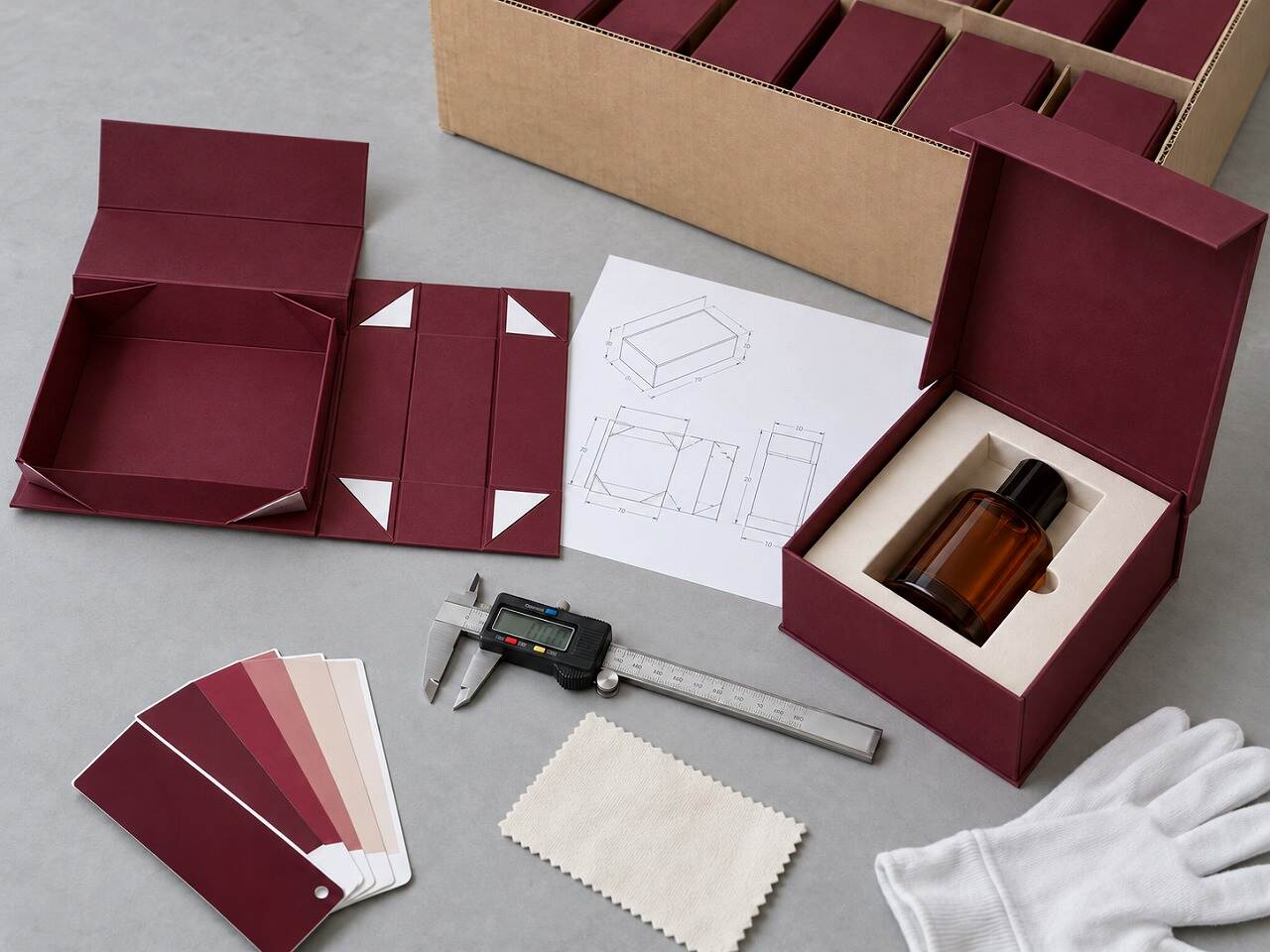
Approve both the presentation box and its export packing: dimensional drawings, product fit, color standard and packed-carton configuration should agree.
Replace subjective statements such as “good quality” with measurable checks and an agreed inspection plan. Critical defects may include exposed adhesive, detached magnets, a box that cannot be erected, severe hinge fracture, incorrect artwork or an insert that damages the product. Major and minor classifications should be agreed for the project rather than copied from a generic checklist.
Finished internal and external dimensions using a stated measurement method.
Squareness, wall alignment, lid gap and front-flap contact after erection.
Corner-retention integrity and closure function after repeated assembly cycles appropriate to the intended use.
Wrap adhesion, clean mitres, edge turns, hinge cracking, scuffing and color consistency.
Foil, emboss, print and insert registration against approved limits.
Product fit, removal, accessory control and loaded-box stability.
Flat-pack count, separators, moisture protection, export-carton strength and pallet arrangement.
A luxury presentation box is not automatically a parcel shipper. If it will travel through courier, ecommerce or pallet networks, develop the outer protective packaging and validate the complete packed system for the actual route. The International Safe Transit Association explains that testing should be selected around the distribution environment and package design objectives. Do not claim an “ISTA-certified box” merely because one drop was performed; document the procedure, sample count, conditioning, payload, configuration and result.
9. Compare MOQ, Price and Lead-Time Drivers
There is no reliable universal MOQ, unit price or lead time for custom collapsible rigid boxes. Quotations change with finished size, panel count, board and paper, number of print colors, finishes, magnet count, insert complexity, quantity by SKU, sample level, packing method, destination and current production capacity. Treat any generic online price as a starting point, not a budget approval.
For a fair comparison, ask suppliers to quote the same specification and separate non-recurring costs from unit costs. The quotation should state:
Quantity and price by SKU, with the currency and validity period.
Included material specification, finishes, insert and packing method.
Sampling, tooling, plates, dies or other one-time charges.
Flat-pack units per export carton, carton dimensions and estimated gross weight.
Production timing measured from a defined approval and payment milestone.
Incoterm, named place, excluded taxes or duties, and shipment assumptions.
Inspection standard, tolerances, sample retention and remedy for nonconforming goods.
When several designs share the same size, ask whether artwork versions can be combined without changing construction or finish setup. Do not assume quantities can be pooled across sizes, colors or inserts. A supplier may need a minimum run per version because printing, wrapping and assembly are scheduled separately.
10. Supplier Qualification, PPWR Boundaries and a Decision-Ready RFQ
Evaluate a manufacturer on its ability to control the entire structure, not only produce an attractive sample. Useful evidence includes relevant collapsible-box samples, documented material control, structural-development capability, inspection records, export packing plans and a clear process for artwork and change approval. GPLPAK provides overviews of its manufacturing, packingenfactory capabilities; request project-specific evidence for any certification, performance or capacity requirement that matters to your purchase.
For products sold into the European Union, avoid reducing the Packaging and Packaging Waste Regulation to a single “50% empty space” slogan. Regulation (EU) 2025/40 includes packaging-minimization requirements and a maximum empty-space ratio for grouped, transport and ecommerce packaging under Article 24, with application timing and measurement details. Sales packaging is addressed through minimization requirements rather than being automatically treated as the same 50% calculation. Confirm the role of each packaging layer and obtain current legal advice for the target market.
Likewise, do not use “recyclable,” “plastic-free,” “FSC-certified” or similar language without supporting evidence for the actual bill of materials and chain of custody. Magnets, films, foams, adhesives and mixed inserts can affect recovery pathways. Request current documentation, define the claim market, and assess whether components can be separated in practice.
Information that belongs in the RFQ
Product sample or controlled drawing, maximum dimensions, packed weight and orientation.
Required internal size or permission for the supplier to derive it from the approved insert.
Box style, lid style, corner-retention method, magnet or alternative closure and reuse expectation.
Board, wrap, liner, print, finish, insert and accessories—or clearly stated performance requirements where the supplier should propose materials.
Quantity by size and artwork version, order pattern and target destination.
Whether boxes arrive flat or erected, the planned assembly station and pack-out method.
Distribution route, outer shipper, palletization and required validation procedure.
Artwork files, brand-color standard, approval stages, tolerances and defect classification.
Send the product dimensions or sample, desired structure, artwork, quantity, destination and acceptance criteria. GPLPAK can review the information gaps before a fit sample is developed.
Request Packaging Consultation Send Your RFQ11. Frequently Asked Questions
What is a custom collapsible rigid box?
It is a paper-wrapped presentation box built from rigid greyboard panels that can lie flat before pack-out and form a squared box when erected. The rigid panels are connected by flexible wrapped hinge gaps, while a separate corner-retention system holds the body in shape.
Are collapsible rigid boxes as strong as fixed rigid boxes?
Not by definition. Strength depends on size, board properties, panel layout, hinge construction, corner retention, insert, payload and outer shipping protection. Compare approved samples under the same loaded condition and distribution route instead of assuming equal performance from board thickness alone.
Do all collapsible magnetic boxes use adhesive corners?
No. Pre-applied adhesive is common, but reusable magnetic corners, hook-and-loop components and mechanical locking tabs are also used. Lid magnets and corner retention perform different jobs and should be specified separately.
What information is needed to quote a foldable rigid box?
Provide the product sample or dimensions, packed weight, intended box style, insert, materials or performance requirements, artwork, finish, quantity per SKU, destination, pack-out method, distribution route and written approval criteria. Missing information should be listed as assumptions in the quotation.
What is the typical MOQ for custom collapsible rigid boxes?
MOQ is project-specific. It changes with box size, materials, artwork versions, finishing processes, insert and production setup. Ask for a current written quote rather than relying on a generic number from another design.
How should a buyer approve the hinge construction?
Approve a physical sample made with the intended board, wrap and finish. Check that the panel gaps fold freely, the surface does not crack or lift, the erected box squares correctly and the construction remains acceptable after the number of assembly cycles relevant to use.
Can a collapsible rigid box be used as an ecommerce shipper?
Usually it should be treated as presentation packaging unless the complete loaded system has been designed and validated for the parcel route. A separate corrugated shipper, cushioning and void control may still be required.
Are collapsible rigid boxes recyclable?
That depends on the complete material combination and the collection and recycling system in the destination market. Paper-based panels can be favorable, but magnets, films, foams, fabrics and adhesives may complicate recovery. Review the actual bill of materials and substantiate any environmental claim.








 Populair nieuws

