
 EM
EM  EN
EN  RU
RU  ES
ES  KO
KO  JA
JA  PT
PT  IT
IT  DE
DE  FR
FR  NL
NL Links Rápidos
A peptide vial packaging box is more than a container-it is a engineered system designed to protect delicate glass vials, communicate brand quality, and satisfy regulatory requirements across global markets. This guide covers everything you need to know about materials, sizing, structural design, and cost optimization for peptide vial boxes.
Whether you are launching a new peptide product or upgrading your current packaging, understanding the relationship between material choices, dimensional specifications, and cost drivers will help you make smarter procurement decisions and avoid expensive mistakes.
Peptide vials come in standardized sizes. Knowing these dimensions is the first step in designing a box that fits perfectly. Below are the most common peptide vial sizes used by brands worldwide:
| Vial Capacity | Height (mm) | Diameter (mm) | Typical Box ID (mm) | Typical Use |
|---|---|---|---|---|
| 2ml | 32 | 16 | 36 x 20 x 38 | Single-peptide vials, starter kits |
| 5ml | 40 | 22 | 44 x 26 x 46 | Standard peptide vials |
| 10ml | 48 | 24 | 52 x 28 x 54 | Multi-dose vials |
| 15ml | 55 | 28 | 60 x 32 x 62 | Clinical / bulk vials |
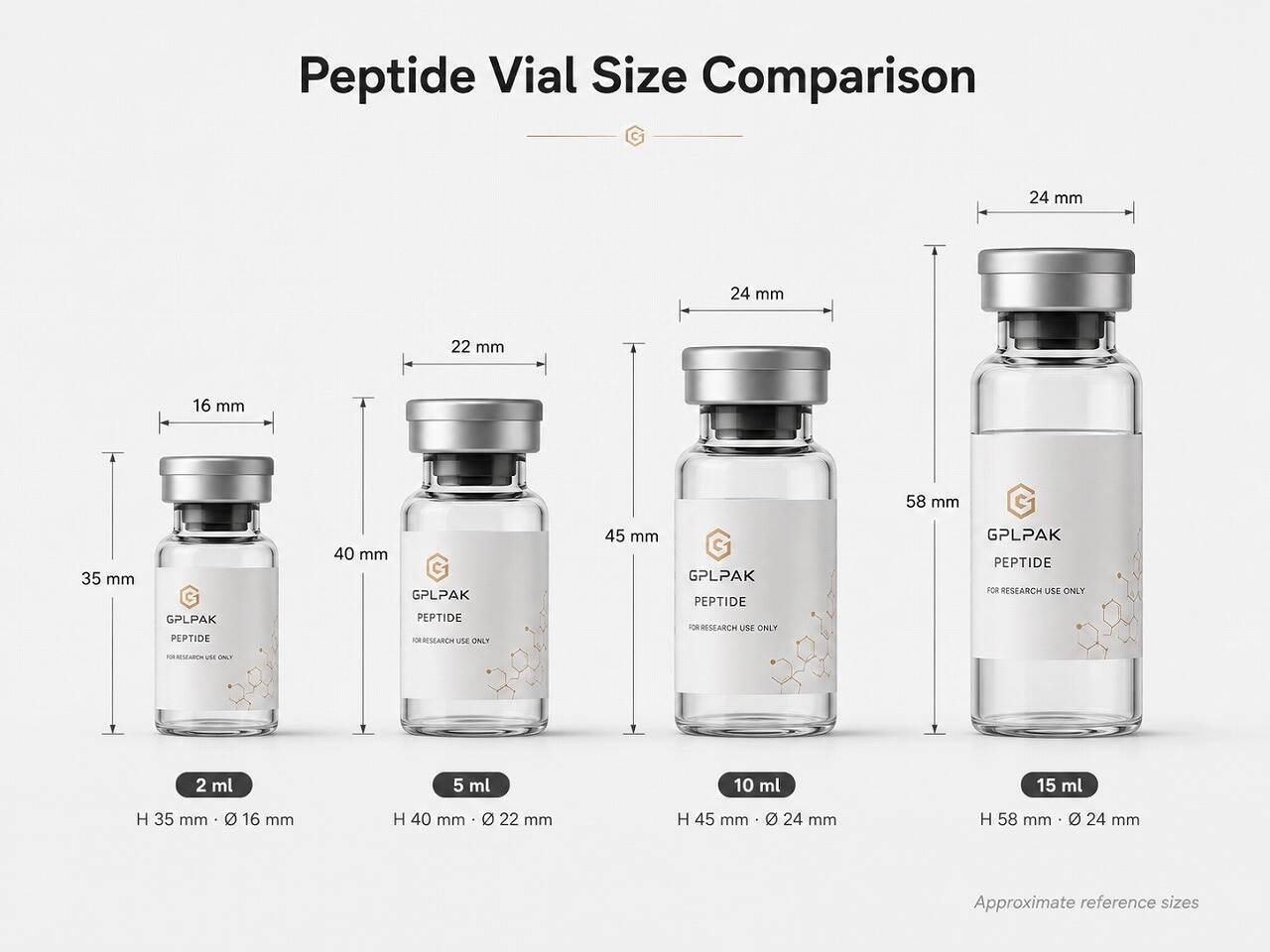
Once you know your vial dimensions, calculating the correct box size requires adding clearance for the insert material and protective padding. The standard formula used by GPLPAK is:
💡 Box ID Calculation: Vial Height + 4-6mm (top clearance) + Insert thickness (3-5mm) = Box inner height. Vial Diameter + 4-6mm (side clearance) x 2 + Insert thickness = Box inner width.
For a 5ml vial (40mm height, 22mm diameter) with a 4mm EVA insert:
Inner height: 40 + 5 (top) + 4 (bottom insert) = 49mm
Inner width: 22 + 5 (left) + 5 (right) + 4 (insert wall) x 2 = 40mm
Inner depth: single vial = 22 + 10 = 32mm / multi-vial = (22 + 10) x N
The outer box dimensions will add 2-3mm for the board thickness (rigid box) or 0.5-1mm (folding carton).
The material you choose for your peptide vial box directly impacts protection, brand perception, and unit cost. Here is how the most common options compare:
| Material | Melhor para | Proteção | Brand Feel | Min. MOQ | Cost Index |
|---|---|---|---|---|---|
| Rigid (Grey Board) | Premium single/multi kits | ⭐⭐⭐⭐⭐ | ⭐⭐⭐⭐⭐ | 500 peças | 100 (baseline) |
| Caixa dobrável | Volume production, retail | ⭐⭐⭐ | ⭐⭐⭐ | 200 pcs | 50-65 |
| Corrugated Sleeve | Shipping / multi-packs | ⭐⭐⭐⭐⭐ | ⭐⭐ | 100 pcs | 30-40 |
| EVA espuma inserir | Precision vial fixation | ⭐⭐⭐⭐⭐ | ⭐⭐⭐⭐ | 500 peças | +15-25 (add-on) |
⚠️ Important: The material choice affects not just cost but also shipping weight and customs classification. Rigid boxes incur higher freight costs due to weight and volume. GPLPAK offers free material consultation to help you select the optimal balance for your target market.
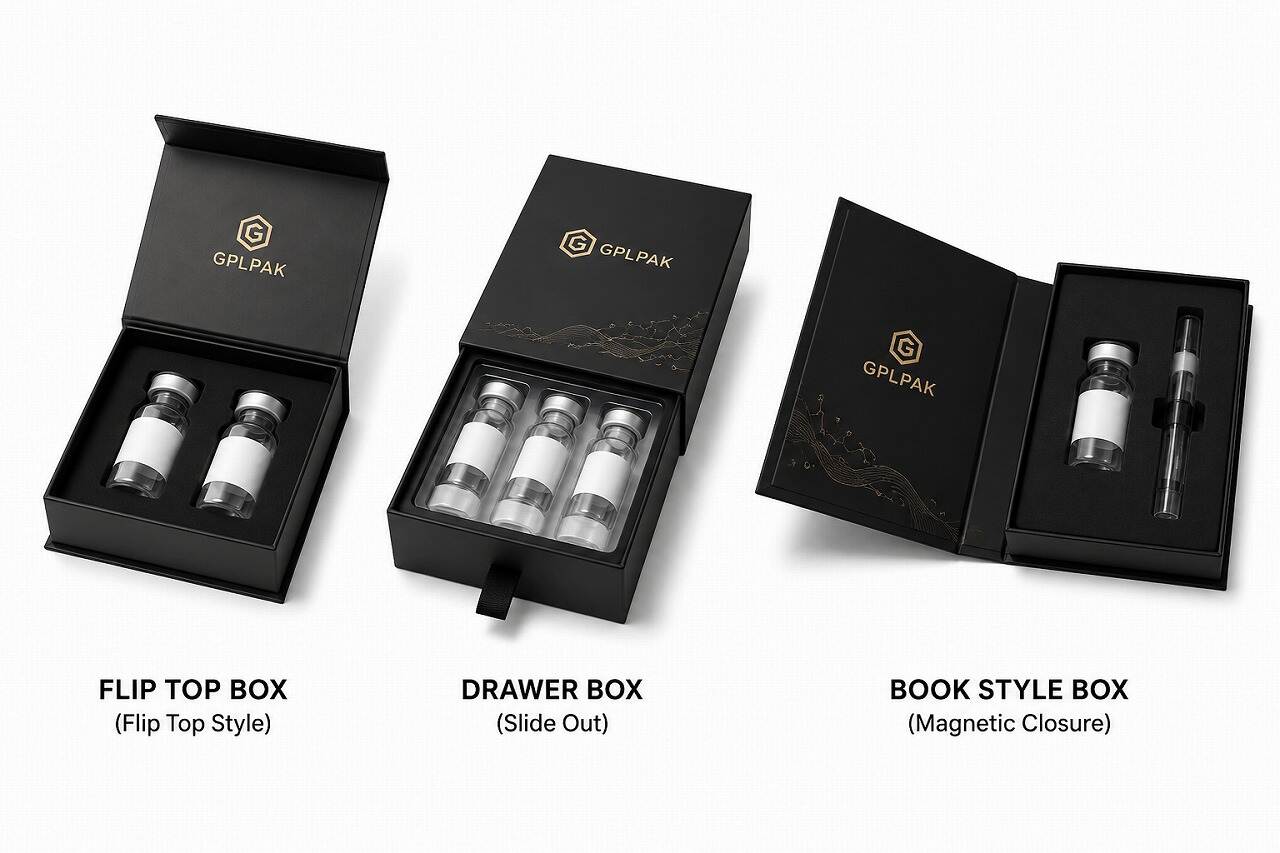
Three box structures dominate the peptide packaging space. Each offers distinct advantages depending on your product format, price point, and brand positioning:
The gold standard for peptide vial packaging. Neodymium magnets embedded in the lid and base create a satisfying, silent close. Ideal for 2-6 vial kits. GPLPAK uses high-density magnets rated for 10,000+ open-close cycles.
→ Related: Lid and Base Boxes
Inner tray slides out from a printed sleeve. Excellent for multi-compartment layouts where vials need to be displayed alongside pens, alcohol swabs, or instruction cards. Slightly higher cost than flip-top due to the sleeve construction.
Opens like a premium hardcover book. The interior pages can carry brand storytelling, clinical references, or usage instructions. Best suited for ultra-premium or limited-edition peptide product lines.
The surface finish of your peptide vial box is where brand identity meets tactile experience. Choosing the right combination of printing and finishing techniques can elevate perceived value significantly:
| Technique | Effect | Cost Impact | Melhor para |
|---|---|---|---|
| Estampagem a quente | Metallic shine, premium look | Medium | Logo, brand name, decorative borders |
| Gravação/Debossing | Raised or recessed texture | Medium | Logo, product name, tactile branding |
| Spot UV | Glossy highlight on matte surface | Baixo | Highlights, patterns, text accents |
| Laminação do Macio-toque | Velvety smooth, fingerprint-resistant | Low-Medium | Premium rigid boxes, luxury feel |
Understanding where your budget goes allows you to optimize without sacrificing quality. Below is a typical cost breakdown for a standard rigid magnetic flip-top peptide vial box (single 5ml vial, 1,000-unit order from China):
| Component | % of Total Cost | Cost per Unit (USD) |
|---|---|---|
| Grey Board + Wrapping Paper | 35-40% | $0.35 - $0.50 |
| EVA Foam Insert (CNC cut) | 15-20% | $0.15 - $0.25 |
| Printing and Surface Finish | 15-25% | $0.15 - $0.30 |
| Magnets + Hardware | 5-8% | $0.05 - $0.10 |
| Assembly and QC | 10-15% | $0.10 - $0.18 |
📌 Cost-saving tip: Ordering 3,000+ units typically reduces per-unit cost by 15-25% compared to 1,000-unit orders. Combining multiple vial size boxes in one production run also reduces tooling and setup costs.
Based on hundreds of peptide packaging projects delivered by GPLPAK, here are the most impactful design recommendations:
Always add 0.5-1mm clearance around the vial for easy insertion and removal. A too-tight fit causes frustration and potential glass damage.
Design the insert in layers - a top layer with vial cutouts and a bottom padding layer. This provides superior shock absorption compared to single-layer designs.
Include a label window or recessed area on the box exterior for product labels, batch numbers, and expiry dates without printing entire boxes for each batch.
Consider the unboxing motion - the most satisfying peptide box opens with the lid hinging away from the user, revealing all vials at once without any reaching.
Optimize box dimensions for shipping - a box that perfectly fits six vials may not fit standard shipping carton dimensions efficiently. Check carton utilization early.
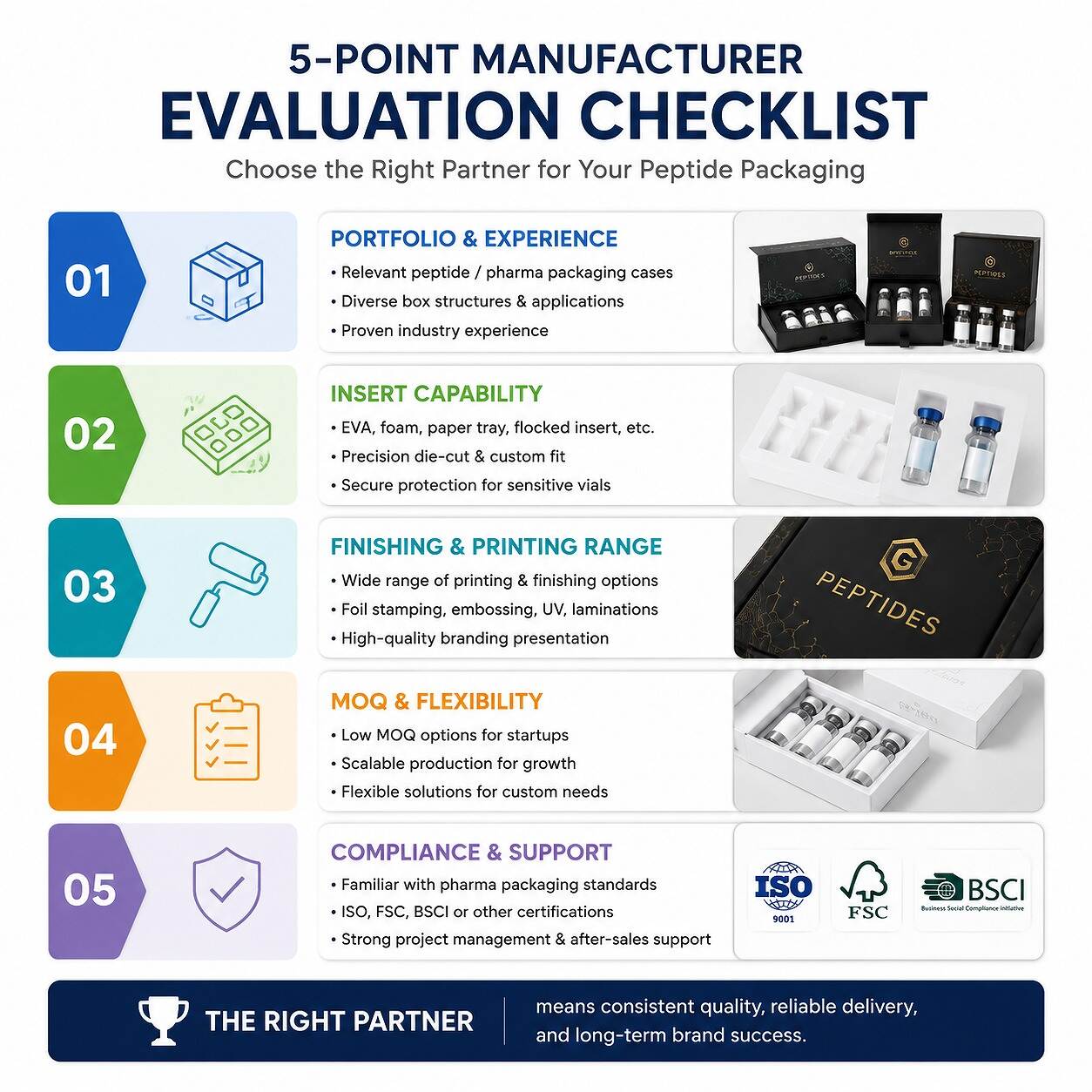
Not all packaging manufacturers have experience with peptide vial boxes. Here is a quick checklist to evaluate suppliers:
Portfolio: Ask to see similar peptide vial box projects. Check edge precision, insert fit, and magnetic alignment.
Insert capabilities: Does the supplier offer CNC-cut EVA, die-cut foam, or molded pulp inserts? CNC provides the tightest tolerances.
Finishing range: Can they handle foil stamping, embossing, and spot UV in-house? In-house finishing reduces lead time and cost.
MOQ flexibility: If you are testing a new product, look for suppliers offering low-MOQ sampling (500 pieces or fewer).
Compliance support: Do they understand FDA, REACH, and FSC requirements for peptide packaging?
With 15+ years of experience crafting custom peptide packaging for brands in 30+ countries, GPLPAK delivers precise, beautiful vial boxes that protect your product and elevate your brand.
© 2026 GPLPAK - China's Professional Custom Packaging Manufacturer
 Notícias quentes
2026-10-07
2026-09-30
2026-09-23
2026-09-22
2026-09-21
2026-09-18
2026-09-17
2026-09-17
2026-09-16
2026-09-09
Discover premium packaging solutions from Dongguan Xinglan Packaging Products Co., Ltd. Specializing in innovative, durable, and custom packaging products for diverse industries.
A GPLPAK está comprometida com a excelência na manufatura.

.jpg)