 АНГЛИЙСКИЙ
 EN
 RU
 ES
 KO
 JA
 PT
 IT
 DE
 FR
 NL
Быстрые ссылки
In brief: a credible quote for custom collapsible rigid boxes wholesale cannot be reduced to one universal MOQ, unit price or lead time. The supplier needs the erected internal size, folded footprint, panel and hinge construction, corner-lock method, wrap and printing, insert, quantity by SKU, export packing and named trade rule. Compare quotes only after those inputs match, then add pack-out labor, freight, storage and quality risk to the unit price.
Wholesale buying is not simply “the same box at a lower price.” A collapsible rigid box carries engineering work — panel layout, hinge gaps, corner retention, closure and insert development — that does not disappear when volume rises. What changes with quantity is how efficiently that fixed work and the material yield are spread across each unit.
This guide separates the three commercial inputs buyers ask about first: minimum order quantity, production lead time and unit cost. It explains what actually drives each one, shows which assumptions belong in a quotation, and finishes with an RFQ structure that lets several suppliers quote the same scope.
Published price bands are rarely transferable from one project to another. A shallow apparel box, a cosmetics set with a fitted insert and a heavy bottle presentation box may all use a fold-flat rigid construction, yet their panel area, board, pack-out labor and export packing are different. Use the table below to make suppliers quote the same deliverable.
| Buying question | What the supplier must state | What changes it most |
|---|---|---|
| Minimum order quantity | Minimum per size, artwork and colorway; whether quantities can be pooled across SKUs | Print method, special paper, tooling and insert type |
| Unit price | Finished-box price at named quantity and trade rule, with insert and packing inclusions listed | Size, board grade, finishing, insert and order volume |
| Production lead time | Milestone dates after structure, artwork, materials and printed sample are approved | Finishing steps, insert production, factory load and SKU count |
| Sampling timeline | Separate timing for structural sample, printed pre-production sample and revision rounds | Artwork readiness, revision rounds and approval speed |
| Tooling and setup | Die, foil or emboss plates, insert tooling, sample charges and whether they recur | Number of SKUs, print process and whether a dieline already exists |
A low headline price may describe a different board caliper, lighter wrap, simpler corner lock, unprinted liner, excluded insert or less protective export carton. It may also use a different quantity or trade rule. Treat those as different products until the supplier confirms a shared written specification.
Request a quote validity period: paper, board, foil, magnets and freight can be time-sensitive inputs. Ask how long the offer remains valid and which assumptions will be repriced if the specification or shipment date changes.
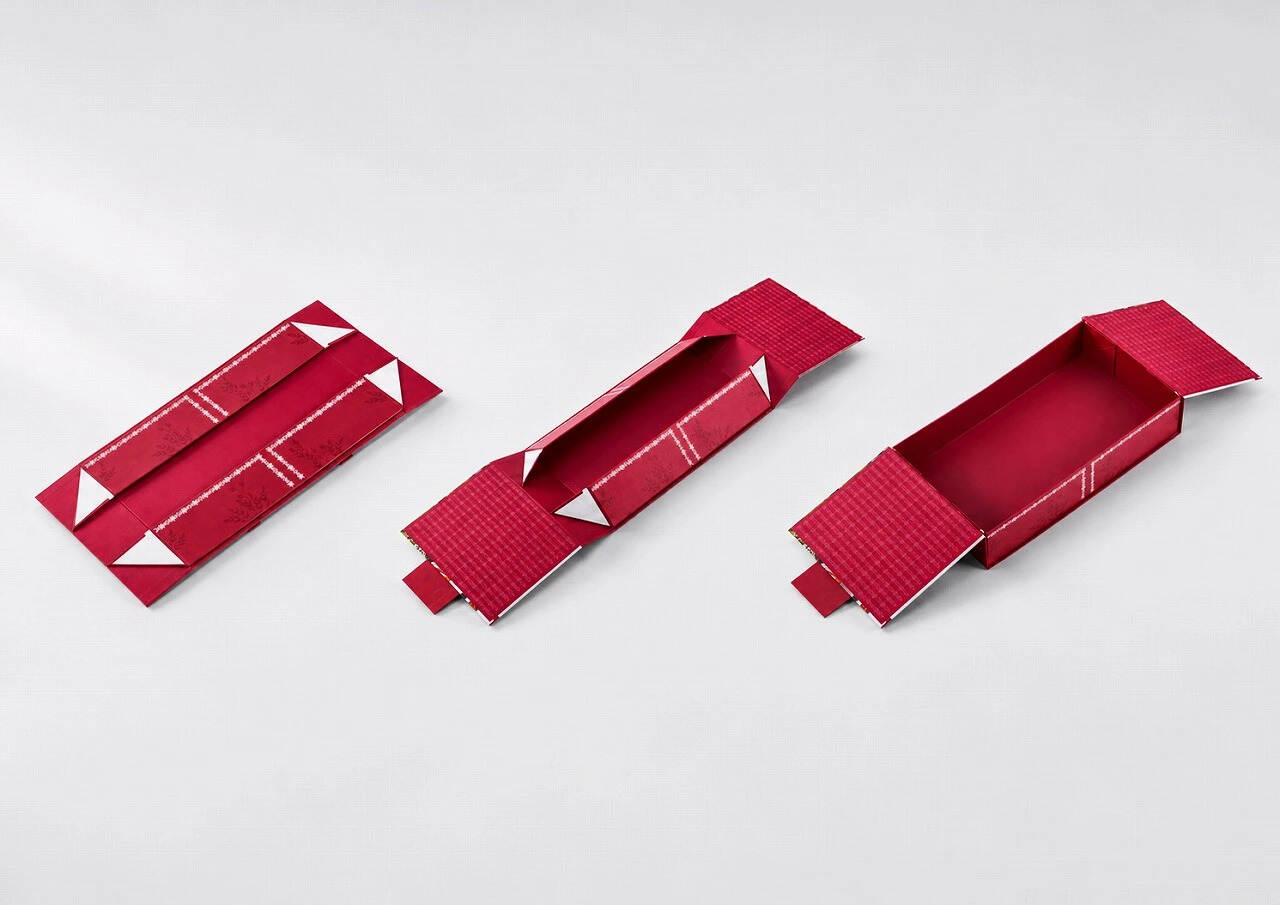
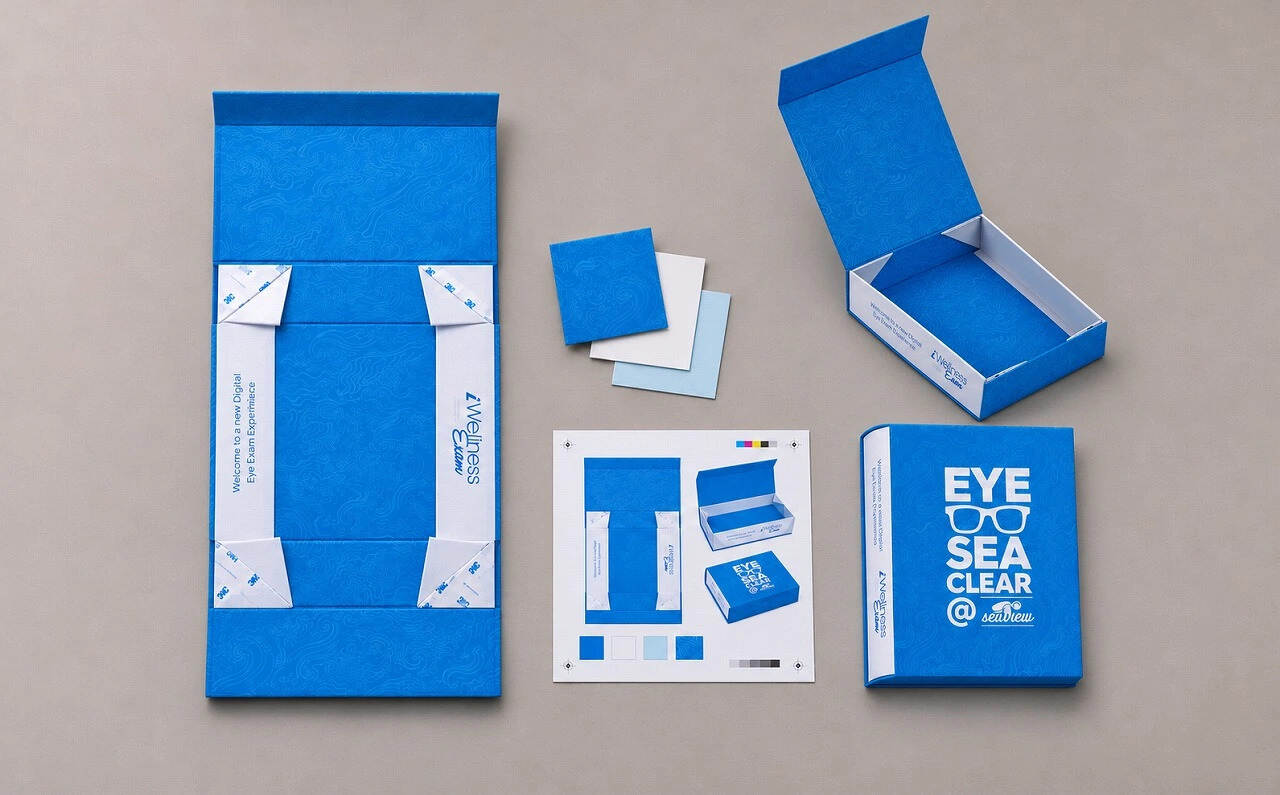
For this product, wholesale means a made-to-order production run rather than a ready-made gift box bought from inventory. The quoted item should be a genuine fold-flat rigid box: separate wrapped greyboard panels are connected by paper hinges, the walls rise from the base, and end flaps or triangular corner supports retain the erected shape. A book-style lid commonly continues from the back panel and closes at the front. A creased folding-carton blank is a different construction and should not be compared as the same product.
The trade-off is commitment. A factory prices around a production run, so it asks for a minimum quantity, a deposit and an approval sequence. Trading companies and sourcing agents can consolidate smaller orders across several factories, but they add a margin and reduce direct visibility of the production line. Neither model is automatically better; the right choice depends on order size, customization depth and how much production transparency the buyer needs.
MOQ per design, not only per order: a supplier may apply the minimum separately to each size, wrap, artwork or insert because every change can require its own setup.
Unit price basis: confirm whether the quote is per finished box, per flat-packed box, or per box plus a separate insert and assembly charge.
Delivery term: EXW, FOB, CIF and DDP produce very different landed costs. The cheapest ex-factory number can be the most expensive delivered option.
A useful first question to any supplier is therefore not “what is your best price?” but “what exactly is included in this price, at what quantity, under which delivery term, and with which approval steps?” The complete B2B buyer's guide covers the wider sourcing workflow, from specification to supplier selection.
A rigid box price is built from several layers. Seeing them separately makes a quotation easier to challenge and easier to optimize without damaging the product experience.
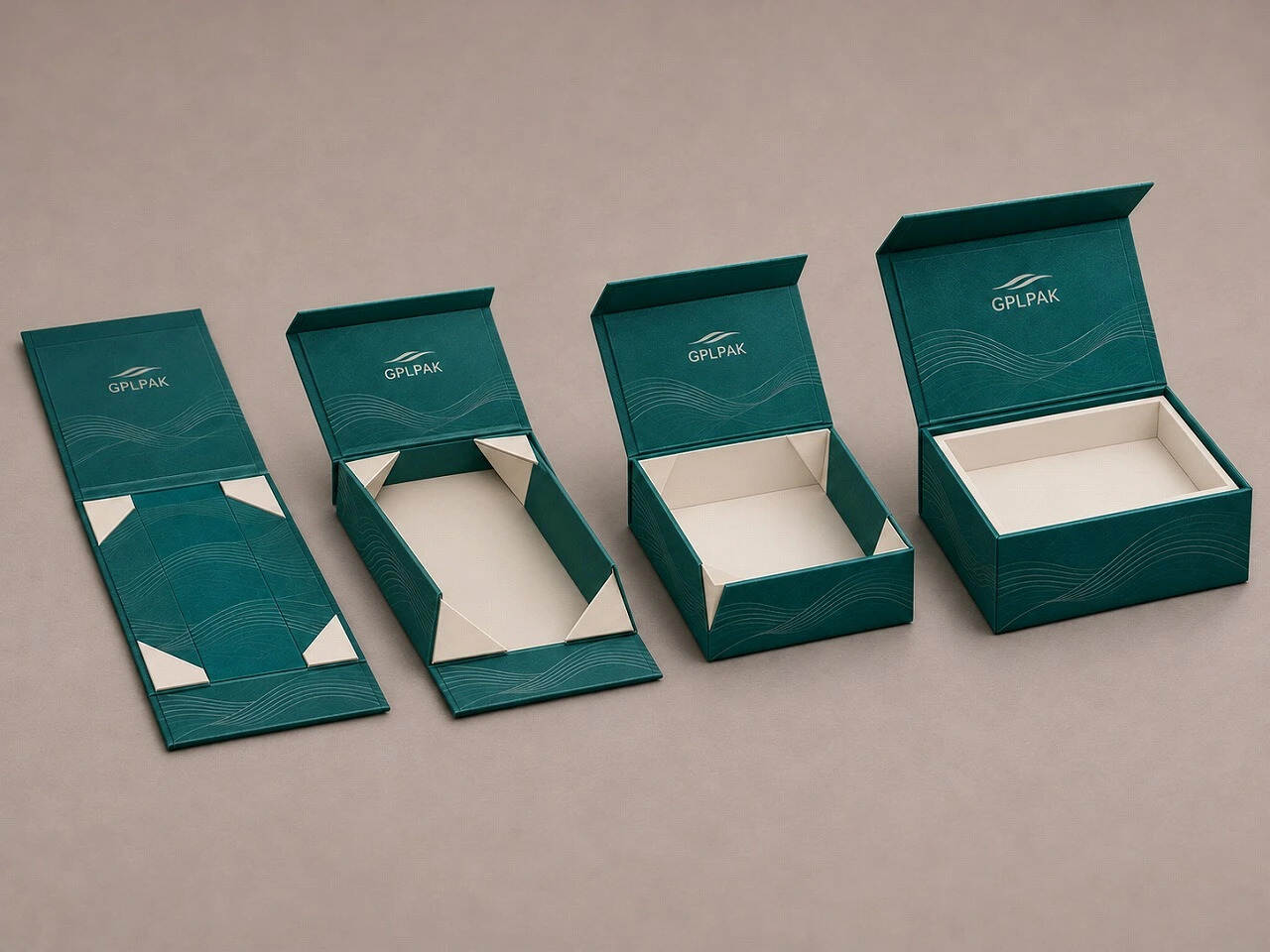
Each component in the flat lay becomes a separate cost line: board, wrap, printing, closure, insert, assembly and packing.
| Cost layer | Why the quote changes | Main variables |
|---|---|---|
| Rigid board and wrap paper | Panel area and caliper set material consumption and master-carton weight | Board grade and caliper, panel area, wrap type, paper market price |
| Printing and surface finishing | Each print or finish pass adds setup, spoilage allowance and inspection points | Number of colors, offset or digital, lamination, foil, emboss, spot UV |
| Conversion and assembly labor | More panels, hinges and hand-applied corner parts increase conversion work | Dieline complexity, number of panels, corner method, hand operations |
| Closure and insert | Closure count, insert material and cavity geometry require separate materials or tooling | Magnet grade and count, EVA or molded pulp, cavity complexity |
| Packing and local handling | Interleaving, flat-pack count, carton strength and pallet pattern affect labor and logistics | Flat-pack count per carton, interleaving, pallet, labeling, export packing |
| Factory margin and overhead | Order complexity, payment risk, inspection scope and capacity reservation affect overhead | Order size, payment terms, quality requirements, current capacity |
Ask the supplier to separate one-time charges from recurring unit costs. A die, foil plate or insert tool may be paid once and reused only while the specification remains unchanged. Board, wrap, printing, conversion, inspection and export packing recur on every production run.
The fold-flat construction can require more engineering and conversion work than a fixed set-up box because hinge gaps, corner retention and repeatable erection must be controlled. It can also reduce the cube occupied by empty boxes before pack-out. Whether that trade is favorable depends on measured flat-pack carton data, assembly labor and the route to the filling location—not on a universal savings percentage. The rigid-box cost guide explains the broader price inputs.
A minimum order quantity is not an arbitrary policy. It is the point at which the fixed costs of a production run — material setup, printing plates, die-making, machine make-ready and quality inspection — can be absorbed without making the unit price unrealistic.
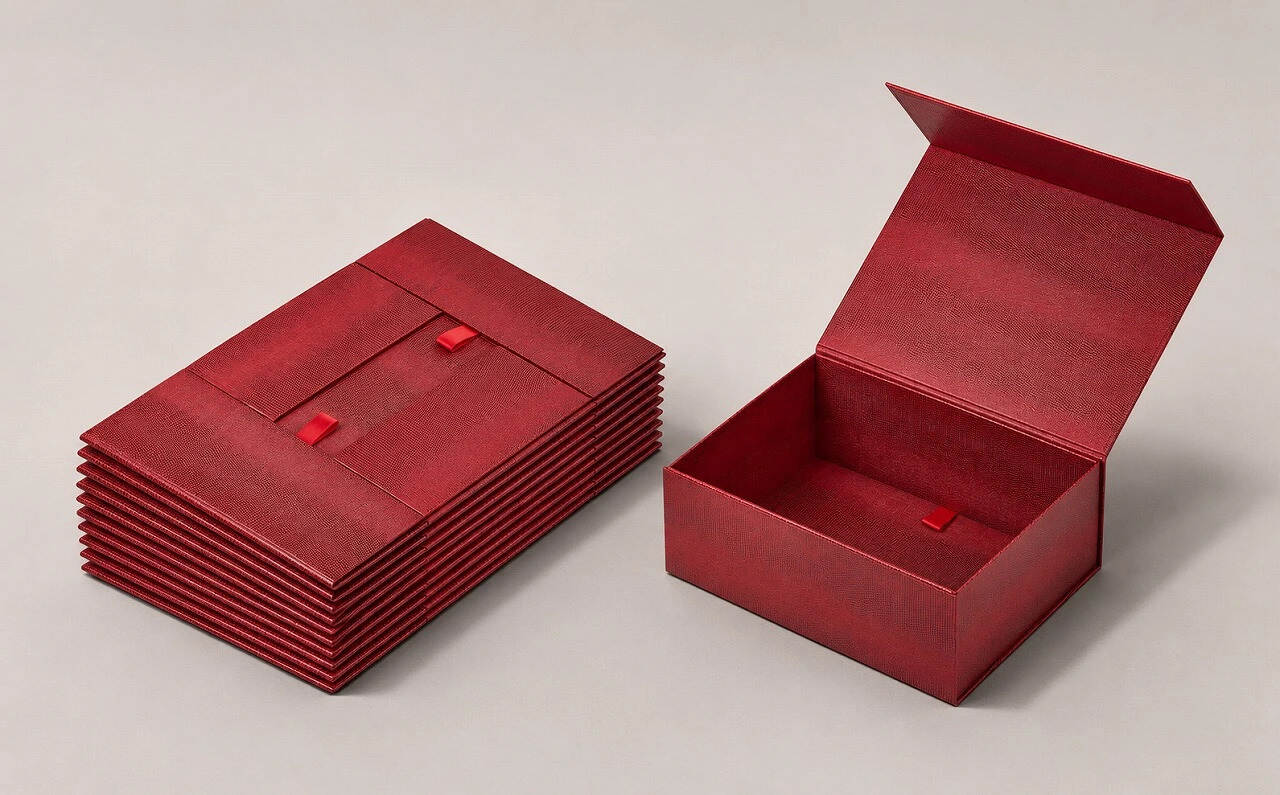
Flat-packed boxes reduce the volume per unit, but the MOQ is still set by print setup, board yield and tooling rather than storage space.
| Configuration | Likely MOQ effect | Reason for the floor |
|---|---|---|
| Simple structure, digital print, standard board | Potentially the lowest entry threshold | Digital print avoids plate cost; simple dieline limits make-ready |
| Custom size, offset print, standard finishing | Factory production minimum normally applies per artwork | Plate set, die and machine make-ready spread across the run |
| Specialty paper, foil, emboss or spot UV | Often higher because specialist materials and processes have their own minimums | Material minimums, extra passes and higher setup loss |
| Custom EVA or molded pulp insert | Driven by the insert supplier, tooling and material yield | Tooling for the insert and separate production scheduling |
| Multiple SKUs or colors in one order | Usually evaluated per SKU unless structure, materials and print setup can be shared | Each design needs its own plates, make-ready and material setup |
There are legitimate ways to lower a first-order minimum without pretending the economics have changed. A buyer can use a stock dieline with a printed wrap, accept digital printing for a launch run, choose a standard paperboard insert instead of a tooled foam insert, or order one colorway first and add variants after sell-through data arrives.
What does not work is comparing a launch run with a forecast-backed production run while expecting the same unit economics. If a very low-volume offer appears unusually cheap, confirm that the board, print method, finish, insert, export packing and acceptance criteria have not quietly changed.
Unit cost generally falls as reusable setup is spread across more finished boxes, but the curve is project-specific. At lower quantities, plates, dies, material minimums and make-ready carry more weight. At higher quantities, board, wrap, conversion labor, finishing yield and insert cost dominate. Request at least three quantity breaks on one unchanged specification rather than borrowing a price from another project.
| Buying stage | How cost behaves | What to request |
|---|---|---|
| Prototype and approval | Sample and tooling charges are not representative of a production unit price | Separate structural sample, print proof, tooling and courier charges |
| Launch production | Fixed setup is spread across fewer units and material yield may be less efficient | One specification with the supplier's minimum and next two quantity breaks |
| Repeat order | Reusable tooling may remain valid, but current material and labor must still be repriced | Tooling status, color standard, approved sample and any material substitutions |
| Multi-SKU program | Shared size and materials can create efficiencies; unique artwork and inserts create new setup | Price by SKU plus a pooled-material scenario where technically possible |
| Forecast agreement | Planned releases may improve purchasing and capacity planning without one oversized delivery | Call-off quantities, storage responsibility, price-review triggers and release schedule |
Do not compare a quote at the supplier's minimum with a high-volume quote from a different factory unless the box and inclusions are identical. A useful quotation identifies the quantity break, expected overrun or underrun policy, packing count, one-time charges and validity period.
Do not optimize the unit price alone: thinning a wall, simplifying the corner lock or removing an insert can increase pack-out errors and product movement. Model the cost of the approved packed system, not only the empty box.
Lead time is usually quoted from deposit or artwork approval, not from the first inquiry. The distinction matters because sampling and approval often take as long as production. A realistic schedule plans backwards from the in-store or launch date and protects time for at least one revision round.
The structure should progress cleanly from a flat wrapped panel set to retained corners and a square, fully erected box.
| Stage | Approval gate | What can delay it |
|---|---|---|
| Structure review and dieline | Product envelope, erected cavity, folded footprint and opening sequence confirmed | Unclear product dimensions, missing artwork zones |
| White or structural sample | Fit, wall squareness, corner retention, closure and pack-out method approved | New dieline, complex insert, revision rounds |
| Artwork proof and approval | Final dieline, copy, barcode, color references and finish zones signed off | Late copy, color approval by committee, font or resolution issues |
| Printed pre-production sample | Printed appearance, foil or emboss position, liner and insert approved | Special paper stock, foil or emboss tooling, insert tooling |
| Bulk production for approved quantity | Purchase order, deposit, materials and signed sample released | Factory load, material arrival, number of SKUs and finishing passes |
| Final inspection and export packing | Inspection result, rework if required, carton marks and packing list approved | Acceptance-sampling findings, rework, missing carton marks |
| International transit and delivery | Forwarder confirms routing, cutoff, customs scope and destination appointment | Port congestion, peak season, routing, customs clearance |
Ask for calendar dates, not only a number of production days. The schedule should name the event that starts each stage, the person who approves it and whether the quoted time excludes material procurement, public holidays, inspection, export booking or international transit. Freight timing should come from the chosen forwarder for the actual route and shipment window.
Two scheduling habits prevent most delays. First, approve the structure before final artwork because a dieline change can move panels, folds and finish zones. Second, reserve capacity against a realistic approval plan when the launch window is fixed; a tentative slot still depends on timely material and sample approval.
Most cost discussions jump straight to quantity. In practice, specification choices can have more influence on the unit price than moving to the next order tier. The table below ranks the levers directionally; the supplier should confirm the effect against your drawing and sample.
| Lever | Cost impact | How to use it without hurting the product |
|---|---|---|
| Box size and panel area | High | Reduce unnecessary clearance; size the insert to the product, not to a round number |
| Board grade and caliper | High | Match stiffness to box size and load; avoid over-specifying “heaviest available” |
| Wrap paper and print method | Medium to high | Use digital print for short runs; reserve specialty paper for visible panels |
| Decorative finishing | Medium | Concentrate foil or emboss on one focal area instead of covering the whole lid |
| Closure system | Low to medium | Choose magnets only where the opening feel justifies the component and assembly cost |
| Insert material and cavity count | Medium to high | Use paperboard for light products; reserve EVA or molded pulp for protection needs |
| Number of SKUs | Medium | Standardize the structure and change only the printed wrap where possible |
Value engineering should be visible in the sample, not only in the spreadsheet. If a change reduces the board grade, test whether the lid still sits flat and whether the walls stay square after erection. If it removes a finishing step, check the box under the lighting conditions where it will be sold. A saving that customers can see is not a saving.
The unit price on a quotation is only one part of landed cost. Freight, insurance, customs charges, inland delivery, pack-out labor and inventory carrying cost must be assigned to the same shipment scenario before supplier offers can be compared.
Collapsible construction can reduce empty-box cube before erection, but the benefit should be measured: ask for flat stack height, units and net weight per master carton, carton dimensions, pallet pattern and destination pack-out labor. Use a named place with the chosen rule. The ICC Incoterms® 2020 guidance also distinguishes rules for any mode from rules intended only for sea and inland waterway transport.
| Incoterm | Seller pays | Risk transfers | Лучшее для |
|---|---|---|---|
| EXW | Makes packed goods available at the named place; buyer handles loading and export tasks | When goods are placed at the buyer's disposal at the named place | Primarily domestic trade; ICC notes practical export-clearance issues |
| FCA | Clears export and delivers to the buyer's carrier at the named place | At the agreed delivery point to the carrier | Containerized or multimodal shipments managed by the buyer's forwarder |
| FOB / CIF | Seller delivers on board; under CIF the seller also arranges freight and minimum insurance cover | When goods are on board the vessel | Only when a sea or inland-waterway rule fits the shipment |
| DDP | Delivers import-cleared goods to the named destination, ready for unloading | At the named destination when goods are placed at the buyer's disposal | Only where the seller can legally and practically perform import obligations |
Always write the rule, named place or port and “Incoterms® 2020” into the quotation and purchase order. Then list non-Incoterm commercial items separately, including inspection, pallets, carton labels, destination appointment, storage and any service beyond the named delivery point.
For a first shipment, calculate landed cost per usable box using the supplier's actual carton count, carton dimensions, gross weight and pallet plan. Add the labor to erect the box and place the insert at the destination pack-out site. That is the fair comparison with a fixed rigid box delivered ready to fill.
Three quotes are only comparable when they describe the same box, the same quantity and the same delivery term. Otherwise the buyer is comparing assumptions, not prices. A simple comparison sheet with the following structure prevents most mistakes.
Normalize the specification: confirm board grade, caliper, wrap paper, print colors, finishing, closure, insert and flat-pack format for every quote.
Normalize the quantity: ask all suppliers to price the same tier and state the MOQ per SKU, not per order.
Normalize the trade rule: use the same Incoterms® 2020 rule and named place for every quote; keep freight, insurance and import assumptions visible.
Separate one-time costs: list die-cut, plate, sample, tooling and setup fees outside the unit price.
Compare the approval process: number of sample rounds, who approves color, and what happens if the first sample is rejected.
Compare quality controls: defect definitions, sampling plan, approved reference sample and access to inspection records. If acceptance sampling is used, define it against the current ISO 2859-1 framework rather than writing “AQL inspection” without parameters.
Compare the schedule: working days from deposit, sample lead time, production lead time and shipping window.
A quote that excludes the insert, uses a different board or starts its schedule from a later approval event is not a cheaper version of the same offer. It is a different product or commercial basis. Normalization makes that visible before a purchase order is issued.
Ask for an inclusion schedule: require a line for the box, insert, individual protection, master carton, pallet, tooling, sample, inspection and freight basis. The supplier does not need to disclose its margin for you to see whether two offers describe the same scope.
The fastest way to receive a usable quotation is to send a complete brief. The list below covers the inputs that most often trigger a follow-up question or a revised price.
Include these twelve inputs
Product dimensions, weight, fragile areas and loading direction
Required erected internal size and any external-size limit
Opening direction, corner-lock method and whether the box must be reversible after erection
Board grade preference or target stiffness
Wrap paper, color references and finish requirements
Insert concept and whether the product must be removable by the end user
Order quantity by SKU, plus a 12-month forecast if available
Target unit budget and any hard cost ceiling
Destination, named place, Incoterms® 2020 rule and preferred freight mode
Required delivery date and whether the date is fixed or flexible
Sample stages required and who will approve them
Material claims, certificates, acceptance criteria and distribution-test requirements needed for the project
Attach the artwork if it is ready, but do not wait for final artwork to request a structural quote. A dieline-based estimate can be produced from dimensions and a reference image, and it often reveals cost issues earlier than a finished design file. If dimensions are still uncertain, the box measurement guide explains which values the factory actually needs.
For projects where the structure is new, budget for a structural sample before the printed pre-production sample. The development sampling stage is where hinge behavior, corner fit and insert clearance are proven. If the packed product will enter a parcel or distribution system, define the relevant route and test objective before selecting a procedure; the ISTA procedure descriptions explain the intended scope of available protocols. Skipping structural approval usually costs more later than it saves upfront.
Send GPLPAK your product dimensions, target quantity, artwork status and destination. The team can return an indicative cost range, a proposed structure and a sampling schedule for your collapsible rigid box project.
Request a Wholesale Quote View Rigid Box CapabilitiesCustom Collapsible Rigid Boxes: Complete B2B Buyer's Guide
© 2026 GPLPAK — Custom paper packaging manufacturer in China
 Горячие новости
2026-11-13
2026-11-13
2026-11-10
2026-11-05
2026-11-02
2026-10-27
2026-10-23
2026-10-16
2026-10-12
2026-10-07
Discover premium packaging solutions from Dongguan Xinglan Packaging Products Co., Ltd. Specializing in innovative, durable, and custom packaging products for diverse industries.
GPLPAK стремится к обеспечению высочайшего уровня производственной деятельности.