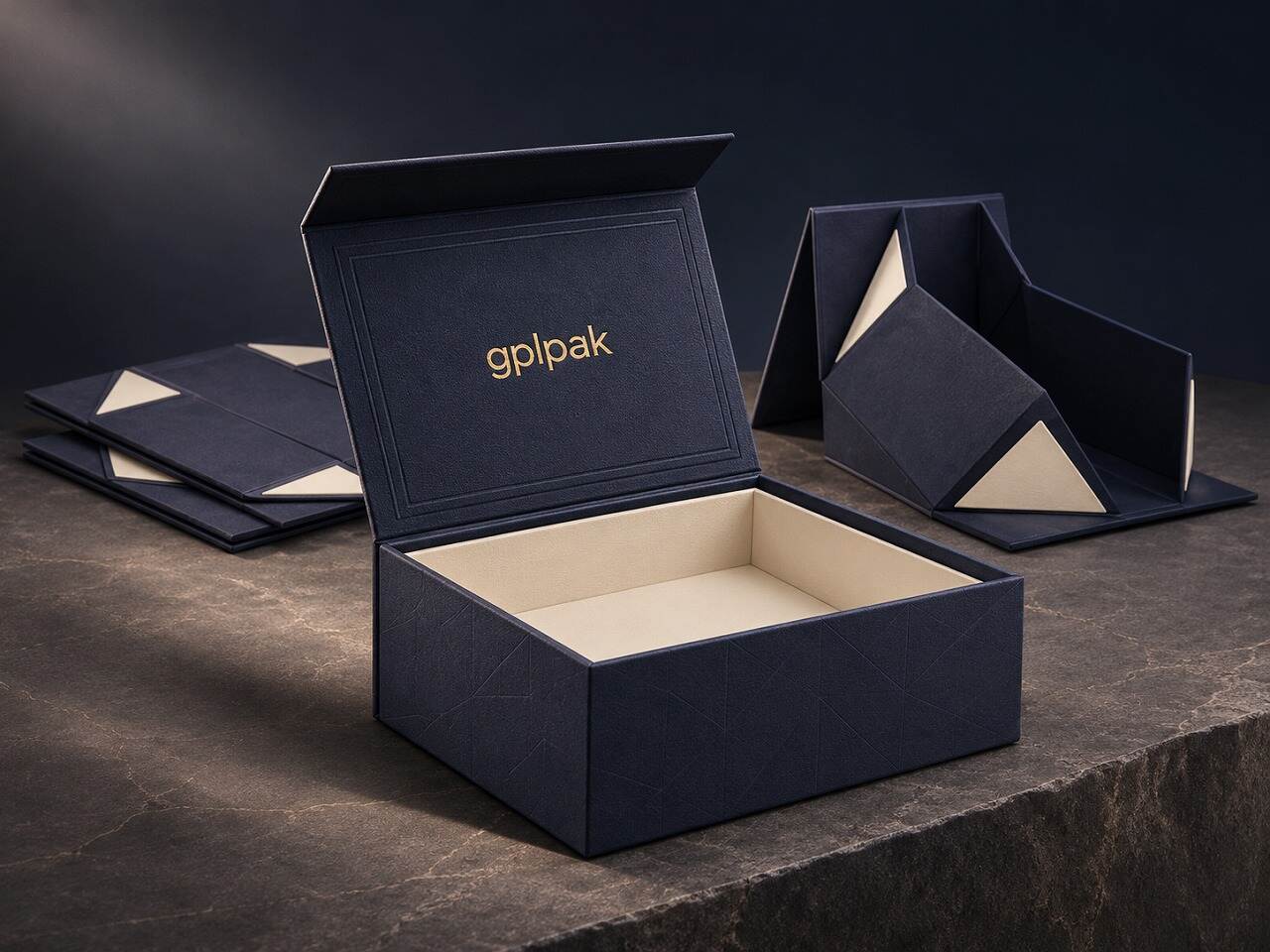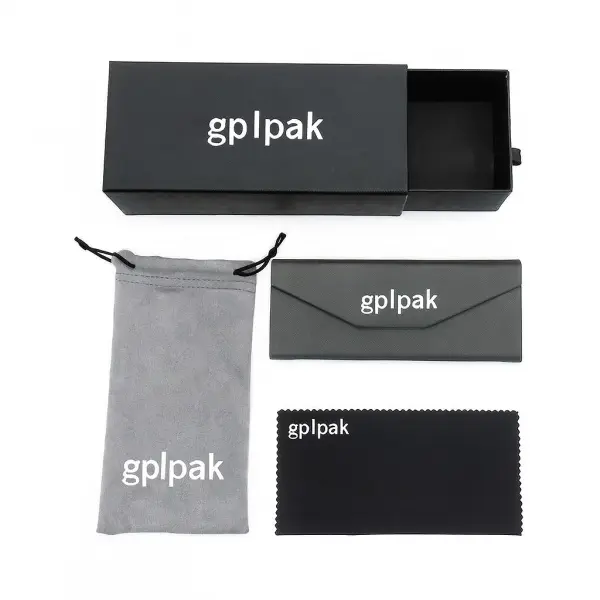
The search for collapsible vs. rigid boxes often produces dramatic savings percentages. Those numbers are not portable from one project to another. A shallow jewellery box, a large apparel gift box and a heavy bottle set do not use the same folded footprint, insert, master carton or packing method. Freight also changes by lane, mode, carrier, contract and season. A credible comparison therefore starts with physical samples and supplier packing data, not a generic percentage.
This guide is for brand owners, sourcing teams, packaging engineers and contract packers comparing premium paper-wrapped boxes. It does not compare a rigid box with a thin folding carton. Both formats discussed here use greyboard panels wrapped with printed or specialty paper; the difference is whether the box body is permanently formed at the factory or engineered to be erected later.
A collapsible rigid box is usually the stronger candidate when empty-box cube is a major cost driver, the box travels a long distance before filling, warehouse space is constrained, and the packer can erect boxes consistently. A fixed rigid box is usually the stronger candidate when packing speed, automation, tight insert registration, heavy contents or low rework matter more than inbound cube.
That is a decision direction, not a price promise. The collapsible format may have extra components, hinge engineering and corner-retention work. It also requires labour at the filling location. Conversely, the fixed format may need larger master cartons, more pallet positions and greater protective packing. Buyers should compare two samples built to the same inside size, outer wrap, insert function, finish level and acceptance criteria.
Freight and storage cube are expensive, annual volume is distributed across several launches, and a controlled manual pack-out operation already exists.
The line must move quickly, the product or insert is demanding, presentation geometry must be highly repeatable, or the box is supplied directly to retail packing sites.
If the presentation box also needs parcel protection, evaluate a separate corrugated shipper. A premium rigid box should not be assumed to be a transit pack.
A conventional fixed rigid box, also called a set-up box, uses paper-wrapped greyboard components that are permanently formed before shipment. Common constructions include two-piece lid-and-base boxes, drawer boxes and book-style magnetic boxes. GPLPAK's rigid box range shows the broader structural family, while the magnetic box category covers hinged-lid formats.
A collapsible rigid box also uses thick greyboard and wrapped surfaces. Its wall and base panels are separated by controlled hinge gaps and joined by the wrap and liner. Corner flaps or retention panels hold the walls square after erection, commonly with concealed magnets or another specified retention method. This is not the same as scoring and folding one thin sheet of paperboard. If a supplier calls an ordinary folding carton a “collapsible rigid box,” the quote is not comparable.
| Decision factor | Fixed rigid box | Collapsible rigid box | Evidence to request |
|---|---|---|---|
| Inbound state | Fully formed and ready to fill | Flat or partly folded; erected at pack-out | Photos of the actual export pack and one unopened master carton |
| Structural principle | Permanent formed corners | Separate wrapped panels, hinge gaps and corner retention | Flat sample, erected sample and cross-section of hinge area |
| Pack-out work | Insert product and close | Erect, lock corners, place insert or product, then close | Timed pilot using the intended operators and work instructions |
| Geometry | Generally stable before filling | Depends on hinge design, retention and erection discipline | Squareness, gap, closure alignment and lid-registration criteria |
| Logistics cube | Driven by formed outer dimensions | Driven by folded footprint, pack thickness and separators | Units per carton, carton dimensions, gross weight and pallet pattern |
Unit box price is only one line in the decision. The useful number is the cost of getting an accepted, packed unit ready for sale at the destination. A sourcing model should separate one-time development charges from recurring unit costs and should show which party performs each task. GPLPAK's article on custom rigid paper box cost drivers provides additional background on specification variables.
“Accepted” matters. If an operator rejects a box because corners do not lock, the lid sits out of square or the wrap cracks at a hinge, the apparent purchase price is not the real cost. Similarly, if fixed boxes arrive crushed because the master carton is under-specified, their low assembly cost does not offset the loss.
| Input | How to collect it | Common mistake |
|---|---|---|
| Finished box and insert price | Quote the same size, materials, print, finish, quantity and packing standard | Comparing different greyboard, wrap or insert specifications |
| Export packing | Request pieces per carton, carton size, gross and net weight, separators and pallet plan | Using the finished box dimensions as shipment dimensions |
| Freight and local charges | Send both supplier packing lists to the same forwarder on the same date and Incoterm | Mixing air and sea quotes or omitting destination charges |
| Storage | Use inbound pallet positions, average days on hand, receiving and pick charges | Pricing only cubic metres while the warehouse bills by pallet or location |
| Assembly and QA | Run a pilot with representative staff, tools, instructions and batch size | Timing one trained person once and treating it as a stable line rate |
| Loss and damage | Record rejects, rework, packed-product damage and customer complaints by cause | Assuming the presentation box is a qualified shipper |
A buyer who does not yet have reliable rates can still build the model with blank input cells and sensitivity ranges. Mark estimates clearly and replace them when a forwarder, warehouse or packer returns a current quote. Avoid publishing one supplier's freight price or labour rate as if it were a market standard.
The theoretical finished-box volume is not the shipment volume. A collapsible design may have a broad flat footprint, protective tissue, magnets, inserts packed separately and a maximum safe stack height. A fixed box may allow lids and bases to nest or may require individual protection. Only the approved master-carton specification captures these effects.
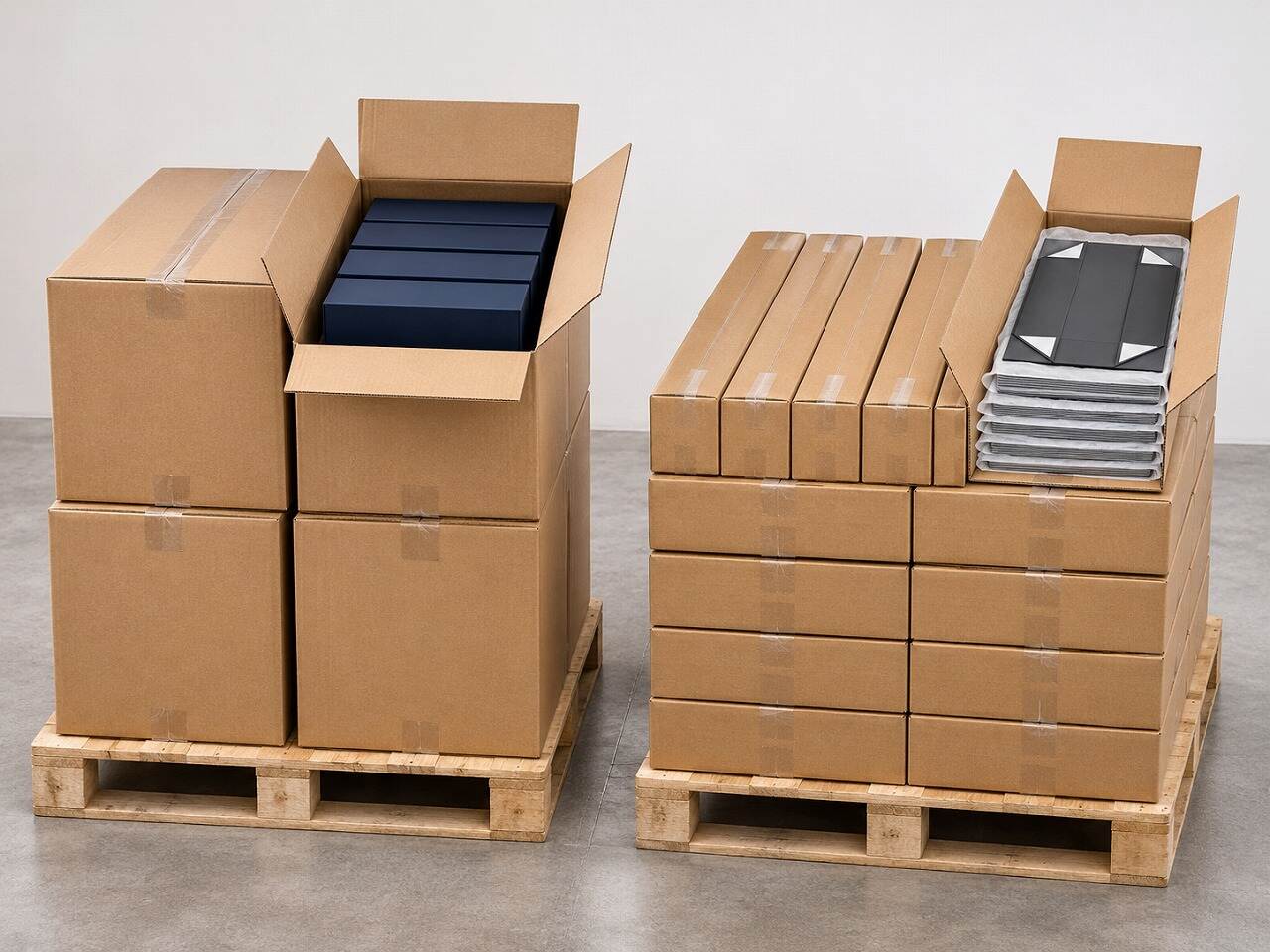
For parcel and air services, dimensional or volumetric weight may exceed actual weight. Carrier rules are service- and market-specific. UPS, for example, defines dimensional weight as package volume divided by an applicable divisor and notes that the divisor varies by rate type; its official shipping dimensions and weight guidance should be checked against the service being quoted. Freight modes use different charging rules, so the buyer should give the forwarder the complete packing list instead of applying a remembered divisor.
Request the following for each option:
master-carton external length, width and height;
units per carton and any separate insert cartons;
gross weight, net weight and carton material specification;
cartons per pallet, loaded pallet dimensions and maximum stack plan;
total cartons, total gross weight and total shipment cube;
photos showing separators, edge protection and moisture protection.
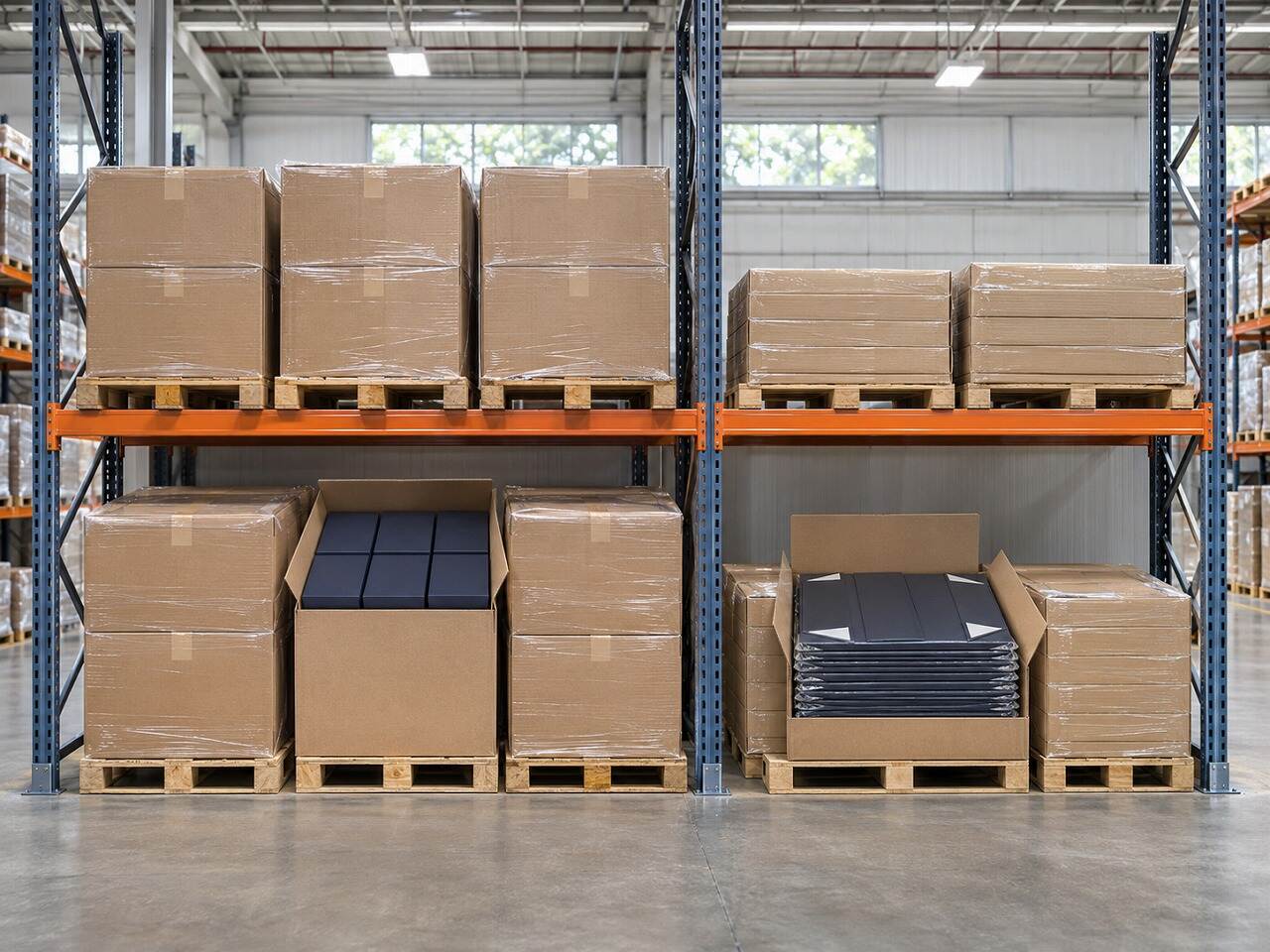
Warehouse cost is not always charged by cubic metre. A fulfilment centre may bill by pallet position, bin, handling event, receiving appointment or average daily inventory. A collapsible box can reduce the number of inbound locations, but its broad flat cartons may not fit the same racking or conveyor. The calculation must reflect the destination warehouse's billing unit and equipment.
| Warehouse question | Why it changes the result | Data owner |
|---|---|---|
| How is storage billed? | Pallet, bin and cubic billing produce different cost curves | Warehouse or 3PL |
| What is average days on hand? | Cube savings matter more when empty packaging remains in stock longer | Planning team |
| Can flat cartons use existing racks? | Long or wide cartons may consume locations inefficiently | Warehouse engineering |
| Where are boxes erected? | Erection may require a staging buffer near the line | Operations |
| Are inserts stored separately? | A compact box pack can be offset by bulky insert cartons | Supplier and receiving team |
| How many handling events occur? | Receiving, put-away, replenishment and picking may each carry a charge | 3PL commercial team |
For seasonal launches, also model peak inventory. The annual average may hide a short period when fixed boxes exceed available locations. Conversely, just-in-time supply or local manufacture may keep fixed-box inventory low enough that the collapsible format's assembly step is not justified.
Collapsible packaging does not remove work; it changes where the work occurs. The factory performs panel wrapping and hinge construction, while the buyer or co-packer erects the body. A fair labour study must include opening the master carton, removing protective material, erecting and locking the box, checking squareness, adding the insert or product, closing the lid and moving the accepted pack to the next station.
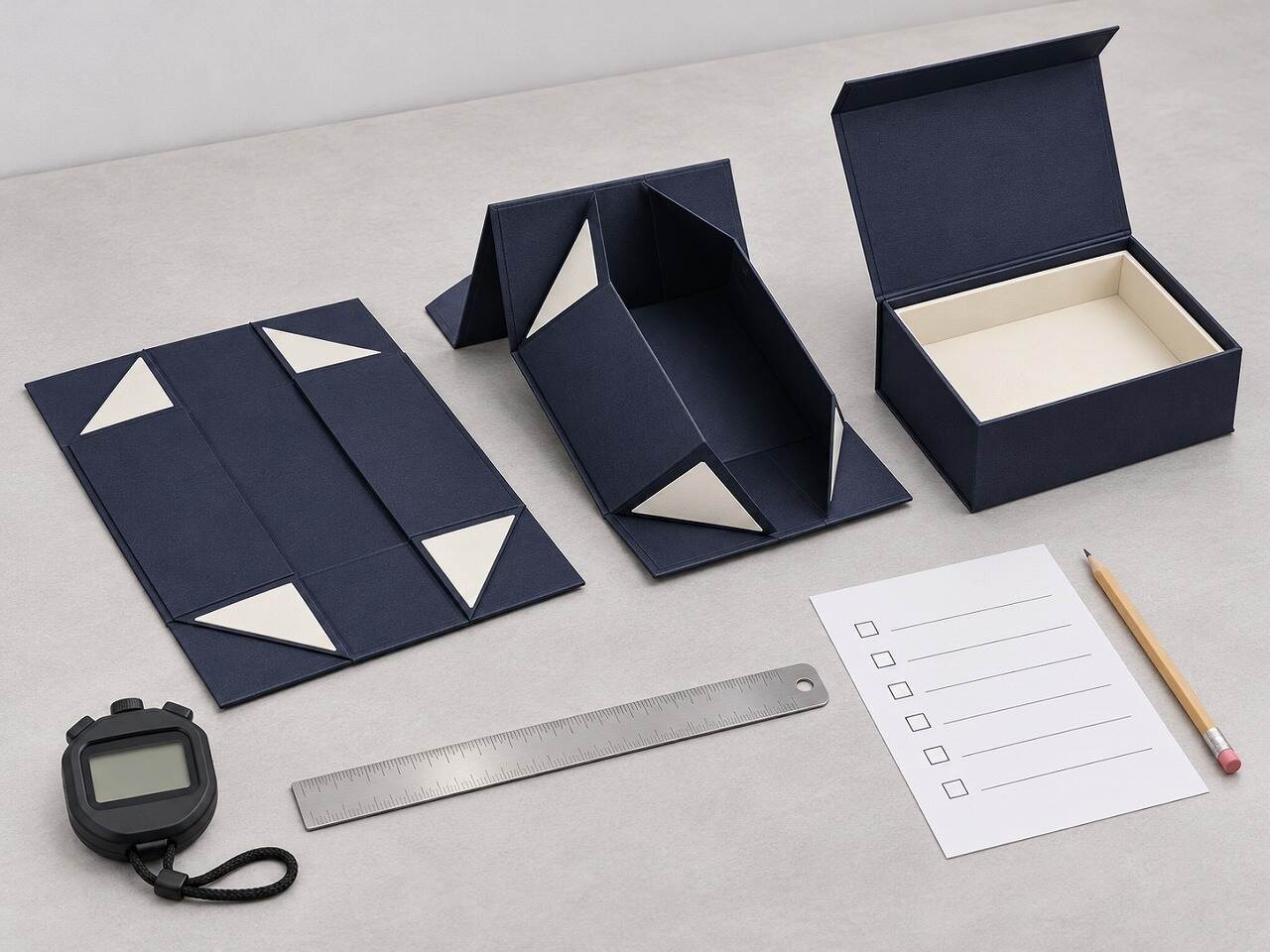
Run the pilot with production-intent samples through GPLPAK's 개발 샘플링그리고design validation stages, or equivalent controls at the selected converter. Use the intended packer, workstation height, gloves, inserts and batch size. Record an average over a meaningful run and separately record training units, rejects and rework.
Write the standard work sequence and define when timing starts and stops.
Train operators before collecting production-rate data.
Time several operators and repeat after a normal break or changeover.
Record the causes of failed corner locks, skewed lids, wrap marks and insert interference.
Convert observed time to cost using the destination's fully burdened labour rate.
Add workstation, fixture and quality-check requirements if they are incremental.
Do not assume that every collapsible design assembles in the same time. Box size, corner retention, magnet strength, liner stiffness and insert sequence can change the work. A simple erection fixture or clearer work instruction may reduce variation, but its benefit should be demonstrated in the pilot.
Both structures can be made well, and both can fail for different reasons. Fixed boxes are vulnerable to corner crush, abrasion and deformation during empty-box transport. Collapsible boxes add hinge, corner-lock and erection variables. The acceptance plan should examine the features that matter to the customer's experience and to the packing line.
Useful inspection criteria include:
assembled length, width, height and diagonal difference;
lid-to-base alignment, closure engagement and opening force where relevant;
corner gap, wall squareness and ability to remain erected through pack-out;
wrap adhesion, hinge flexing, scuffing, foil registration and colour tolerance;
insert location, product clearance and removal experience;
master-carton compression, internal movement and arrival condition.
Distribution testing must represent the packed product and actual route. ISTA advises users to select procedures with the real distribution environment in mind, use current protocols and test representative samples; see its official design and testing guidance. A handmade white sample may be appropriate for early fit work, but it does not prove the performance of production materials, finishes, packed product or shipper.
GPLPAK's product development, 제조업그리고packing pages describe the relevant workflow stages. Project-specific tolerances, test plans and acceptance levels should be agreed in writing before production.
There is no universal order quantity at which collapsible packaging wins. The break-even point is driven by the difference in verified logistics cost and the difference in assembly, quality and product cost. Instead of inserting sample prices that may look authoritative, use the formula below with current project data.
If the result is positive, the collapsible option has a cost advantage under the modelled scenario. If it is negative, the fixed option has the cost advantage. Then stress-test the result by changing freight rate, days on hand, labour rate and reject rate one at a time. A decision that reverses after a small change is sensitive and deserves a pilot or a dual-source contingency.
| 시나리오 | Signal favouring collapsible | Signal favouring fixed rigid |
|---|---|---|
| Long inbound lane | Large verified reduction in cartons or pallets | Little cube difference after inserts and protection are included |
| Expensive or limited storage | Fewer billable locations for meaningful days on hand | Packaging arrives just in time and occupies few locations |
| High-speed pack-out | Erection is off-line, controlled and inexpensive | Line cannot absorb erection time or variation |
| Heavy or precise product set | Pilot proves square geometry and stable insert fit | Permanent corners support more consistent registration |
| Multiple fulfilment sites | Each site has trained staff and approved work instructions | Sites need a ready-to-pack format with minimal training |
| Premium launch risk | Production-intent validation confirms appearance and closure | Complex hinge finishes or corner retention create unacceptable risk |
Keep the model version-controlled. Record the quote date, currency, exchange-rate assumption, Incoterm, route, batch size, warehouse tariff and labour basis. That makes the decision reviewable and prevents an old freight rate from being treated as a permanent structural fact.
Product category alone does not select the box. Two cosmetics brands may use different formats because one fills in China and ships finished sets, while the other imports empty boxes and packs regionally. Start with where the box is made, where it is filled, how long it is stored empty and how it reaches the customer.
Collapsible can suit large presentation formats packed in regional facilities. Fixed rigid may be preferable when bottles require precise insert registration or the finished set is packed near the box factory.
Large empty boxes can create substantial cube, so collapsible merits a pilot. Confirm that staff can erect corners cleanly and that garments do not interfere with closure.
Small fixed boxes may already use limited space, while tight insert and lid alignment can be important. The logistics advantage of collapsible may be modest unless volumes or travel distance are high.
Consider the entire network. If empty boxes move internationally but filled goods ship locally, collapsible may improve inbound efficiency. If the box factory also performs final packing, fixed boxes can travel only once as finished packs and may avoid a separate erection step. A packaging consultation should therefore map material flow before a structure is chosen.
Environmental language needs the same discipline. Fewer pallets or lower dimensional weight may support a project-specific reduction in transport space, but it does not by itself prove a lower product carbon footprint or recyclability. Document material composition, magnets, adhesives, local recovery routes, freight mode, assembly loss and reuse assumptions before making public claims.
The fastest way to get misleading prices is to ask two suppliers for “the same luxury box” without a common specification. Provide a physical product or controlled drawing, packed weight, inside clearance, desired opening sequence, artwork, finish references, insert function, quantity by delivery, destination, pack-out site and acceptance criteria. GPLPAK's box measurement guide explains the basic dimension convention.
Ask each supplier to quote a fixed and collapsible option against the same brief where technically feasible. Require separate lines for box, insert, tooling, sample, export packing and optional services. For each option, obtain a packing list and production-intent sample before final approval.
| RFQ section | Minimum information | Approval evidence |
|---|---|---|
| Product and channel | Physical envelope, weight, fragility, retail/ecommerce route and outer shipper | Fit sample with actual or controlled dummy product |
| 구조 | Fixed or collapsible state, opening sequence, retention method and insert | Flat-state and erected-state photos plus signed drawing |
| 외관 | Artwork, colour standard, wrap, foil, embossing, coating and reference sample | Colour and finish standard under agreed viewing conditions |
| 물류 | Destination, delivery lots, carton limits, pallet limits and labelling | Approved master carton, packing list and pallet pattern |
| Operations | Pack-out location, target line process, labour constraints and work instructions | Timed pilot and operator feedback |
| Quality | Critical dimensions, visual limits, test route and inspection method | Golden sample, inspection record and agreed acceptance criteria |
Score suppliers on evidence, not just presentation. A reliable quote explains assumptions and exclusions, shows how units are protected in transit and identifies what the buyer must validate. Browse GPLPAK's custom packaging products for structural references, then submit the actual product data for a project-specific comparison.
No. A collapsible rigid box is normally made from separate thick greyboard panels wrapped with paper and connected across designed hinge gaps. A folding carton is generally die-cut and creased from thinner paperboard. Ask for a flat sample and material specification to confirm what is being quoted.
There is no responsible universal percentage. Savings depend on folded thickness, footprint, units per carton, pallet pattern, freight lane, mode and carrier. Compare complete supplier packing lists through the same forwarder on the same date.
No. Concealed magnets are common in magnetic book-style designs, but corner retention and lid closure can use other specified methods. The mechanism should be chosen for the opening experience, assembly process, material strategy and local requirements.
Fixed corners often provide stable geometry before filling, but “stronger” is incomplete without a load case. Product support, hinge durability, insert performance and distribution protection should be tested with the actual packed configuration.
Fixed rigid boxes usually remove the erection step. The real difference depends on the collapsible mechanism, workstation, insert sequence and operator training. Run a timed pilot and count rework rather than relying on an advertised assembly time.
Some designs can be re-flattened, but repeated-use performance depends on wrap, hinge construction, corner retention and handling. If reuse is a requirement, define the cycle, appearance limit and functional acceptance criteria and test it.
Usually yes for parcel distribution. A premium paper-wrapped box is generally designed for presentation, not as a standalone transport package. Validate the product, presentation box, cushioning and corrugated shipper as one packed system.
Send the product or controlled drawing, packed weight, inside clearance, artwork, finish references, insert requirements, order quantity, delivery lots, destination, pack-out location, distribution route and written acceptance criteria. Also request carton and pallet data for both structures.
Share your product, target inside size, artwork, quantity, destination, pack-out method and distribution route. GPLPAK can review fixed and collapsible rigid-box concepts and prepare the packing information needed for a landed-cost comparison. Timing, price, MOQ and performance remain project-specific until the specification is reviewed.
 핫 뉴스
2026-11-05
2026-11-02
2026-10-27
2026-10-23
2026-10-16
2026-10-12
2026-10-07
2026-09-30
2026-09-23
2026-09-22
Dongguan Xinglan Packaging Products Co., Ltd.의 프리미엄 포장 솔루션을 발견하십시오.
 영어
 EN
 RU
 ES
 KO
 JA
 PT
 IT
 DE
 FR
 NL