 АНГЛИЙСКИЙ
 EN
 RU
 ES
 KO
 JA
 PT
 IT
 DE
 FR
 NL
Быстрые ссылки
In brief: a magnetic closure collapsible rigid box is a paper-wrapped rigid-board presentation box engineered to ship flat, erect squarely and close through concealed magnets in the lid flap and mating wall. A purchase-ready specification must define the panel construction, hinge and corner-retention method, magnet and mating component, finished gaps, packed product, opening-test method and approved physical sample. Magnet grade alone does not predict the customer’s opening experience.
For sourcing teams, the difficult part is not finding a supplier that can place magnets inside a box. It is converting a desired “premium snap” into a repeatable structure that still aligns after printing, wrapping, flat packing, erection and filling. The closure is affected by the entire tolerance stack: board cutting, recess depth, wrap build-up, hinge position, wall squareness, magnet polarity and the distance between the two mating parts.
This guide is written for brand owners, packaging engineers, importers and contract packers purchasing foldable magnetic gift boxes, flat-pack magnetic boxesилиcollapsible rigid packaging. It explains what belongs in the drawing, RFQ, sample approval and quality plan. For the broader format decision, start with GPLPAK’s custom collapsible rigid boxes buyer’s guide.
The phrase “magnetic box” describes a closure, not a complete construction. A fixed set-up box, a collapsible rigid box and a creased folding carton can all use magnets, yet their board, tooling, packing method and performance differ. Your RFQ should first state the packaging job and construction family, then describe the closure.
| Format | Construction | Pack-out condition | Buyer watchpoint |
|---|---|---|---|
| Collapsible rigid box | Separate rigid-board panels connected by wrapped hinge zones | Supplied flat; erected and locked before filling | Corner retention, hinge life and squareness after erection |
| Fixed magnetic rigid box | Pre-formed rigid-board body and hinged lid | Delivered set up and ready to fill | Higher inbound and storage cube |
| Magnetic folding carton | Creased paperboard blank with magnetic component | Folded and locked or glued during packing | Different wall stiffness, edge profile and tooling |
| Rigid sleeve or drawer box | Tray and sleeve; may use ribbon rather than magnets | Usually supplied set up | Opening action and insert access differ |
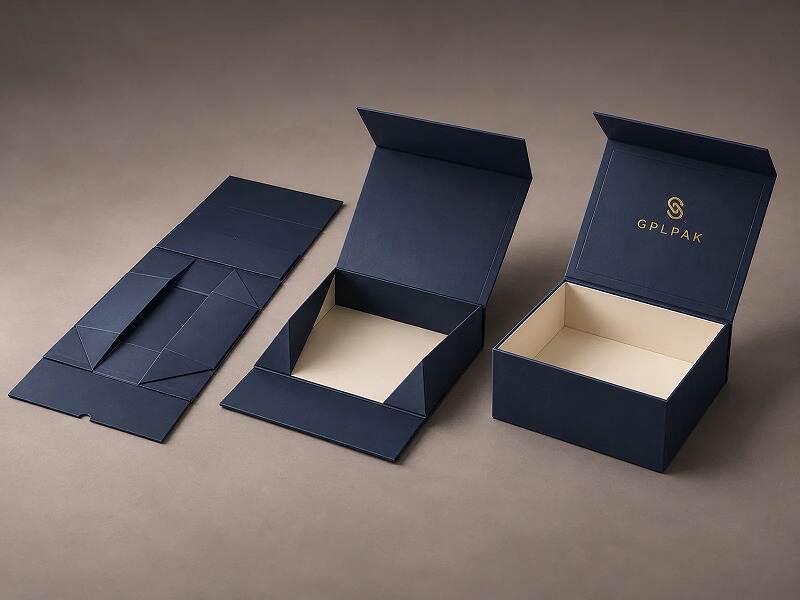
If the project requires a premium set-up presentation with no erection step, compare a conventional Жесткая коробка на заказ. If flat supply is central to the business case, define the structure as a paper-wrapped, separate-panel collapsible rigid box with concealed magnetic lid closure. That sentence removes most quotation ambiguity.
A true collapsible rigid box does not depend on one thick sheet being deeply creased. Individual greyboard panels are spaced to create controlled hinge gaps, then bridged by the outer wrap and liner. When the box is flat, the walls lie within the panel arrangement. During erection, the walls rise and a separate corner-retention feature holds the body square.
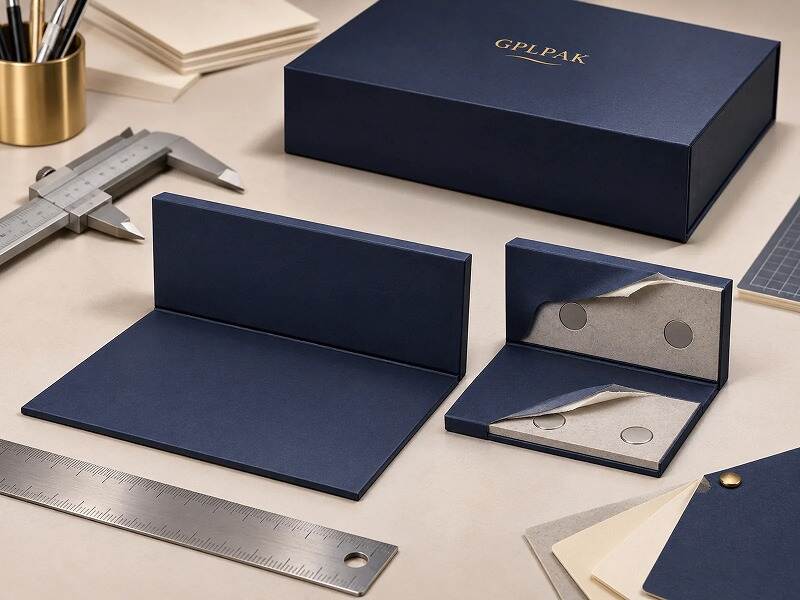
The magnetic lid closure is another subsystem. Magnets are commonly recessed inside the front lid flap and aligned with steel plates or opposite-polarity magnets inside the front wall. The finished user should see a smooth wrapped surface—not exposed discs. PackMojo’s collapsible magnetic rigid-box dieline guide similarly identifies the front flap as the magnetic closure area and shows the folding side-wall construction.
The final relationship between magnet and mating plate is created by several converted parts, not one cutting operation. Board length, wrap turn-in, hinge gap, corner position and the way the operator squares the body all influence where the front wall sits beneath the lid flap. If each dimension is controlled independently but the stack is ignored, two individually “in-tolerance” parts can still produce a visibly skewed closure.
The structural drawing should therefore use common datums and include finished-box checks. Useful outputs are the left and right lid-to-wall gap, front-flap overlap, box diagonals or another agreed squareness method, and the relative position of the concealed components after erection. These checks should be performed with the specified corner system engaged. Measuring a flat blank alone cannot prove that the erected closure will align.
A cutaway is useful for engineering review; the approved production surface should remain smooth, fully wrapped and free from visible hardware.
Do not combine two functions in one specification. Lid magnets keep the cover closed. Corner magnets, adhesive tabs or mechanical folds keep the erected body square. A box can have a strong lid closure and still fail at its corners.
A callout such as “two N42 magnets” is incomplete. The grade describes magnetic material properties; it does not define the installed holding force through paper, adhesive, board recesses and air gaps. Published grade data from magnet manufacturers, such as this NdFeB property table, is useful for component control, but a packaging buyer still needs to approve the installed closure in the finished box.
| Drawing field | What to state | Why it matters |
|---|---|---|
| Magnetic component | Material/grade, diameter, thickness, plating and quantity | Controls component identity and corrosion protection |
| Mating component | Steel plate or second magnet, dimensions and orientation | Changes attraction, polarity control and cost |
| Location | Coordinates from cut panel datums; polarity map where required | Prevents lateral offset and repelling pairs |
| Pocket and retention | Recess geometry, adhesive or retention method, permitted surface telegraphing | Keeps hardware flush and secure |
| Installed gap | Wrap, liner, adhesive and clearance between mating faces | Magnetic attraction falls as separation increases |
| Acceptance condition | Approved sample plus agreed opening-test method and visual limits | Connects drawing data to actual user experience |
Polarity should be controlled at component preparation and verified during assembly. Where a magnet attracts a steel plate, polarity does not change attraction, but orientation and location still affect closure symmetry. Where two magnets mate, the polarity map becomes an essential drawing item. The safest approval combines component traceability with a finished, decorated sample.
There is no credible universal opening-force range for every magnetic closure box. A small jewellery box, a wide apparel box and a deep bottle set have different lever arms, flap lengths, magnet spacing, wrap builds and intended users. A number copied from another project can create a closure that feels weak, opens abruptly or damages the wrap when pulled.
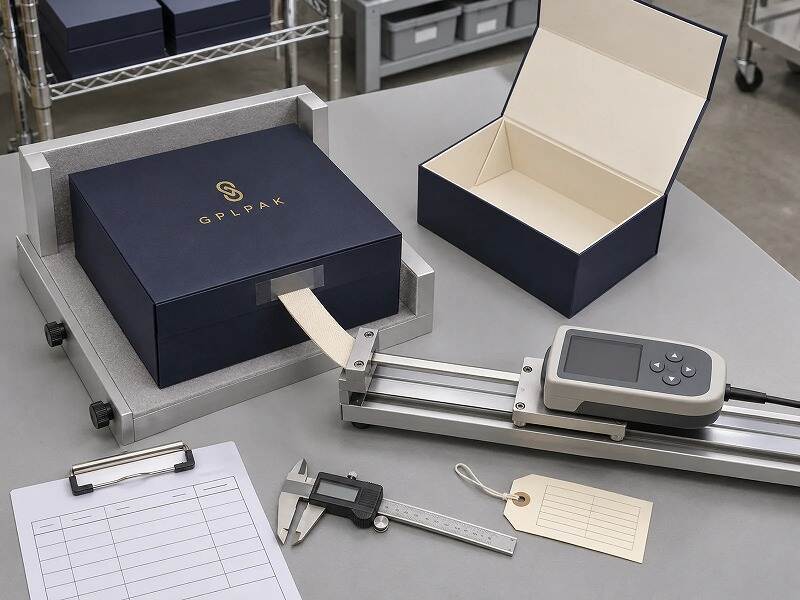
Instead, approve the desired experience on a representative sample, then document a repeatable comparison method. The method should state:
whether the box is empty or packed with the production product and insert;
the conditioning state and time since erection;
where the box is restrained and where the pulling fixture attaches;
the pull direction, lid angle and controlled test speed;
the instrument, units, sample count and how results are summarized;
the acceptable range or approved-sample comparison agreed after development trials.
A repeatable fixture is more useful than an unqualified “strong magnet” claim. Final limits should come from the approved project sample, not the illustrative setup shown here.
The closure cannot be separated from the board and wrap specification. Increasing board thickness may stiffen a flap, but it also changes the hinge geometry, recess depth and folded footprint. A heavy textured paper can improve perceived quality while increasing the material between the magnetic components. Foil, embossing and laminated finishes may cross hinge zones poorly if artwork is not adapted to the structure.
During development, review these interactions:
Panel plan: finished internal dimensions must be translated into individual cut panels, hinge gaps and wrap allowances.
Paper grain: grain direction and hinge orientation should support repeated folding without whitening or cracking.
Recess depth: the magnet or plate should sit securely without a visible bump, weak local board or sharp edge beneath the wrap.
Artwork safe zones: critical foil, fine type and embossing should avoid moving hinge gaps and concealed hardware unless trialled.
Liner build-up: inner paper, turn-ins and adhesive overlap influence both finished clearance and attraction distance.
Ask the converter to identify board by grade or supplier specification rather than colour alone. Approve paper, lamination, foil and embossing on the actual structure because flat colour swatches cannot reveal hinge behaviour or magnet telegraphing. GPLPAK’s выборка развития page explains why printed, production-intent prototypes are used to resolve such interactions before the production run.
A collapsible structure creates more moving boundaries than a fixed set-up box. Fine foil rules crossing a hinge can break visually when the panel rotates; a large embossed area can stiffen a flap or reveal pressure marks; and dark uncoated papers may show whitening where fibres are repeatedly bent. These are not reasons to avoid premium finishes. They are reasons to place critical artwork with the mechanical construction visible in the dieline.
Request an artwork file that distinguishes cut panels, flexible hinge gaps, turn-ins, concealed magnet pockets, glue zones and visible faces. The approved decorated sample should be opened, closed, collapsed and erected several times during review—not photographed once in a presentation position. Record which surface changes are acceptable for a reusable pack and which are defects for a single-assembly retail pack.
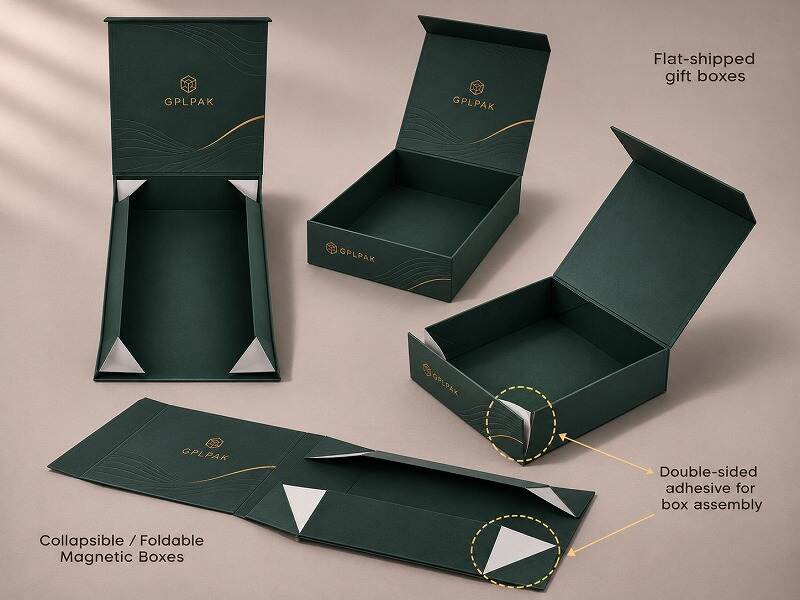
Corner retention determines whether the flat body becomes square, stays square during filling and can be collapsed again. It also changes labor and end-user behaviour. Do not assume that a “magnetic collapsible box” uses magnets at both the lid and corners; many designs use magnetic lid closure with adhesive corner stays.
Corner-retention options should be evaluated for erection time, squareness, reusability and appearance—not confused with the lid-closing magnets.
| Corner method | Pack-out effect | Strength | Approval focus |
|---|---|---|---|
| Peel-and-stick stays | Operator removes liners and bonds corners | Permanent assembly; simple finished wall | Adhesion after storage, erection time and placement consistency |
| Reusable magnetic stays | Corners engage without release liner | Can allow repeated collapse and erection | Corner stability, hardware visibility and cost |
| Mechanical fold or lock | Panels interlock during erection | Avoids pressure-sensitive adhesive | Ease of assembly, protrusions and repeatability |
| Fixed set-up body | No customer erection step | Consistent geometry when well made | Inbound cube and storage capacity |
Time the complete pack-out process with production operators: unfold, square, secure corners, insert product, close lid and place into any outer shipper. A corner system that looks elegant in a studio can still be unsuitable if it slows a high-volume packing line or requires precise manual alignment.
A magnetic presentation box is usually secondary packaging, not automatically a parcel-ready shipper. The product, insert, presentation box, protective materials, outer corrugated case and distribution route form one system. The lid staying closed in a desk test does not prove that the product will arrive undamaged.
Build a project-specific validation plan in this order:
Define damage: product damage, insert movement, lid opening, crushed corners, scuffing, wrap cracking and unacceptable cosmetic change.
Define the packed configuration: actual product or controlled dummy, production insert, accessories, retail box and outer shipper.
Select a distribution procedure: choose the test with a qualified laboratory or packaging engineer based on route, handling and pack weight.
Record pre- and post-test condition: photographs, closure behaviour, dimensions and agreed defects.
Retain tested and control samples: connect results to the signed specification and change-control process.
ISTA explains that its 1 Series procedures are integrity tests rather than simulations of every distribution hazard; the correct procedure depends on the packaged product and route. ASTM D5276 addresses free-fall drop testing of loaded containers, but it is not a complete distribution program by itself. Use the ISTA test-procedure overview and the current ASTM D5276 scope as starting references, then document the procedure selected for your project.
Air shipment note: magnets can be regulated when the magnetic field outside the completed package exceeds carrier or jurisdictional limits. The U.S. FAA publishes a specific threshold and packing guidance for magnetized material. Do not assume a small box is automatically exempt; ask the freight forwarder or carrier to review the finished shipping configuration for the relevant lane.
An opening-force check is a manufacturing-control tool for one feature. A packed-system test challenges the package through handling events and evaluates defined damage. They should not be merged into one vague requirement such as “pass drop test and magnet test.” The purchase order should identify which check is performed during production, which validation is performed on packed samples and what happens if either result falls outside the approved limit.
For production control, sampling frequency should reflect risk, process history and the buyer’s inspection plan. Early output after tooling setup or a material change normally deserves closer review than a stable repeat run. Any change to magnet source, board, wrap, adhesive, pocket geometry, corner retention or packing method should trigger documented assessment because it can alter the installed closure even when the artwork remains unchanged.
Most closure complaints are system problems, not proof that the magnet itself is defective. Diagnose the installed geometry before changing grade or adding more magnets.
| Symptom | Likely causes to inspect | Engineering response |
|---|---|---|
| Closure feels weak | Lateral offset, excessive installed gap, wall bow, incorrect component or incomplete closure contact | Measure alignment and gap first; update pockets, datums or wall geometry before increasing magnet strength |
| One side closes first | Unequal magnet position, skewed lid hinge, box not square | Reference both locations from common datums and add squareness checks after erection |
| Visible circular bump | Shallow recess, thick adhesive, thin wrap or excessive local pressure | Rebalance recess and retention; approve appearance under agreed lighting |
| Magnet becomes loose | Poor surface preparation, unsuitable adhesive, oversized pocket or impact | Specify retention method and verify after cycling and packed-system handling |
| Wrap cracks at hinge | Hinge gap, paper grain, brittle coating or low-temperature folding | Trial the production paper/finish on the real hinge and define an appearance limit |
| Box will not stay square | Corner-retention placement, panel tolerance, insert interference or poor erection sequence | Separate corner and lid checks; run a timed loaded pack-out trial |
A decorated sample is essential, but asking for it too early can conceal structural mistakes beneath expensive finishing. Use staged approvals so each sample answers a defined question.
Input review: product dimensions, weight, insert, intended opening experience, pack-out site, order quantity and distribution route.
Structural white sample: confirm erected internal size, panel plan, hinges, corners, insert access and lid alignment. Use the actual product.
Closure trial: compare feasible component layouts in the real structure; agree the preferred installed opening feel and test method.
Decorated production-intent sample: verify wrap, colour, foil, embossing, concealed hardware, hinge appearance and pack-out sequence.
Packed-system validation: test representative product, insert, retail box and outer shipping pack under the selected plan.
Golden-sample approval: sign the physical sample, drawing, bill of materials, artwork, inspection limits and change-control rules together.
Keep an approved sample at both buyer and supplier locations. A photograph is useful for colour and layout reference but cannot define hinge resistance, squareness, opening feel or tactile defects. When qualifying a new source, use the separate 12-point collapsible rigid-box manufacturer checklist.
The approved sample is useful only when its materials and process are traceable. The purchase order should require written approval before substituting a magnetic component, steel plate, board, wrap, adhesive or corner system. If a substitution is proposed, the supplier should identify the reason, affected specification fields and verification required. This prevents a visually similar component from entering production while changing closure behaviour or air-shipment classification.
A useful quotation package lets each supplier price the same deliverable. Include these fields rather than sending only a reference photo:
| 01. Product description, dimensions and packed weight | 02. Erected internal size and dimensional convention |
| 03. Flat footprint and maximum packed bundle size | 04. Panel material, grade and finished board plan |
| 05. Hinge layout and permitted appearance after cycling | 06. Corner-retention method and assembly sequence |
| 07. Magnetic component, mating part, locations and retention | 08. Opening-test method and golden-sample reference |
| 09. Wrap, liner, printing, coating, foil and embossing | 10. Insert material, fit, loading orientation and accessories |
| 11. Quantity by artwork/SKU and forecasted repeat orders | 12. Export packing, pallet or parcel constraints and Incoterm |
| 13. Packed-system test plan and acceptance criteria | 14. Inspection, traceability and engineering-change process |
Request that alternatives be quoted as separate, clearly described options. If one supplier proposes a steel plate and another proposes a second magnet, the closure systems are not identical. The same applies to adhesive corners versus reusable magnetic corners. For total-cost planning, see custom collapsible rigid boxes wholesale: MOQ and cost drivers and the overview of custom rigid paper-box cost.
No. A collapsible rigid box normally uses separate rigid greyboard panels joined by wrapped hinge gaps. A folding carton is usually converted from a creased paperboard blank. Both can fold and use magnets, but they differ in wall stiffness, manufacturing, freight footprint and presentation.
No. Magnets are common for book-style lids and sometimes for reusable corners, but ribbon ties, sleeves, mechanical locks and other closures are possible. Select the closure from the opening experience, reusability, cost, shipping and regulatory requirements.
No. A higher material grade can provide different magnetic properties in the same geometry, but installed performance also depends on magnet size, mating part, alignment, separation, wall stiffness and retention. Approve the finished closure under a documented test method instead of selecting by grade alone.
There is no universal target. The correct level depends on box size, lid geometry, payload, intended user and desired feel. Develop and approve a production-intent sample, then use the same fixture, pull point, direction, speed and conditioning state for production comparisons.
Often yes, but acceptance depends on the magnetic field outside the completed shipping package and the rules that apply to the lane and carrier. Confirm the packed configuration with the freight forwarder; do not rely on the magnet count or box size alone.
ISTA procedures evaluate a defined packaged-product system. The empty retail box is only one component. Test the actual or controlled product, insert, presentation box, cushioning and outer shipping pack in the approved configuration.
Control the recess, retention method, component thickness, paper build-up and wrapping pressure together. Review a decorated production-intent sample under agreed lighting and define the acceptable cosmetic limit before mass production.
Send the product or controlled drawing, required internal size, expected payload, preferred structure and corner method, artwork and finishes, insert, quantity by SKU, packing route, destination, test needs and target schedule. A physical product is preferable when fit and balance are important.
Share the product dimensions, payload, target box size, artwork, order quantity and distribution route. GPLPAK can review the structure and prepare a project-specific sampling path before mass-production approval.
Request a Project Review View Magnetic Box Options Горячие новости
2026-11-18
2026-11-13
2026-11-13
2026-11-10
2026-11-05
2026-11-02
2026-10-27
2026-10-23
2026-10-16
2026-10-12
Discover premium packaging solutions from Dongguan Xinglan Packaging Products Co., Ltd. Specializing in innovative, durable, and custom packaging products for diverse industries.
GPLPAK стремится к обеспечению высочайшего уровня производственной деятельности.