 EN
 EN
 RU
 ES
 KO
 JA
 PT
 IT
 DE
 FR
 NL
Liens rapides
Choosing a custom collapsible rigid box manufacturer is a qualification exercise, not a price comparison. A capable supplier can prove, with documents and a physical sample, that the flat-packed box you approve will still erect squarely, close with the same magnet force and survive transit on the ten-thousandth unit — not just the first one. This 12-point checklist converts that claim into verifiable checkpoints: what to ask, which evidence to request, and which answers should end the conversation.
Collapsible rigid boxes are a hybrid product. They carry the wrapped grey board, foil stamping and tight tolerances of a luxury set-up box, but they are engineered to ship flat and be erected by a packer or by the end customer. That combination adds variables a conventional rigid box factory never has to control: hinge direction, corner-lock geometry, wrap clearance at the fold, magnet polarity and alignment, adhesive creep, and the erection force after weeks in a container. A supplier that is excellent at one construction is not automatically competent at the other.
The framework below is written from the buyer's side of the table. It assumes you are sourcing from China or another export market, that you have a product to protect and a brand to present, and that you want a supplier relationship that survives the second and third order. Every checkpoint includes the evidence a serious manufacturer can produce within a few days — and the warning signs that a quote is being built on optimism rather than process control.
In a collapsible box, the difference between a good and a bad supplier rarely shows up in the first sample. It shows up in week six of a production run, when 3,000 boxes arrive with corner locks that need two hands and a knee to seat, or with lids that sit 1.5 mm proud on one side because the wrap was laminated at a different tension from the approval sample.
The financial exposure is asymmetric. A rigid box that fails inspection is scrap. A collapsible box that fails in the field is worse: it reaches your customer, damages the unboxing experience you paid a premium to create, and generates returns that cost several times the unit price. On a 5,000-unit launch, a 3% erectability failure rate means 150 customer complaints and a replacement shipment — before anyone has discussed the tooling amortization.
This is why the qualification process has to look past the showroom. The questions that matter are process questions: Who converts the grey board? Who wraps the panels? Who inserts the magnets, and how is polarity checked? What happens when the print registration drifts mid-run? A supplier with answers is a supplier with a system. A supplier with adjectives is a supplier with a brochure.
💡 Tip: Run this checklist before you request a quotation, not after. Suppliers quote what they are asked to quote. If your RFQ omits board grade, magnet specification, tolerance and test standard, every quote you receive will be for a different product, and the cheapest one will usually be the one that quietly omitted the most.
The table below is the working version of the checklist. Each row names the checkpoint, the evidence a competent manufacturer can supply, and the answer that should make you pause. The sections that follow explain how to interpret each one.
| # | Checkpoint | Evidence to request | Red flag |
|---|---|---|---|
| 1 | Define the packaging job | Written spec sheet with internal dimensions, product weight, volume and test standard | Quote issued without a spec sheet |
| 2 | Verify collapsible experience | Three comparable SKUs with video of erection and closing | Only non-collapsible rigid box references |
| 3 | Map in-house vs subcontracted | Process flow with each step marked in-house or outsourced | Cannot name who converts the board |
| 4 | Audit structural engineering | Dieline, 3D mock-up, tolerance stack and hinge test data | No tolerance drawing, only a photo |
| 5 | Confirm material traceability | Board grade, grammage, FSC claim and lot records | Vague "high quality" material description |
| 6 | Control artwork and color | Proofing standard, Delta E target and drawdown for special finishes | "Color will be close to your file" |
| 7 | Approve a process sample | Production-run sample plus signed golden sample | Hand-made sample from a different line |
| 8 | Agree measurable QC criteria | AQL level, defect classification and inspection points | "We check every box" with no record |
| 9 | Check capacity and change control | Monthly capacity, peak-season plan, written ECN flow | Promises any volume at any date |
| 10 | Verify compliance documents | FSC, RoHS or REACH, food-contact and transit test reports | Certificates with no scope or expiry date |
| 11 | Compare total landed cost | Costed quote covering tooling, packing, freight and duties | Unit price quoted without Incoterm |
| 12 | Confirm service and escalation | Named contact, response SLA and written claim window | Only a sales chat account, no company email |
A collapsible rigid box cannot be quoted responsibly from a photo. Before you contact a manufacturer, write a one-page specification that covers the variables below. This document becomes the basis for every quotation, the reference for the sample, and the attachment to your purchase order. Suppliers who receive it will quote faster and more accurately; suppliers who resist it are telling you something useful.
Internal dimensions in millimetres, measured against the product plus any insert, with the measurement method stated. External dimensions follow from board thickness, so specify which one is fixed.
Product weight and centre of gravity, because a 1.2 kg cosmetic jar and a 6 kg wine bottle demand different board grades and hinge reinforcement.
Construction type: magnetic closure, lid-and-base, drawer, book-style or sleeve. Each has a different fold pattern and a different failure mode.
Annual and per-order volume, with a realistic forecast range. Volume drives tooling amortization, material purchasing and whether offset or digital print is economic.
Transit and test standard: ISTA 1A or 3A, Amazon SIOC, or your own drop protocol. State it now; retrofitting a test standard after tooling is expensive.
Market and compliance scope: EU, US, UK, Middle East. This determines labeling, material declarations and whether food-contact documentation is needed.
If you have not fixed every value, say so and give ranges. A manufacturer who works with ranges and flags the cost impact of each choice is more valuable than one who returns a single number with no assumptions attached. For a deeper treatment of the box itself, the complete B2B buyer's guide to custom collapsible rigid boxes covers structure, materials and cost drivers in detail.
Ask for three references that are genuinely comparable: same construction family, similar size, similar print coverage, produced in the last eighteen months. Then ask for a short video of the box being erected and closed one-handed. This single request separates factories that build collapsible boxes from factories that have built one.
Listen for the vocabulary. An experienced supplier will talk about hinge score depth, corner lock clearance, wrap grain direction and the difference between a 45-degree and a 90-degree corner fold. They will ask you how the box will be erected — by a packer on a line, or by an end customer opening a mailer — because the answer changes the target erection force.

Comparable samples, board offcuts and magnet stock on the audit table: ask to see all three together.
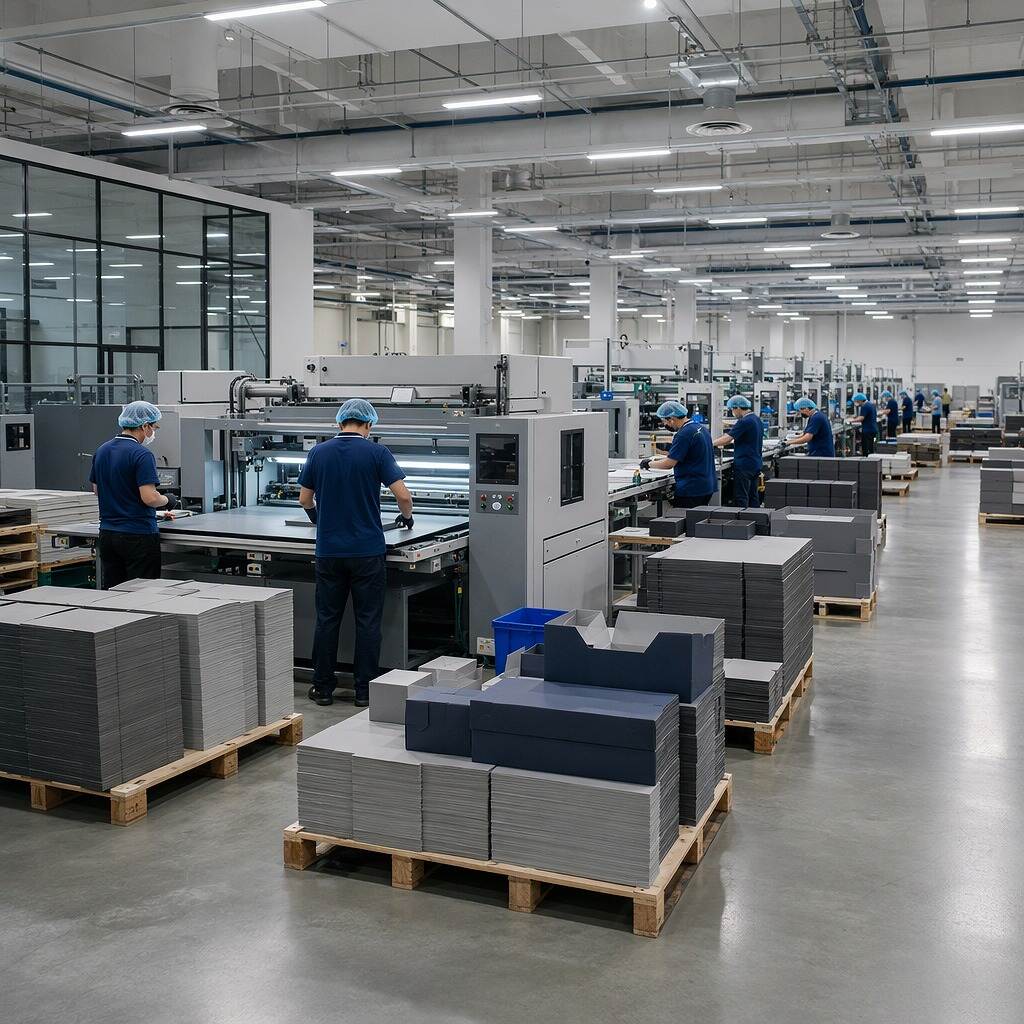
Almost no packaging factory performs every step under one roof. Printing, grey board converting, magnet insertion, foam or EVA cutting, and assembly are frequently split between the supplier and its neighbors. That is normal. What is not normal is a supplier who cannot tell you which steps are theirs.
Ask for a process flow with each step marked in-house or outsourced, and ask which subcontractors are used for the critical steps. The risk you are pricing is the interface between companies: a wrapped panel that leaves one plant at 0.2 mm over thickness arrives at another and no longer closes cleanly. Suppliers who own converting and wrapping have tighter control over that interface than suppliers who broker it.
⚠️ Important: A trading company is not automatically a bad choice — many add real value in communication, consolidation and quality follow-up. The problem is a trading company that presents itself as a factory. Verify the production site address, ask for a live video walk-through, and confirm that the entity on the quotation is the entity that will invoice you.
A collapsible box is a folding mechanism disguised as packaging. Its engineering file should include a dieline with fold lines and grain direction, a 3D mock-up showing the erected and collapsed states, a tolerance stack for the closure, and test data for hinge fatigue. Ask how many erection cycles the hinge is expected to survive and how that was validated.
Tolerance is where optimistic suppliers get caught. Every material in the stack — grey board, adhesive, wrap paper, laminate — carries a thickness tolerance, and those tolerances add up at the closure. A supplier who can show you the stack calculation, and who proposes a closure gap that accommodates the worst case rather than the nominal case, is engineering the product. One who says "our workers are very skilled" is hoping the problem away.
How does the wrap grain direction change the fold behaviour at the hinge, and which direction did you choose for this box?
What is the target erection force, and how do you measure it on the line?
If the board arrives 0.15 mm over gauge, what happens to the lid fit, and what is your correction?
How many open-close cycles did the hinge survive in your last test, and at what temperature and humidity?
Vague material descriptions are the most common source of quote drift. "High-grade grey board" can mean 800 gsm or 1,400 gsm, and the difference changes both rigidity and price by a wide margin. Require grammage, board type, paper face stock and adhesive class in writing, then verify them against the sample you receive.
| Component | What to specify | Why it matters in a collapsible box |
|---|---|---|
| Grey board | Grammage, thickness, recycled content, moisture content | Controls panel stiffness and how the corner lock seats after folding |
| Wrap paper | Face stock type, grammage, grain direction, coating | Determines fold cracking, scuff resistance and color stability |
| Magnets | Grade, diameter, thickness, pull force, polarity convention | Sets closure feel and whether the lid stays shut in transit |
| Adhesive | Type, open time, temperature range | Affects delamination at the hinge after container heat exposure |
| Insérer | EVA density, foam grade, moulded pulp or PET, fit clearance | Prevents product movement, which is the leading cause of transit damage |
Traceability is the second half of this checkpoint. Ask whether the mill certificate or FSC transaction record can be linked to your production lot, and whether the supplier keeps a retained sample from each run. If your brand makes a sustainability claim, the chain-of-custody documentation has to survive an audit, not just a marketing page. GPLPAK publishes its FSC and RoHS certification scope, which is the level of detail you should expect from any supplier you shortlist.
On a wrapped box, color is applied to paper that will then be folded, glued and handled. The same ink film that matches your brand guide on a flat sheet can crack along a hinge or shift when a soft-touch laminate is applied. The supplier should name the proofing standard, state a color tolerance, and produce a drawdown for any special finish before committing to production.
Ask specifically about foil stamping over folded edges, emboss registration across a hinge line, and whether the laminate is applied before or after printing. These are the details that decide whether the box looks premium at arm's length or only in a photograph. A supplier who offers a physical proof with the actual substrate and finish is worth a higher unit price than one who emails a PDF.
There are two kinds of sample and they are not interchangeable. A prototype is made to prove the concept; it may be hand-cut, hand-wrapped and assembled by a technician. A pre-production sample is made on the production line using the production dieline, the specified materials and the actual process. Only the second one tells you what your order will look like.
Insist on a pre-production sample from the production line, and test it the way your customer will. Erect and collapse it twenty times. Close it and shake it. Drop it from the height your transit standard requires. Leave it in a warm room for a week and check for adhesive creep or wrap lifting. Then sign and retain a golden sample, and require that the bulk order be measured against it.

Measure the closure gap and corner squareness on the sample, then write the numbers into the inspection plan.
"Good quality" is not a specification. Before production, agree on an inspection standard, a defect classification and the measurement points that matter for this box. The table below is a practical starting point for a collapsible rigid box; adjust the acceptance values to your product and your customer's expectations.
| Characteristic | How to measure | Typical acceptance |
|---|---|---|
| Internal dimensions | Caliper at three points per axis, box erected | Within the tolerance on the approved drawing |
| Closure gap | Feeler gauge or calibrated gap gauge at four sides | Even gap, no visible step, no interference |
| Corner squareness | Diagonal measurement difference | Consistent across the lot, within drawing limit |
| Magnet pull | Force gauge, lid opened from closed position | Within the agreed range, consistent left to right |
| Print and finish | Visual against golden sample, colorimeter where specified | No scuff, blister, foil skip or delamination |
| Erectability | Timed trial by a packer, 20 cycles | No deformation, no torn hinge, repeatable fit |
Write the AQL level into the purchase order. For consumer packaging, general inspection level II with an agreed critical, major and minor defect classification is common; critical defects such as a non-closing lid should have an acceptance number of zero. If the supplier cannot explain their AQL plan in one paragraph, they do not have one.
Ask for monthly capacity in the specific construction, not in square metres of cardboard. A factory that runs 200,000 folding cartons a month may still have only two collapsible assembly lines. Ask what happens in the pre-Chinese-New Year peak, how orders are scheduled, and whether your tooling is stored and maintained between runs.
Change control is the quieter risk. If you revise artwork after the golden sample, what is the process? Who re-approves the dieline? Is there a written ECN form, and does the old tooling get quarantined? Suppliers who answer these questions without hesitation have been through a recall or a chargeback before — which is exactly the experience you want protecting your order.
Compliance is not a certificate PDF; it is a certificate with a scope that covers your product and an expiry date that covers your shipment. Check the certificate number with the issuing body where possible, and confirm that the material grades used for your box fall inside the certified scope.
Forest certification: FSC chain-of-custody with a valid license code, and a transaction certificate that references your order if you intend to use the logo.
Chemical compliance: RoHS and REACH declarations for inks, adhesives, laminates and magnets, plus heavy-metal and phthalate test reports where relevant.
Food contact: if the box touches food directly or indirectly, request food-grade declarations for the board, ink and adhesive, and confirm the production line separation.
Packaging and waste rules: EU buyers should confirm recyclability claims and material reporting obligations under the evolving Packaging and Packaging Waste Regulation, plus national extended producer responsibility registration.
Transit performance: ISTA or equivalent test reports for a comparable box and weight, not a generic certificate for a different product.
💡 Tip: Ask for the documents before you ask for the price. A supplier who can produce a scoped FSC certificate and a REACH declaration within two working days has a compliance system. One who says "we will send after you order" is telling you the documents are borrowed.
Unit price is the least comparable number in packaging sourcing. One quote includes tooling and export cartons; another amortizes tooling into the first order and charges freight separately; a third assumes a different Incoterm. Normalize before you compare, and put every line into the same cost model. Our guide to what a custom rigid paper box actually costs breaks down the same cost drivers from the factory side.
| Cost line | What to normalize | Why it changes the decision |
|---|---|---|
| Tooling and plates | One-time vs amortized; ownership on cancellation | A low unit price with high tooling punishes small first orders |
| Sampling | Prototype, pre-production and courier costs | Free sampling is often priced into the unit rate |
| Unit price | Same quantity tier, same materials, same insert | Price breaks can differ by 20% between tiers |
| Export packing | Carton strength, units per carton, pallet configuration | Collapsible boxes ship flat, so carton efficiency is a real saving |
| Freight and duties | Incoterm, chargeable weight, HS code, duty rate | FOB and DDP quotes cannot be compared directly |
| Quality cost | Inspection, rework, replacement and return handling | A 5% defect rate can erase a 10% price advantage |
Build the landed cost per usable box, not per shipped box: divide total landed cost by the number of units that pass inspection and reach the customer in sellable condition. That single change in the formula usually reorders the shortlist. For the volume side of the equation, see the comparison of collapsible versus rigid boxes and their shipping and storage costs.
Most sourcing failures are communication failures wearing a quality costume. Ask who your account manager will be, who covers when they are on leave, and who has the authority to stop a production run. Get a written response-time commitment and a named escalation contact — not a generic sales inbox.
Then agree the commercial safety net in writing: the defect claim window after arrival, who pays for rework or replacement, how defective units are counted, and whether the supplier will support a third-party inspection at your cost. A supplier who negotiates these terms fairly is a supplier who expects to still be working with you next year.
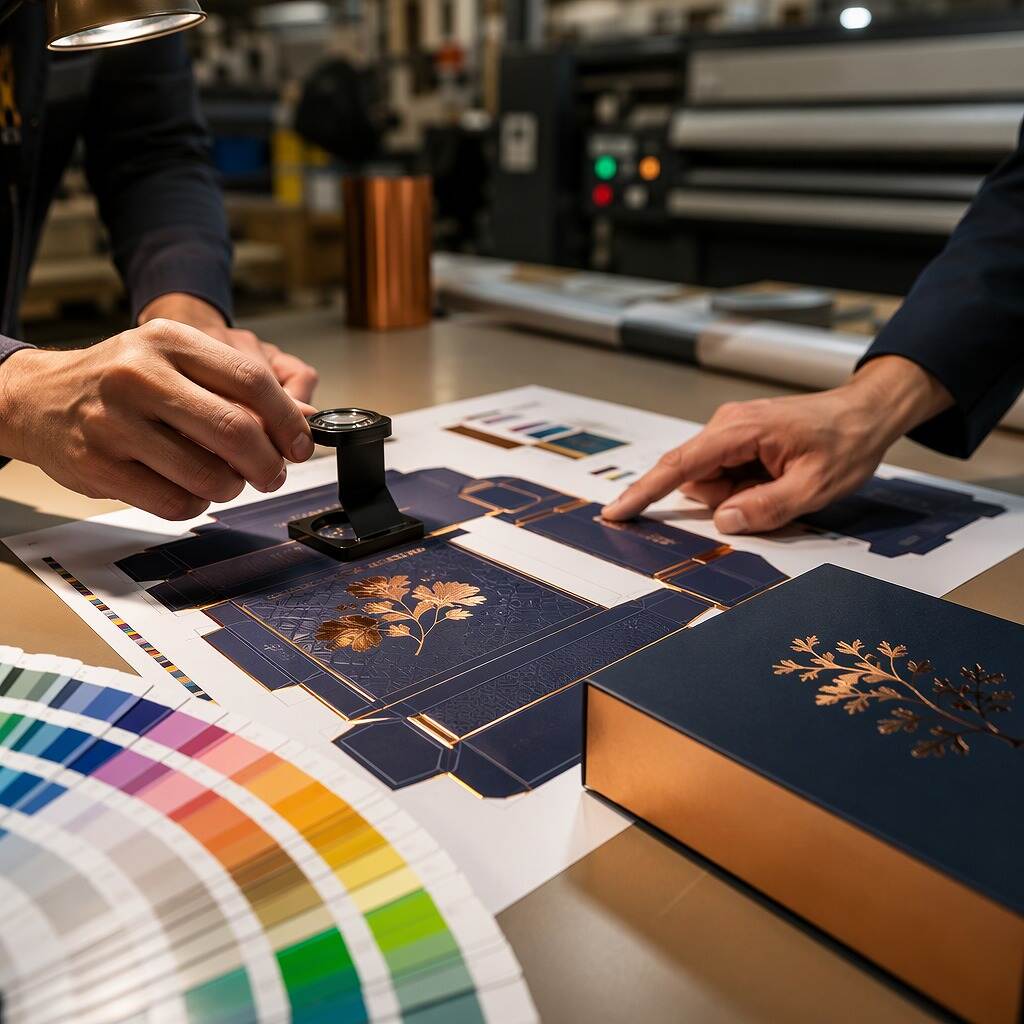
A complete approval pack: signed golden sample, inspection report, material declarations and certificate scope.
A factory visit does not need to be a week-long expedition. Ninety focused minutes, with the right questions and a camera, will tell you more than a year of email. If you cannot travel, run the same agenda over a live video call and ask the supplier to walk the floor without cutting away.
Look at board labels and grammage, check that the board you specified is actually in stock, and ask how material is segregated by job.
Watch a panel being wrapped and folded. Check hinge scoring depth, corner alignment, and whether operators have a visual standard at the station.
Confirm magnet polarity checking, adhesive application method, and how assembled boxes are rested before packing.
Ask to see the last three inspection reports, the retained samples, and the corrective action log. Records tell the truth about the process.
Sit with the engineer, open your dieline, and ask what they would change and why. The quality of that conversation is the audit result.
If the visit is remote, ask for a continuous walk-through rather than a slideshow, and request that the camera show machine nameplates and material labels. A supplier with nothing to hide will do it without friction. A supplier who needs to prepare a "video set" is not showing you the factory that will make your boxes.
Some issues are negotiable. Others are structural. The following signals usually mean the supplier cannot deliver a collapsible rigid box program at the quality level the format implies, regardless of the price on the quotation.
A quote within two hours, without a specification. Real collapsible box pricing requires a dieline, a material stack and a volume tier. Speed here means guessing.
No tolerance drawing and no answer on closure gap. The box may look right in a photo and fail on the packing line.
Samples made somewhere other than the production line. A beautiful hand-made prototype is not evidence of process capability.
A price 30% below the shortlist average with the same spec. Either the material grade changed, the insert disappeared, or the quote is a placeholder that will be renegotiated after tooling.
Refusal to allow a third-party inspection. This is a standard, low-cost request in export packaging. Refusal is an answer.
Certificates with no scope, no number and no expiry. A logo on a website is not compliance documentation.
Pressure for full payment before sample approval. Standard terms exist precisely to avoid this exposure.
⚠️ Important: Do not use a low price to justify skipping the sample approval. The cost of one pre-production sample is a rounding error against the cost of air-freighting replacements or delaying a retail launch.
Once the shortlist is down to three suppliers, send the same specification, the same artwork files and the same Incoterm to all of them, and ask each to quote three volume tiers. Then normalize the responses into a single sheet with the following columns: tooling, sampling, unit price per tier, export carton cost, units per carton, lead time, payment terms, and validity period.
Two adjustments matter more than the rest. First, add the cost of the insert if one supplier excluded it. Second, adjust for carton efficiency: a collapsible box that packs 40 units per carton instead of 25 reduces freight per unit by a meaningful margin on ocean shipments, and that difference can outweigh a few cents of unit price.
Finally, ask each supplier to state the assumptions behind their number. The supplier who writes "based on 1,000 units, 1,200 gsm grey board, 157 gsm art paper, EVA insert, FOB Shenzhen, 25 days" has given you a document you can hold them to. The one who writes "best price" has given you a marketing line. For a broader view of how manufacturers position themselves, see this strategic review of finding custom packaging manufacturers in China and these five factors for selecting a hard paper box manufacturer.
Human judgment drifts toward the supplier who communicates best in your language or replies fastest. A weighted scorecard keeps the decision anchored to the things that determine whether the order succeeds. Score each criterion from 1 to 5, multiply by the weight, and review the result with the evidence file open.
| Criterion | Weight | What earns a top score |
|---|---|---|
| Structural engineering | 20% | Dieline, tolerance stack, hinge test data, clear answers on fold behaviour |
| Sample quality | 20% | Pre-production sample passes erectability, closure and drop checks first time |
| Quality system | 15% | Written AQL plan, retained samples, corrective action records |
| Capacity and lead time | 15% | Realistic capacity, peak-season plan, buffer in the promised date |
| Conformité | 10% | Scoped certificates, material declarations, transit test reports |
| Communication | 10% | Named contact, technical English, fast answers with evidence attached |
| Landed cost | 10% | Competitive cost per usable box, transparent assumptions, fair terms |
A supplier who scores 4 or 5 on the first two criteria and 3 on price is usually the better long-term partner than the reverse. Engineering and sample performance are the two areas you cannot fix after the purchase order is signed; price can be renegotiated on the next order, and usually is.
Send us your dieline, product dimensions and target volume. We will return a structural review, a material recommendation, a pre-production sample plan and a costed quotation covering the same twelve checkpoints — so you can compare us on evidence, not adjectives.
© 2026 GPLPAK - China's Professional Custom Packaging Manufacturer
 Actualités chaudes
2026-11-10
2026-11-05
2026-11-02
2026-10-27
2026-10-23
2026-10-16
2026-10-12
2026-10-07
2026-09-30
2026-09-23
Discover premium packaging solutions from Dongguan Xinglan Packaging Products Co., Ltd. Specializing in innovative, durable, and custom packaging products for diverse industries.
GPLPAK s’engage à offrir une excellence en matière de fabrication.