 EN
 EN
 RU
 ES
 KO
 JA
 PT
 IT
 DE
 FR
 NL
Liens rapides
In brief: an eco-friendly collapsible rigid box is not defined by kraft colour. Specify a solid greyboard core with paper wrap and flexible hinge gaps, verify any FSC claim through chain-of-custody documents, and assess the finished stack—including adhesive, magnets, coatings and insert—for the intended collection stream. PPWR rules began applying in phases on 12 August 2026; EU buyers should plan for the design-for-recycling framework rather than claim that an untested mixed-material box is already "100% recyclable."
Sustainability questions from B2B buyers have changed since 2024. They are no longer "can you make it in kraft paper." They are "which certificate covers this board, what happens to the magnet at end of life, and will this spec still be legal in 2030." Those are answerable questions, and they belong on the specification sheet rather than in a marketing paragraph.
This guide separates the three things buyers routinely mix together: fibre sourcing (where the paper comes from), recyclability (what happens to the finished box in a mill), and compliance (what EU law requires, by when). It also explains which design choices in a collapsible rigid box quietly destroy the recyclability claim, and how to write a green claim that survives scrutiny.
The phrase is too broad for a specification. Separate three questions: whether fibre is certified and traceable, whether the complete package has evidence for the intended recycling route, and whether each printed environmental claim is substantiated. The box described here uses separate solid greyboard panels wrapped in paper, not corrugated board or a single creased carton blank.
The distinction matters because the three legs fail independently. A box can be made from 100 percent FSC-certified board and still be difficult to recycle because of a plastic laminate. It can be fully repulpable and still carry a claim that regulators consider misleading. Or it can be compliant on paper and still be rejected by a mill because the magnet pocket cannot be separated.
| Claim you want to make | Evidence a buyer should demand | Where it usually breaks |
|---|---|---|
| Made from certified fibre | FSC or PEFC chain-of-custody certificate number and scope, plus the claim category on the invoice | The certificate covers the converter, but the specific board grade or the wrap paper is bought outside the scope |
| Recyclable | A recognised assessment or mill acceptance for the whole material stack, not only the board | Plastic film lamination, foam inserts and encapsulated magnets make the box a mixed-material item |
| Recycled content | Percentage by weight, pre-consumer or post-consumer, and which component it applies to | A recycled greyboard core is claimed as if the printed wrap were recycled too |
| Plastic-free | Component-by-component declaration including laminates, windows, magnets, ribbons, glues and inserts | A thin BOPP laminate or a PET window is easy to overlook and hard to defend |
| Compostable | Certification to a recognised compostability standard for the finished item, plus the disposal route it assumes | Paper boxes are rarely compostable as a system, and industrial composting is not available to most consumers |
Important: "eco-friendly" is a marketing word, not a technical specification. In the EU, generic environmental claims are increasingly restricted. Use it in a blog title if you like, but put measurable statements on the box: certified fibre, stated recycled content, and the actual end-of-life instruction.
Certification is the easiest of the three legs to verify, and the easiest to overstate. A supplier holding a chain-of-custody certificate can sell certified output, but only for the products and sites inside the certificate scope, and only with the correct claim on the commercial documents.
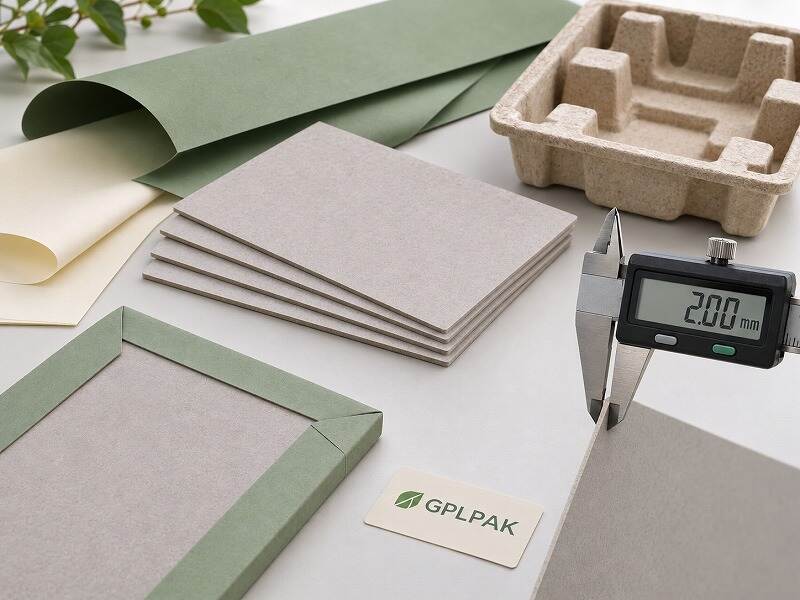
Certified board only becomes a certified box when every fibre input in the certificate scope is controlled, including the wrap paper and the liner.
| Label | What it means | Typical use in rigid boxes |
|---|---|---|
| FSC 100% | All fibre comes from FSC-certified forests | Premium virgin kraft board and wrap for brands that want the strongest claim |
| FSC Mix | A mix of FSC-certified, recycled and controlled fibre, tracked through the chain of custody | The most common claim for rigid box board that combines virgin and recycled pulp |
| FSC Recycled | All fibre is recycled, with a defined split between pre-consumer and post-consumer content | Greyboard cores made from recovered paper, common in collapsible rigid boxes |
PEFC works in a similar way with a different governance model; both are recognised in Europe and both rely on a chain-of-custody audit of the converter. The FSC certificate database is public, so a licence code on a quotation can be checked in minutes. Whichever scheme is used, three checks separate a real claim from a logo on a website. First, the certificate number must be visible and traceable to the converting site, not only to a trading company. Second, the claim category must appear on the invoice and packing list, because that is what transfers the certified status to you as the buyer. Third, the on-product label must be applied under the scheme's own trademark rules, including the licence code.
Do not infer that a particular box is FSC-certified from a supplier's website or a photograph of a certificate. Request the current certificate, confirm the relevant product group and site in scope, and check that the correct claim accompanies the specific order on sales documentation. FSC's chain-of-custody guidance explains the traceability requirement.
Recycled content answers "what is it made of." Recyclability answers "what happens to it after use." A box can score well on the first and poorly on the second. Greyboard with a high post-consumer recycled content is normal in this product category and does not reduce structural performance when the caliper and ply are specified correctly, but it can carry more mineral filler and slightly different stiffness, so the dieline and pocket depth should be validated on the actual board batch.
State recycled content by component and weight, supported by supplier declarations and purchase records. A hypothetical percentage is not a product claim: the greyboard core, wrap paper, liner and total package may all have different values. Do not print an overall percentage until the actual bill of materials and calculation are approved.
Three numbers make the claim auditable, and all three should appear in the same document:
Percentage by weight of the finished box, not of the board alone, so the wrap and liner are included in the denominator.
Pre-consumer or post-consumer split. The two are not interchangeable in most reporting frameworks, and buyers increasingly ask for post-consumer only.
Which components the percentage covers, with the certified or uncertified status of each one stated separately.
Paper recycling mills do not see a box; they see a fibre stream with contaminants. Anything that does not disperse into pulp becomes rejects, and reject rates are what determine whether a mill accepts a grade and what the packaging producer pays in modulated fees. In a collapsible rigid box, the board is rarely the problem. The problem is what has been added to it.
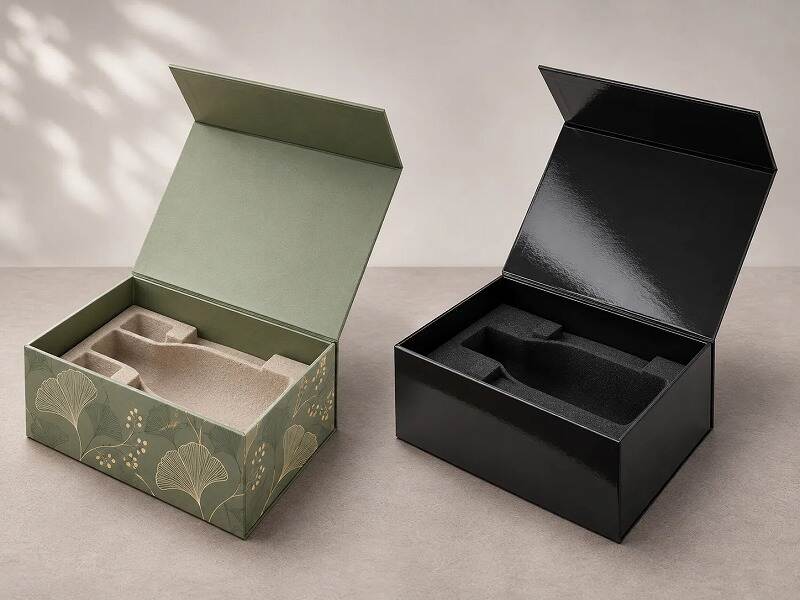
Two boxes that look equally premium: the left one is a single fibre stream once the insert is lifted out, the right one is a laminate, a foam tray and a magnet pocket.
| Layer | Repulpability impact | Eco-design alternative |
|---|---|---|
| Greyboard core | Low. Recovered fibre board is a standard furnish for recycled paper mills | Specify recycled content and keep the caliper no thicker than the structure needs |
| Printed art paper wrap | Low to moderate. Ink coverage and coating type affect the deinking load | Water-based or vegetable-oil inks; uncoated or lightly coated stock; avoid heavy full-surface varnish |
| Plastic film lamination | High. A BOPP or PET film does not disperse and becomes reject or a fibre-quality penalty | Aqueous or bio-based coating for scuff resistance; specify the protection level instead of the material |
| Estampage à chaud | Moderate at high coverage. Metallic foil fragments are screened out but reduce yield | Keep foil to a logo area; use embossing, high-build varnish or metallic ink for large panels |
| Adhesives | Low at normal application weights if the adhesive is water-based or a standard hot melt | Ask for the adhesive type and application weight; avoid excessive glue lines that create stickies |
| Neodymium magnets | High if encapsulated. Metal is recoverable by magnetic separation only when it is free to be separated | Expose the magnet for removal, use a paper-only closure, or design a tear-out pocket for end users |
| EVA foam insert | High. Foam does not repulp and is not collected with paper | Removable molded-pulp insert or a solid paperboard platform with validated product fit |
| PET window or ribbon | Moderate to high depending on how easily it separates | Paper window patch, die-cut opening, or a removable ribbon that the customer keeps |
The practical reading of this table is not "remove every added material." It is "know which layer is doing the damage and decide whether it is worth it." A plastic laminate that protects a scuff-prone dark wrap may be defensible if the brand accepts the recyclability penalty, but it cannot coexist with a "100 percent recyclable" claim. The cost-benefit analysis of eco-friendly paper boxes covers the price side of those trade-offs.
A collapsible rigid box can combine solid greyboard, paper wrap, adhesive, magnets and a separate insert. That does not automatically make the finished pack recyclable or unrecyclable. The design question is how each component behaves in the intended collection, sorting and recycling system—and which parts can realistically be removed without compromising safe use.
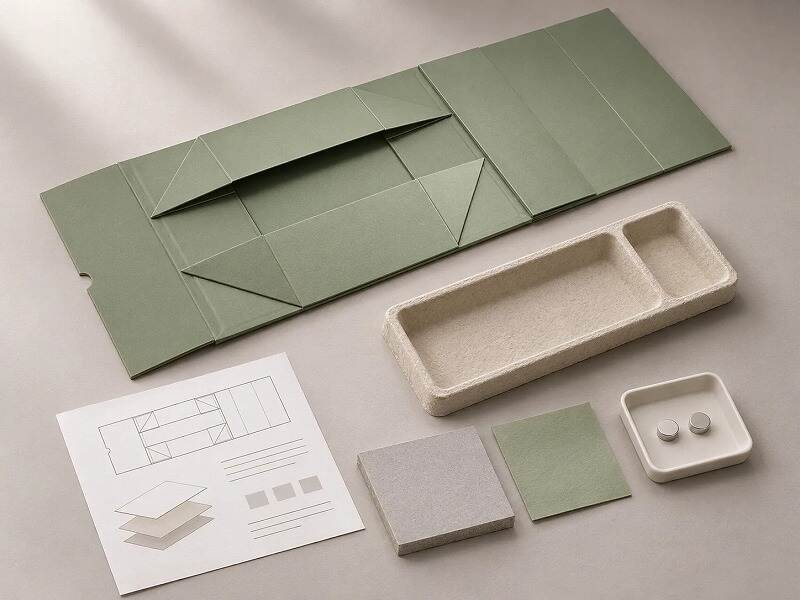
Material audit illustration: the loose magnets are sample components, not a claim that concealed production magnets can be removed by hand.
A pocket with a visible peel tab or a slot that lets the disc be pushed out converts a contaminant into a recoverable component. If the magnet must be hidden, specify a tear line around the pocket.
A removable molded-pulp insert or solid paperboard platform can simplify material separation. Confirm the intended local sorting route; a foam insert needs its own disposal instruction and must not be described as paper.
A candidate aqueous coating may avoid a separate plastic film, but its recyclability and scuff protection are not guaranteed by the word “water-based.” Test the finished wrap with the selected coating and intended recycling method.
Give a specific instruction only when the action is safe and feasible for the production design. Do not tell consumers to remove encapsulated magnets unless the closure includes a validated, accessible removal feature; otherwise disclose the mixed-material construction and follow market-specific sorting guidance.
The same logic applies to the wrap. A box wrapped in printed art paper around a greyboard core is essentially a single fibre stream once the magnet and insert are removed. A box wrapped in a plastic film, lined with flocking and closed with a magnet is three streams and a reject. The difference is visible on the sample table long before it reaches a mill.
"Recyclable" is a testable property in Europe, not a marketing opinion. Several methods exist, and they answer slightly different questions. Buyers should know which one a supplier is citing, because a favourable result on one method does not guarantee acceptance at a specific mill.
| Method or framework | What it assesses | How buyers use it |
|---|---|---|
| 4evergreen Recyclability Evaluation Protocol | Fibre-based packaging against a common European scoring approach, including component separability | A practical screening tool for a new structure before committing to tooling |
| ATICELCA 501 | Repulpability of paper-based packaging in a laboratory pulping sequence, with a yield threshold | Widely recognised in Italy and used across Europe as evidence for a recyclability claim |
| ISO 18604 and EN 13430 | The standard framework for packaging recoverable by material recycling, and the requirements to demonstrate it | Useful as the contractual reference when a buyer wants a defined method rather than a score |
| Mill acceptance trial | Actual behaviour in a specific mill's pulper, including reject rate and stickies | The final word for high-volume programmes; slower and more expensive than a lab method |
For most buyers, the sensible sequence is a lab assessment on the proposed stack, then a mill trial once volumes justify it. Ask for the report, not the summary sentence. The useful parts are the furnish, the pulping conditions, the yield, the reject description and whether the sample included the magnet, the insert and the adhesive at production weights.
Tip: test the box as sold, with the closure and insert in place. A certificate for the greyboard alone says nothing about a finished box that contains two magnets and a foam tray, and that gap is where most "recyclable" claims quietly fall apart.
The Packaging and Packaging Waste Regulation replaced the old Directive 94/62/EC with a directly applicable regulation. Regulation (EU) 2025/40 entered into force on 11 February 2025 and applies from 12 August 2026. Because it is a regulation, it does not need national transposition, although many operational details arrive through delegated acts and national registries.
For a non-EU manufacturer shipping into the EU, the important structural point is that obligations attach to the economic operator placing the packaging on the market. In practice that is usually the importer or the brand established in the EU, but the importer will pass the requirements back up the supply chain in the purchase order. Being able to answer these questions is now part of being a qualified supplier.
| Date | Requirement | What it means for a rigid box |
|---|---|---|
| 12 August 2026 | The regulation applies | The regulation starts applying in phases. Identify which requirements already apply to this package and which await later dates or implementing measures. |
| From 2028, subject to implementing measures | Harmonised material-composition labelling is phased in | Confirm the applicable date and final format before printing long-lived artwork or a disposal instruction. |
| 1 January 2030 | Design-for-recycling performance requirements phase in, subject to the legal timetable for delegated acts | Assess the finished wrap, inserts and embedded hardware against the final category-specific criteria; do not infer compliance from greyboard alone. |
| 1 January 2030 | Separate rules affect certain transport, grouped and take-away packaging formats | Do not assume a secondary rigid gift box qualifies as legally reusable or that it falls within every reuse target; determine its actual packaging role. |
| 2035 | Recyclability "at scale" | Recycled-at-scale requirements depend on the applicable implementing-act timetable as well as collection and sorting evidence. |
Two distinctions matter. The PPWR's minimum recycled-content percentages target plastic packaging, not the greyboard core of a rigid paper box. Also, the design-for-recycling and recycled-at-scale obligations have phased dates linked to delegated or implementing acts; do not present a laboratory result today as an indefinite legal approval. Consult the European Commission PPWR overview and the current legal text before placing a package on the EU market.
The minimisation requirement deserves attention in this product category. Rigid boxes are often deliberately thick-walled and generously sized because that is what creates the premium impression. The regulation does not ban that, but it does require justification of volume and weight, and it caps empty space in grouped, transport and e-commerce packaging. A collapsible box that ships flat has an advantage in transport packaging volume; a box with a hollow false base does not.
Compliance is mostly documentation. The box itself may be perfect, but if the importer cannot register the packaging, declare the weight and show the certificates, the shipment creates a problem rather than a sale.
Material declaration by component: board, wrap, liner, adhesive, magnet, insert, ribbon and any coating, with weights. This drives the EPR fee and the recyclability assessment.
Chain-of-custody certificate and claim: certificate number, scope and the claim category stated on the invoice, so the certified status transfers with the goods.
Heavy metal statement: the combined limit for lead, cadmium, mercury and hexavalent chromium in packaging is 100 mg/kg, and it applies to the finished packaging, not only the board.
Recyclability evidence: a test report or mill acceptance covering the full material stack, with the date and the exact specification tested.
Food contact documentation, if relevant: a declaration of compliance for the food-contact layer, with the migration testing basis and the conditions of use.
Chemical compliance: a REACH statement covering SVHC above 0.1 percent by article, and confirmation of SCIP notification where required.
EPR registration details: the importer's registration number in each member state where packaging is placed on the market, plus the declared weight per material.
For material identification, verify the correct code and national sorting instructions for the finished composite rather than applying the code for corrugated fibreboard. This article covers a solid greyboard, paper-wrapped rigid box; any embedded metal, plastic film or removable foam changes the composition assessment. A paper symbol on its own does not prove that the whole package is sortable in a local paper collection stream.
European rules on environmental claims are tightening at the same time as packaging rules. Directive (EU) 2024/825 amends the consumer protection rules to restrict generic environmental claims and unsubstantiated sustainability labels, with transposition due by 27 March 2026 and application from 27 September 2026. A claim that cannot be substantiated across the whole life cycle is exposed, and "eco-friendly" with no qualifier is exactly the kind of generic wording the rules target.
| Risky wording | Why it is exposed | Defensible alternative |
|---|---|---|
| 100% eco-friendly | No defined meaning; cannot be substantiated across a life cycle | State only verified properties: the approved FSC claim for this order, documented recycled content by component, and the actual ink or coating specification. |
| 100% recyclable | False if the box contains a laminate, foam or permanent magnet that the local stream cannot separate | "Paper components recyclable; remove the two magnets before disposal" with a tested stack behind it |
| Plastic-free | A single overlooked component makes the whole claim untrue | Component-level declaration; name the closure, insert and coating materials explicitly |
| Biodegradable | Suggests a disposal outcome that may not exist in the market where it is sold | Describe the certified property and the required disposal route, or omit the claim |
| Carbon neutral box | Depends on offsets and system boundaries that are rarely disclosed at product level | Report the measured footprint per box with the methodology, and separate any offset purchase from the product claim |
There is a commercial upside to precision. Buyers in the EU are increasingly asked by their own compliance teams to evidence packaging claims, and a supplier who can produce a component matrix, a certificate number and a recyclability report in one pack wins the order without a price negotiation. The manufacturer audit checklist includes the documentation questions worth asking at the sampling stage.
The price effect of an environmental specification is project-dependent. Certified or recycled-input board, wrap, coating, insert tooling, sampling, evidence and handwork must be quoted against the same size, volume and delivery terms. Do not assume a universal price premium or saving without comparable supplier quotations.
| Change | Cost direction | Why |
|---|---|---|
| FSC-certified board | Small increase, sometimes none | Certificate administration and chain-of-custody handling rather than a different material |
| Recycled greyboard | Often neutral or lower | Recovered fibre is a mature commodity; caliper and stiffness must still be specified properly |
| Coating instead of film laminate | Neutral to slightly higher | Aqueous coating is usually cheaper than lamination, but may need two passes for equivalent scuff resistance |
| Molded pulp instead of EVA | Higher at low volume, converging at scale | Tooling amortisation; pulp cavities need draft angles and a thicker wall than foam |
| Removable magnet pocket | Small increase in conversion time | An extra die station or a hand fold, offset by simpler end-of-life handling and cleaner claims |
The most defensible improvement is a measured comparison: right-size the solid greyboard while maintaining strength, trial a paper wrap and coating against the required scuff resistance, and replace a foam insert only after the alternative passes fit and distribution checks. Compare material mass, flat-pack cube, pack-out labour and damage performance together. The wholesale cost breakdown covers quotation variables.
Several production examples show the range of what is achievable with a paper-first stack: an eco perfume box with coated paper and a tuck closure, Asustainable garment shipping box, and an eco jewellery box with a fabric pouch that illustrates the mixed-material problem in a small format.
Fourteen questions, in the order they should be asked. If a supplier cannot answer eight of them, the project is not ready for tooling.
| Area | Question to put in writing |
|---|---|
| Fibre | Which certificate number covers this board and this wrap, and which claim category will appear on the invoice? |
| Recycled content | What percentage of the finished box by weight is pre-consumer and post-consumer recycled material, by component? |
| Coatings | Is the surface a film laminate, an aqueous coating or a bio-based coating, and what is the dry application weight? |
| Closure | Can the magnet be removed by hand without tearing the panel, and what force is needed to remove it? |
| Insérer | Is the insert molded pulp, paperboard or foam, and can it be supplied in a paper-only version with the same cavity? |
| Recyclability | Which method was used, on which exact specification, with what yield and reject result, and can I see the report? |
| Heavy metals | Do you have a test showing the combined lead, cadmium, mercury and chromium VI content is below 100 mg/kg? |
| Inks and adhesives | Are inks water-based or vegetable-oil based, and what adhesive chemistry and coat weight is used? |
| Food contact | If the box touches food, is there a declaration of compliance and does the recycled fibre meet the applicable food-contact rules? |
| Labelling | Which sorting code will be printed, and does the artwork leave space for the harmonised EU label? |
| EPR data | Can you provide the weight per component so my importer can file the correct declaration and fee category? |
| Chemical compliance | Is there a REACH SVHC statement, and is SCIP notification needed for any article in the box? |
| Claims | Which environmental claims will appear on the box, and what evidence supports each one? |
| Change control | Will I be told before any material, coating or supplier of a component is changed after approval? |
Send GPLPAK your product, destination market, box dimensions and desired claim. Request a solid-greyboard paper-wrapped structure, component-level material declaration, project-specific FSC documentation where applicable, and a sampling plan for the finished pack.
Request an Eco Spec Review Browse PackagingCustom Collapsible Rigid Boxes: Complete B2B Buyer's Guide
What Is a Custom Collapsible Rigid Box? Structure and Assembly
Are Eco-Friendly Paper Boxes More Expensive?
Wholesale Collapsible Rigid Boxes: MOQ, Lead Times and Unit Cost
© 2026 GPLPAK — Custom paper packaging manufacturer in China
 Actualités chaudes
2026-11-19
2026-11-18
2026-11-13
2026-11-13
2026-11-10
2026-11-05
2026-11-02
2026-10-27
2026-10-23
2026-10-16
Discover premium packaging solutions from Dongguan Xinglan Packaging Products Co., Ltd. Specializing in innovative, durable, and custom packaging products for diverse industries.
GPLPAK s’engage à offrir une excellence en matière de fabrication.