B2B Packaging Sourcing Guide
A practical way to compare structure development, physical samples, quote scope, quality control and delivery responsibility—using evidence rather than sales claims.
Updated November 2026 · By GPLPAK Packaging Team · Advent calendar packaging
Five checks for every prospective manufacturer
01 Structure: request a versioned dieline. 02 Sample: inspect a filled physical prototype. 03 Quote: compare the same specification and inclusions. 04 QC: agree measurable acceptance criteria. 05 Delivery: name the owner of pack-out and remedy decisions.
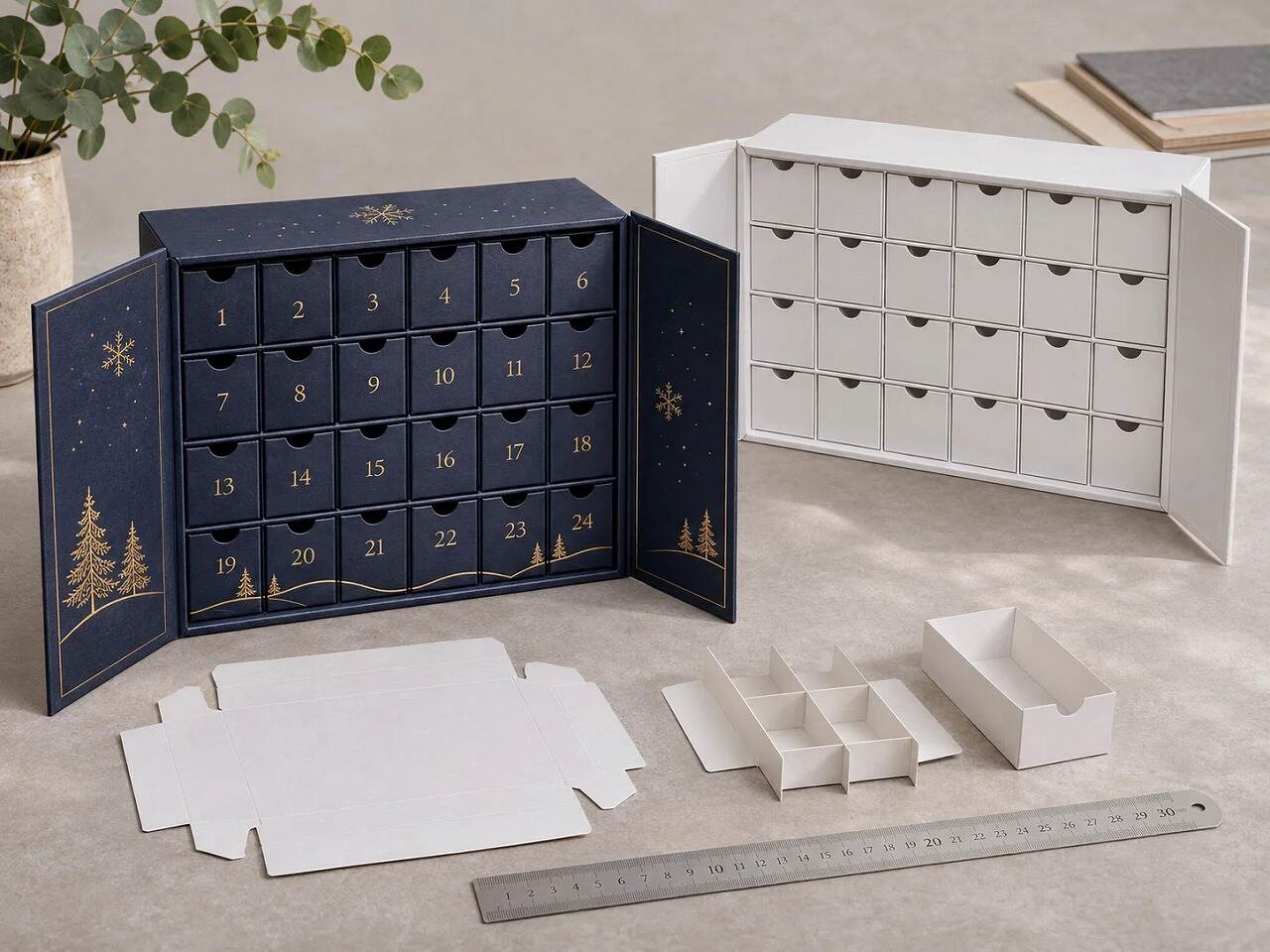
How to choose an advent calendar manufacturer: ask each candidate to prove that its team can turn your actual product list into a repeatable box and then deliver units that match the approved sample. Use the same five evidence requests for every bidder. A claim without a drawing, sample, inspection record or written responsibility should remain unverified.
This is a supplier-qualification framework, not a ranking of factories. A 24-drawer rigid calendar for skincare minis and a perforated-door carton for individually wrapped chocolate need different structures and controls. The buyer's task is to compare the evidence against one agreed specification, not to find a universal "best" factory.
Before you request a sample, build a one-page advent calendar supplier checklist and send the same questions to every candidate. The value is not the score itself but the consistency: you can compare answers side by side instead of comparing sales presentations.
| What you are testing | Question to ask | Evidence to request |
|---|---|---|
| Structure development | Who draws the dieline and the compartment grid, and who approves it? | Dieline file, 3D mockup, named structural engineer, revision history |
| Physical sampling | Is the sample hand-made or produced on the same process as bulk? | Production-intent sample, material spec, fit test with your actual products |
| Quote scope | Which line items are included, and which are charged separately? | Written quote with tooling, sampling, assembly, packing and freight terms stated |
| Quality control | What is inspected, at which stage, against which standard? | Inspection plan, AQL level, anonymised recent report, defect classification |
| Delivery responsibility | Who owns the carton plan, shipping marks, documents and remake cost? | Packing specification, Incoterm, named contact, written remedy clause |
Use the same scorecard for every bidder: add columns for evidence received, revision/date, responsible person, open issue and decision. Missing evidence should remain "not verified" rather than receiving a passing score.
A manufacturer may still outsource a specialist process, and an agent may manage a project well. The useful distinction is who performs each operation, who controls the approved specification and who is contractually responsible for defects. Ask both types of supplier for the same evidence.
| Capability | Direct manufacturer | Trading company or agent | Marketplace seller |
|---|---|---|---|
| Dieline and structure changes | Identify the design owner and request a revision-controlled dieline | Identify the partner designer and the change-approval route | Confirm whether the format can be changed beyond artwork |
| Insert and tray tooling | Confirm tool maker, storage, maintenance and ownership in writing | Confirm the same terms with the actual tool-owning party | Ask whether custom tooling is available and transferable |
| Sample production | Record sample process and differences from intended bulk production | Confirm which plant makes the sample and the bulk order | Request a project-specific sample before approval |
| QC ownership | Request the inspection plan and named sign-off owner | Clarify who inspects and how reports reach the buyer | Request a written inspection and escalation route |
| Accountability for defects | Name the contracting party and remedy procedure | Define agent and factory responsibilities in the contract | Check platform terms plus the seller's written remedy |
A factory visit is useful but not the only verification method. Request the legal entity and production address, a live walkthrough of the relevant process where practical, a named technical contact and a documented change-approval route. A sales contact who cannot answer a tolerance question may simply need to involve an engineer; judge the quality of that technical response rather than assuming the business model.
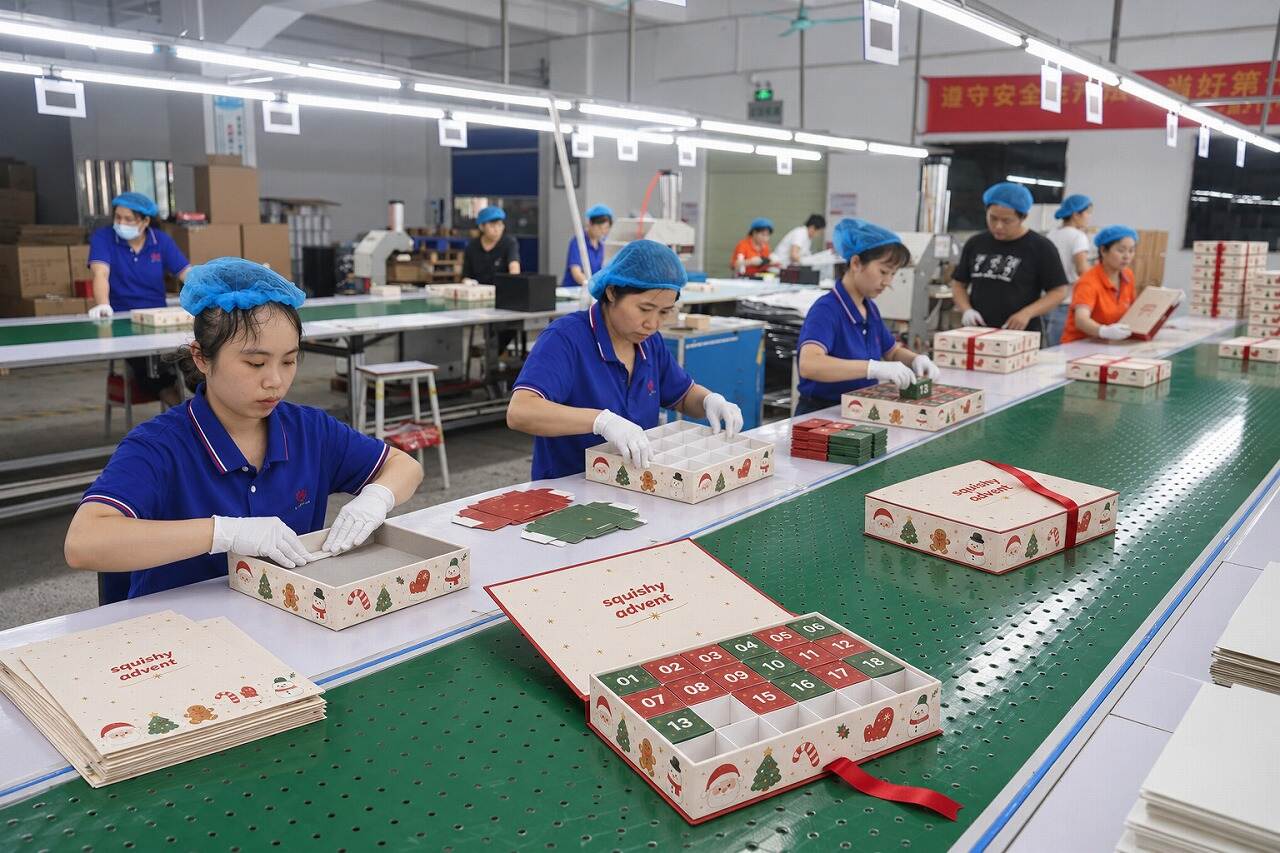
Real GPLPAK paper-box assembly workshop. For a specific advent calendar order, request project-specific process and inspection evidence.
For a broader view of how factory-direct sourcing works in China, see this guide to custom packaging box manufacturers in China.
An advent calendar is an assembly with coordinated tolerances, not only a printed outer box. For a 24-day design, the numbered openings must align with 24 positions; doors or drawers must operate as intended; and each cavity must retain its actual product through the agreed distribution route. A 12- or 25-day project needs the same design logic with a different layout.
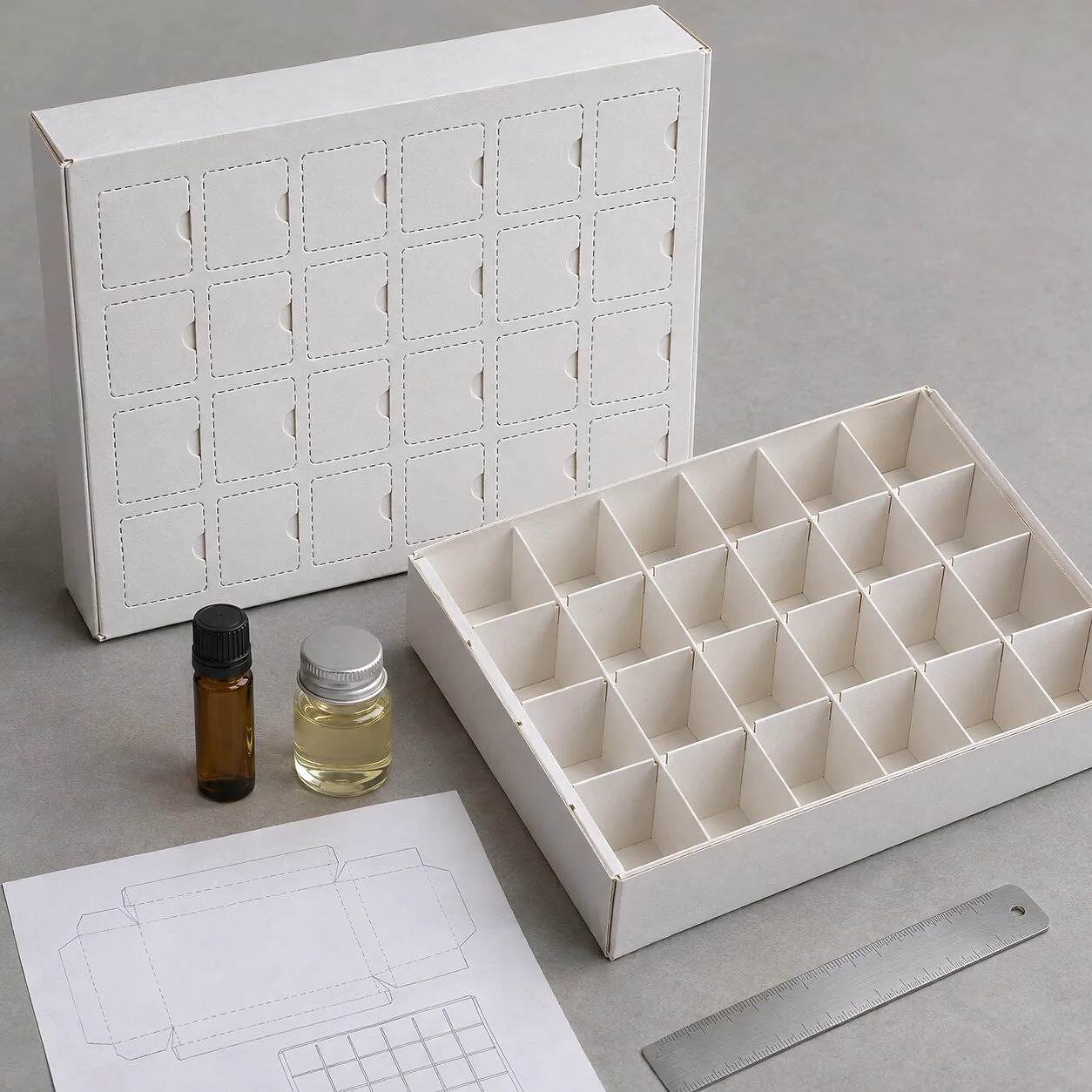
Illustrative structural sample: match every numbered door to its cavity and actual product.
Can you show the internal dimensions of each compartment, not only the external box size?
How will you set clearance using the maximum measured product dimensions and the chosen insert material?
Which insert and barrier materials suit the actual filled products, and what evidence supports that choice?
Who owns the cutting die after the project ends, and can it be transferred?
How many structural revisions are included before tooling is cut?
Insert choice affects retention, access, pack-out time and material recovery. Paperboard partitions work well for many regular shapes; molded-fibre forms can cushion selected fragile items; EVA can create close-fitting cavities; and thermoformed PET can provide a shaped tray. None is automatically the most protective or recyclable in every market. Compare actual fit, drop-test results, tooling, assembly and the destination's recovery route before selecting one.
For a mixed-size calendar, ask for a position-by-position product map with each item's maximum dimensions, weight, orientation, removal access and any fragile points. The supplier should return a cavity drawing and a prototype that can be checked with the actual products. GPLPAK's development and samplingそして設計検証 pages describe related services.
If the plan is a rigid, book-style or magnetic calendar, review real constructions rather than renderings: a magnetic book-shaped advent calendar box shows how a spine, hinge and 24 cavities coexist, while a calendar-style magnetic folding rigid box shows what can be shipped flat and assembled at destination.
A beautiful white mockup proves that someone can cut and glue by hand. It does not prove that a production line can repeat the box thousands of times. Ask for a production-intent sample: made with the specified board, the specified wrap paper, the intended print method and the actual insert material.
| Checkpoint | How to test it | Fail condition |
|---|---|---|
| Product fit | Insert every real product, including the largest and smallest SKU | Product rattles, tilts, or requires force to remove |
| Door and drawer action | Open all 24 positions in sequence, then repeat ten times | Torn perforation, sticking drawer, separated hinge |
| Print registration | Check that the printed grid aligns with compartment edges on all sides | Visible drift greater than the agreed tolerance |
| Colour match | Compare against an approved physical target under consistent lighting | Brand colour shift on foil, lamination or uncoated stock |
| Transit survival | Pack the sample in the proposed shipping carton and run a drop test | Corner crush, split wrap, insert collapse |
⚠️ Important: Sign and retain one approved "golden sample" with a date and revision number. Without it, "the bulk does not match the sample" becomes an opinion rather than a measurable claim.
Ask for the material specification in writing: board type and grammage, wrap paper, print process, lamination, foil or embossing, and the adhesive used at the seams. "High-quality paper" is not a specification. The same visual design behaves very differently on a 1.5 mm grey board than on a 2.5 mm board, and a matt lamination that looks premium on a mockup can scuff badly in a retail bin.
For chocolate, tea or other foods, first map which surface actually touches the food. A sealed primary wrapper may separate the food from the display calendar; loose food may place the tray or liner in direct contact. Specify the target market, contact surfaces, barrier or pouch construction and the applicable material declarations or tests before making any food-contact claim. The outer decorative box alone does not establish compliance. GPLPAK's food packaging page is a starting point for discussing that boundary.
Useful for premium drawer or book-opening presentations when shelf presence matters. Compare the assembled volume and pack-out work with any fold-flat option before selecting it.
A practical option for perforated-door formats. It can ship flat, but the window and perforation design still need a filled-pack test for access, retention and transit.
"We check every box" is not a quality system. A verifiable system names the inspection stages, the sampling plan, the defect classes and the person who signs the report. Ask for an anonymised report from a recent calendar project and read what was actually measured — dimensions, colour, adhesion, hinge strength, print defects.
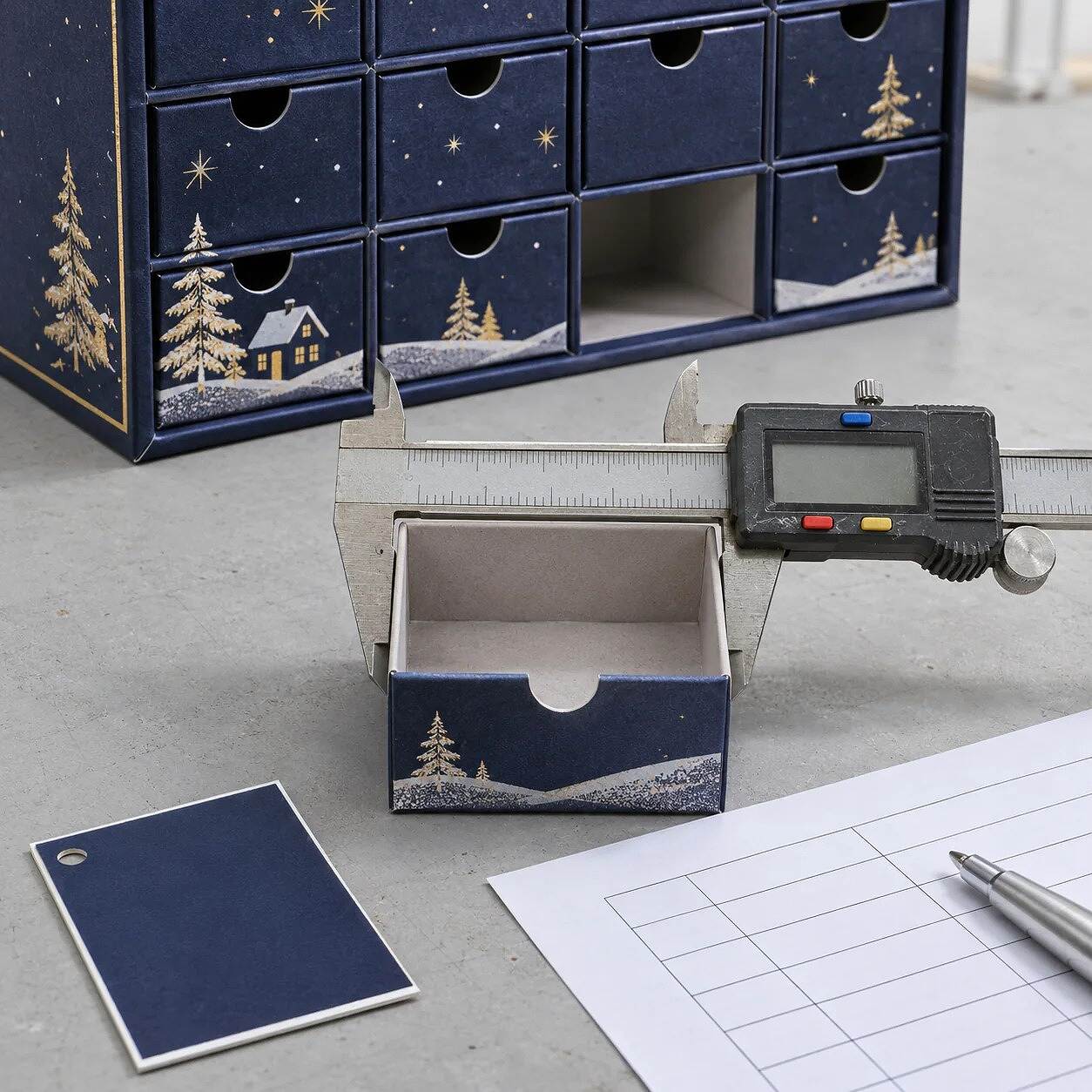
Illustrative inspection setup: measure the removable drawer against the signed-off sample and drawing.
Incoming material: board grammage, wrap paper shade, adhesive batch.
In-line: die-cut registration, compartment depth, glue line position.
Assembly: 24-position count, drawer clearance, door tear line, insert seating.
Pre-shipment: inspect against the agreed sampling plan and approved colour target; use distribution tests only when the packed configuration and acceptance criteria are defined.
Record retention: photos, measurements and sample reference kept for the order.
Agree critical, major and minor defect examples before production, along with the sample size, acceptance criteria and who signs the release. The inspection plan should be specific to this order; an "AQL" label alone is not an agreed quality standard.
The most common sourcing mistake is comparing totals produced from different specifications. A quote is only comparable when every line below matches. Build one specification sheet and send the same version to every candidate.
External dimensions and internal compartment dimensions
Board type, thickness and wrap paper
Print colours, finishes and special processes
Insert material, cavity layout and whether tooling is new
Flat-packed or assembled, and who performs assembly
Tooling, sampling and plate fees, stated once and separately
Quantity tiers, carton pack, gross weight and Incoterm
Lead time measured from deposit or from artwork approval
Payment terms, currency and quote validity
Then convert every offer to the same basis: cost per finished, packed unit at your target quantity, with tooling amortised separately. Keep freight and duty in a second column so you can see where the difference actually sits. Detailed cost modelling deserves its own workbook — this checklist only ensures you are comparing the same product, not two different boxes with the same name.
Quote comparison: Ask for your target quantity plus one lower and one higher tier, with tooling and other one-time charges separated. If a tier cannot be quoted, ask for the minimum feasible quantity and the reason.
Advent calendars are bulky, corner-sensitive and often seasonal. A late or crushed delivery cannot be fixed by air freight in December. Clarify the physical plan before price dominates the conversation: how many units per carton, whether boxes ship flat or assembled, pallet dimensions, corner protection, moisture control and shipping marks.
Agree the commercial plan at the same time. State the Incoterm, the named port or door, who prepares the commercial invoice and packing list, who books the container, and who is responsible for damage discovered at destination. If the factory quotes FOB but the agent quotes DDP, the numbers are not comparable. GPLPAK's packing serviceそしてmanufacturing pages outline how these handovers are usually documented.
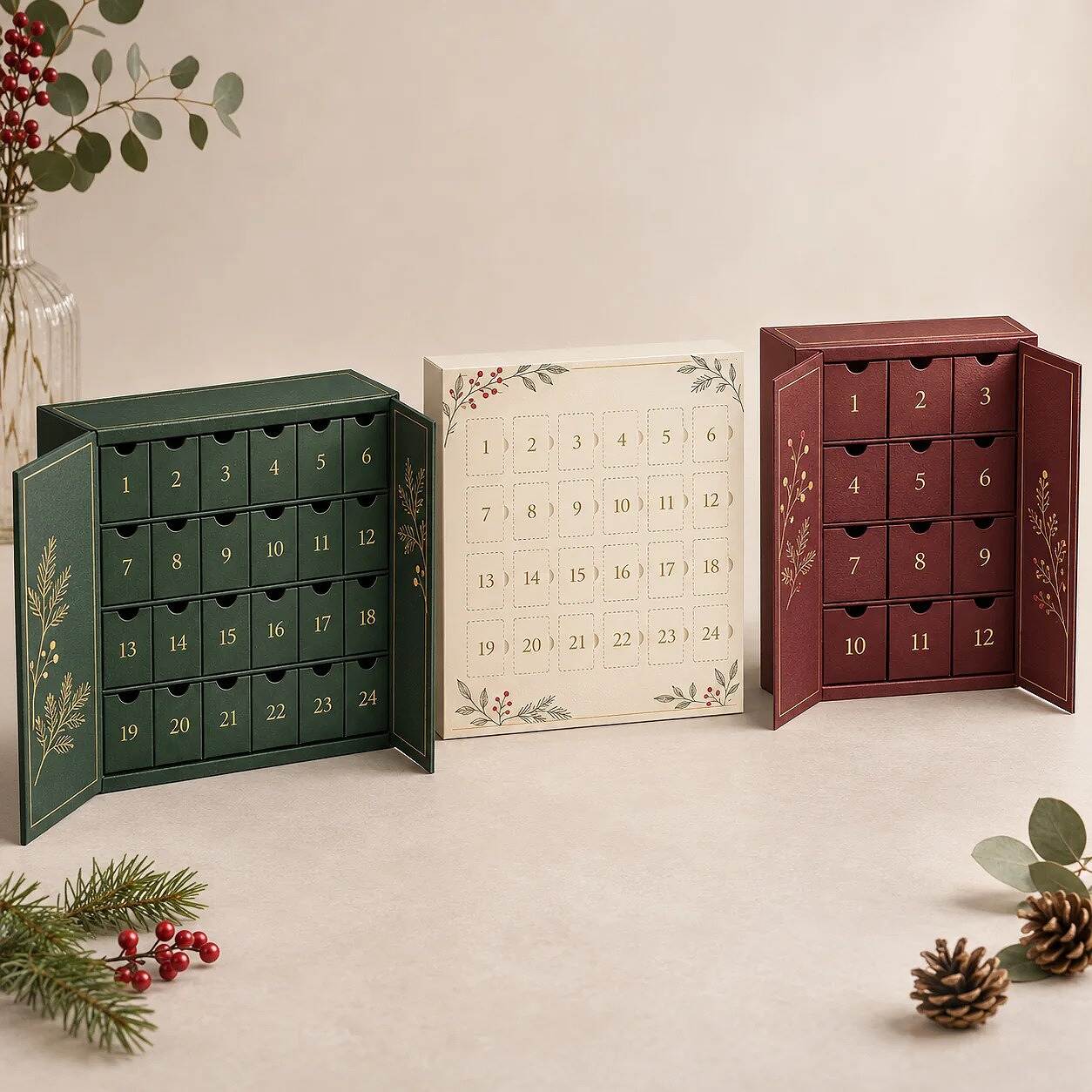
Illustrative format comparison: 24 drawers, 24 perforated doors and a smaller 12-drawer gift format.
During a seasonal project, decisions arrive faster than contracts. The manufacturer's ability to track them is a production capability, not a soft skill. Test it early with a versioned question list: every answer gets a date, an owner and a revision number.
Score these behaviours: Does the technical contact answer the question that was asked? Are drawings returned with marked changes, or only a polite "yes, no problem"? When a material is unavailable, do they propose an alternative with trade-offs, or wait for you to discover it? Is there one account owner, or a new name every week?
A practical test is to request one small structural change and check that the dieline, quote and sample record carry the same revision. If one document is not updated, pause approval until the discrepancy is resolved; this is a project-control issue regardless of whether you work directly with a factory or through an agent.
A price is given before dimensions, insert and quantity are defined.
The company cannot say whether the cutting die is new, shared or owned by a third party.
Factory video or a live call is refused, but a catalogue of stock photos is offered instead.
The "sample" is a generic box with your logo added, not your structure.
Quality is described only as "100% inspection" with no plan or record.
Changes are accepted verbally but never appear in a revised drawing or quote.
Nobody will state in writing who pays for a remake if the bulk fails the approved sample.
None of these signals is proof of fraud. Each one, however, shifts risk onto you — and in a seasonal category, risk has a deadline.
Every dimension, material and finish is written down and versioned.
Sealed, dated and signed by both sides, with the revision number on the label.
Tooling, plates, sampling and setup separated from the unit price.
Sampling method, defect classes, acceptance criteria and remedy for a failed shipment are agreed in advance.
Artwork approval, sample approval, bulk start, inspection, handover to freight — each with a date.
If you are still at the concept stage, start with the format rather than the factory. GPLPAK's guide on how to custom a calendar paper box for holidays walks through the format decision, and the custom advent calendar packaging page shows the constructions and compartment options available for a first feasibility review.
Send your product list, target quantity and deadline. Ask GPLPAK to review the compartment layout, insert choice and sample plan against your actual items before you approve tooling or bulk production.
GPLPAK Packaging Team · Gplpak.com
 ホットニュース
2026-11-25
2026-11-20
2026-11-19
2026-11-18
2026-11-13
2026-11-13
2026-11-10
2026-11-05
2026-11-02
2026-10-27
Discover premium packaging solutions from Dongguan Xinglan Packaging Products Co., Ltd. Specializing in innovative, durable, and custom packaging products for diverse industries.
 英語
 EN
 RU
 ES
 KO
 JA
 PT
 IT
 DE
 FR
 NL