 EN
 EN
 RU
 ES
 KO
 JA
 PT
 IT
 DE
 FR
 NL
Liens rapides
In brief: a custom collapsible rigid box for cosmetics is a wrapped greyboard presentation box designed to ship flat and be erected before filling. Buyers should specify the hinge and sidewall mechanism, bottle restraint, market-specific artwork zone and pack-out method together. The retail box is not automatically a parcel shipper; validate the filled retail pack together with its planned transit carton. The cosmetic brand and its regulatory responsible person must approve label content before print.
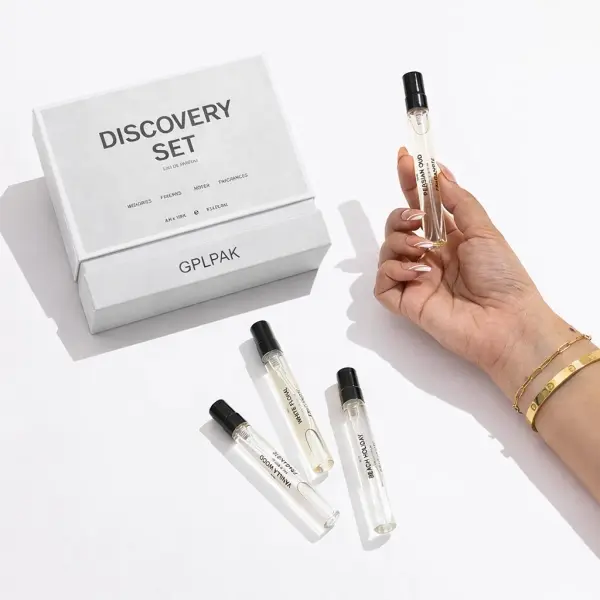
Cosmetics is the category where rigid packaging design is most visible and least forgiving. A serum bottle is heavy for its volume, a cream jar is wide and shallow, a compact has a pressure point on the lid, and a fragrance set may be the only packaging a customer keeps. At the same time, the outer box is often the surface that carries the legally required product information, because the primary container is too small, curved or expensive to print.
This guide separates the packaging converter's job from the cosmetic brand's regulatory job. Structural samples and insert trials establish fit; print proofs establish colour and legibility; the brand's responsible person or qualified regulatory adviser approves the final market-specific claims and mandatory text. Reserve the label area before approving the structural dieline.
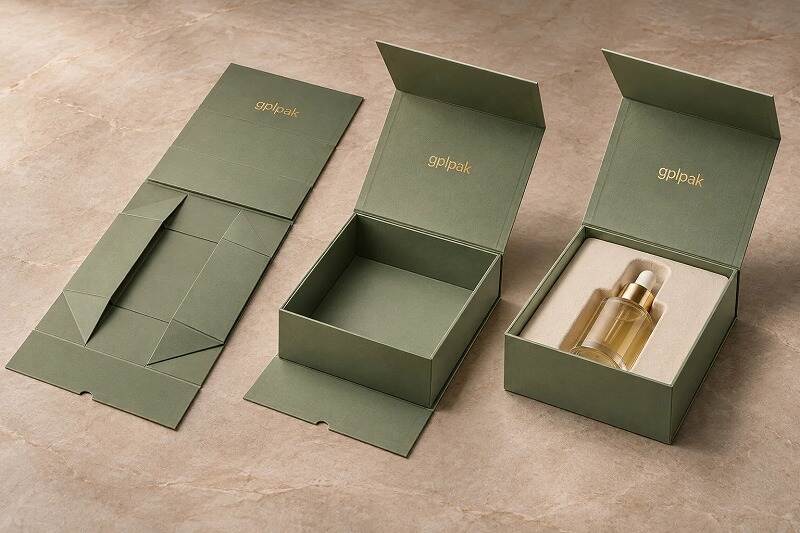
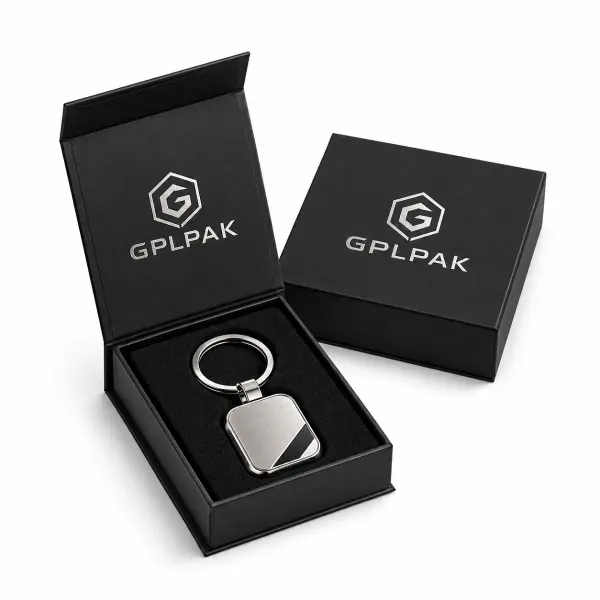
A collapsible rigid box uses wrapped greyboard panels, scored hinges and a defined corner-lock or adhesive mechanism so the body can ship flat and be erected at the filling site. Its reduced inbound cube is a potential advantage, not a guaranteed saving: compare finished-pack dimensions, export carton quantity, assembly labour and damage results against a fixed rigid box.
The business case has three parts: lower inbound freight and storage cube, premium printed panels, and the option to erect packs as a launch or promotion needs them. Offset those benefits against erection time, closure quality control and the space needed for loose inserts. Request both flat-pack and assembled-pack carton data before comparing landed cost.
The trade-off is mechanical: corners must square reliably, the hinge and wrap must tolerate the specified opening cycles, and the insert must restrain the actual filled item. Ask for a flat sample, an erected sample and a written assembly sequence. Our collapsible rigid box buyer's guide covers the general construction; this article applies it to cosmetic sets.
“Book style,” “drawer” and “lid and base” describe how a box opens, not whether it folds flat. A conventional glued drawer, lift-off lid box or double-door cabinet is usually shipped pre-assembled. A genuine fold-flat proposal needs a drawing of the flattened panels, corner connection, erection sequence and final load path. Compare opening styles only after that construction test.
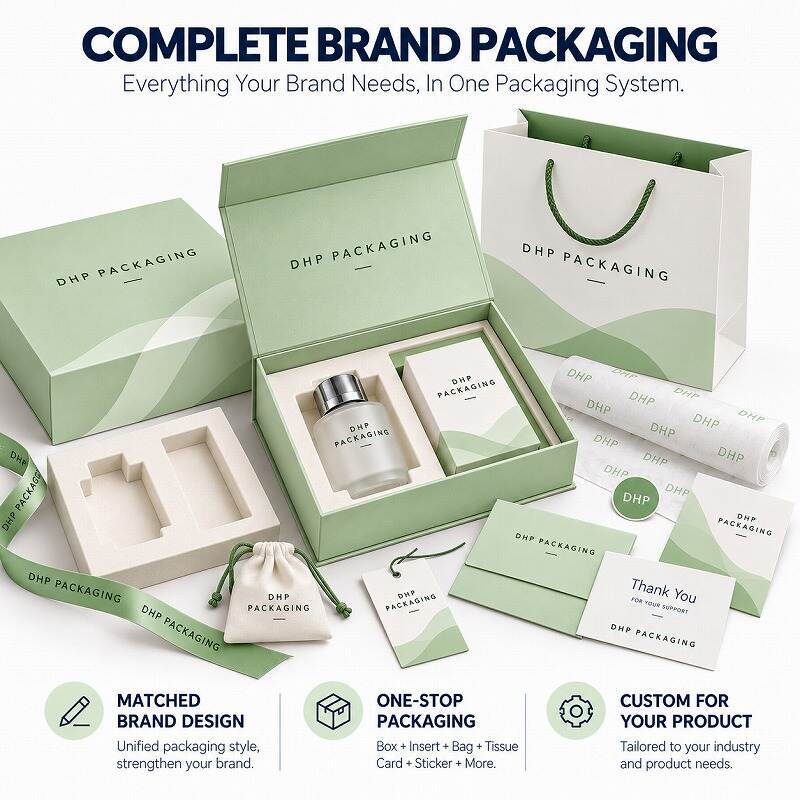
The assembled appearance alone does not prove that a box is collapsible; inspect its flat blank and corner construction before ordering.
| Format | Best for | Opening feel | Fold-flat check |
|---|---|---|---|
| Book-style magnetic | Two to six items, flat or upright, gift sets and launch kits | Slow lift with a full reveal | Can be engineered fold-flat if scored sidewalls and corner fixing are specified; approve the erected corner and hinge |
| Drawer-style alternative | Tall bottles, ampoules, single-product hero boxes | Slide out, controlled and linear | A conventional rigid sleeve and tray are fixed; a collapsible version requires separate engineering for both components |
| Lid-and-base alternative | Wide jars, compacts, small sets with a flat layout | Lift-off, ceremonial but simple | Usually a fixed rigid construction; ask whether both lid and base genuinely flatten and how they lock |
| Double-door alternative | Premium gift sets, fragrance, festive editions | Two-handed, symmetric, theatrical | Frequently fixed; do not infer collapsibility from hinged front doors |
| Flip-top variant | Single item, retail counter display, sampler boxes | Quick thumb lift | Possible only with a foldable body; validate flap closure after insert and product are fitted |
A practical rule from production: the more items in the set, the more the box behaves like a tray, and the more the insert does the work. A book-style box with five items is not a bigger version of a book-style box with one item; it is a different structure with a different lid stiffness and a different hinge load. Decide the item count before the dieline, not after.
For an RFQ, request photos or samples of the same SKU in three states: flat, erected empty, and fully packed. This establishes that the quoted flat-pack saving and the visible retail presentation refer to the same construction, not two different products.
Most damage in cosmetic sets happens inside a box that arrived in perfect condition. The glass did not break on the outside; it broke against another component, or the dropper cracked because the bottle moved two millimetres more than the cavity allowed. The insert is the protective system, and it is chosen on geometry and mass, not on how it photographs.
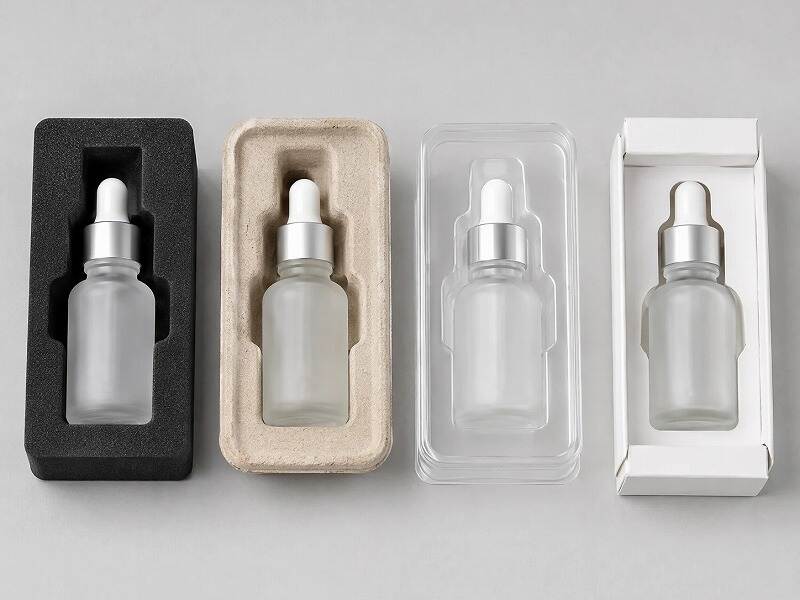
The same bottle, four inserts. Protection, tolerance and end-of-life all change with the material, and so does the minimum order quantity.
| Insert type | Protection | Cavity tolerance | When to use it |
|---|---|---|---|
| mousse EVA | High, especially for repeated shock and thin glass | Can be closely profiled, subject to foam grade, tooling and bottle variation | Heavy bottles, multi-item sets, premium unboxing where the tray is visible |
| Molded pulp | Moderate to high for broad contact; less good in thin sections | Requires draft, radii and a tested fit range | Paper-first brands, refill sets, larger volumes where tooling amortises |
| Thermoformed PET or rPET | High, with a controlled snap fit around a bottle shoulder | Repeatable after tool approval; account for sheet and trim variation | Single hero products, retail display, transparent presentation |
| Folded paperboard platform | Moderate; relies on the platform geometry and the box walls | Defined by board caliper, score and fold sequence | Light items, samplers and paper-led designs; recycling depends on the finished pack |
Controlled fit, not a guessed clearance: measure the maximum finished bottle envelope, including label, cap and manufacturing variation. Agree cavity retention and removal force on physical samples; an overly tight cavity can damage glass or slow pack-out.
Support the shoulder, not the cap: a dropper cap is the weakest point. The cavity should carry the bottle at the shoulder or body, leaving the cap free of load.
Keep load off the closure: specify lid-to-cap clearance against the highest approved bottle and insert tolerance, then verify it after the box is closed and the transit case is stacked.
Test with the real fill weight: an empty bottle is not a sample. Fill to the declared nominal content, because the centre of gravity and the drop behaviour change with liquid mass.
For multi-item sets, verify that bottles cannot strike each other or a hard trim after vibration. Wall or web thickness is project-specific; set it from the actual filled mass, insert material and validated transport route, then check that staff can remove each product without tearing the insert.
Beauty packaging is judged in the hand and under retail lighting. Finish selection should therefore balance colour fidelity, abrasion resistance, hinge cracking and the actual recycling assessment of the complete pack; no single coating or foil is universally best.
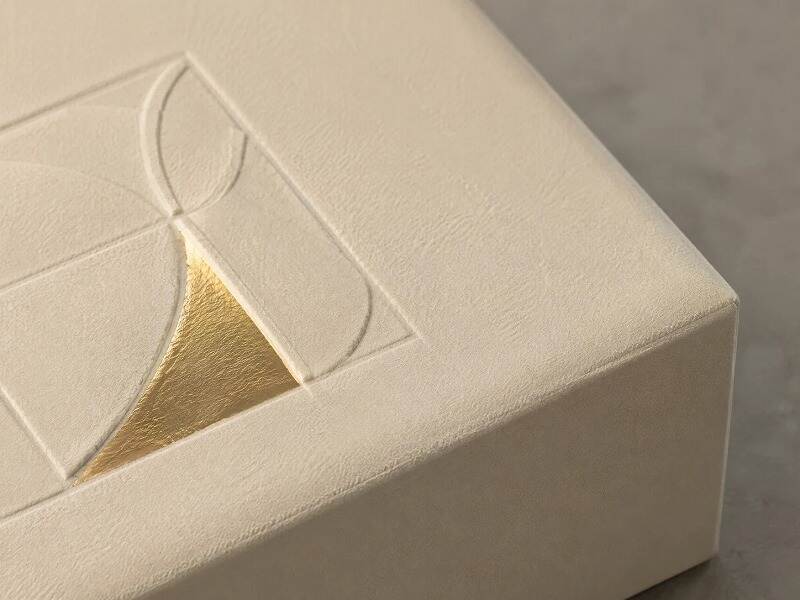
Raking light is the honest test for a premium finish: it shows foil edge definition, emboss depth and the evenness of a soft-touch surface that flat photography hides.
| Finir | Effect | Handling risk | Recycling impact |
|---|---|---|---|
| Laminage mat à toucher doux | Velvet surface, strong on dark colours | Shows fingerprints and scuffs; hard to clean | High: a plastic film over the whole panel |
| Aqueous matte or gloss varnish | Clean, slightly drier look; good on pastels | Less scuff resistance than film unless double-coated | Low: stays in the fibre stream |
| Estampage à chaud | Sharp metallic logo, high perceived value | Fine foil lines can fill in; large solid areas scratch | Moderate at high coverage; keep it to the logo area |
| Emboss or deboss | Tactile depth without added material | Needs a tool and clean board; deep emboss can crack the wrap | None, if the board and wrap allow the depth |
| Spot UV | Gloss contrast against a matte field | Can yellow over time; visible on textured paper | Low to moderate depending on area |
| Window patching | Product visibility without opening the box | Film can wrinkle; dust shows on the inside | High: a plastic patch in a paper panel |
Colour is where brand teams and printers argue. A colour approved on a coated proof looks different on an uncoated wrap, and a colour approved on paper looks different from the same colour on a glass bottle under retail light. Two numbers keep the conversation objective.
Physical proof, not a screen: approve the real wrap stock under agreed viewing conditions. Record target colour values, measurement method and tolerance in the job specification; a monitor alone cannot approve press colour.
Agree the tolerance: specify the colour-difference method and acceptable variation for the actual substrate and print process. Do not promise a universal ΔE number across paper, glass, film and foil.
Approve a drawdown on the real stock: ink on uncoated recycled board absorbs differently than on coated art paper. Approve the colour on the paper you will actually print.
Cosmetic packaging fails in three predictable ways: glass breaks, liquid leaks, and the box deforms under a stack. Each has a structural answer that belongs on the drawing, not in the complaint file.
A 50 ml glass jar with a thick base can weigh more than a box full of paper. The load path runs from the insert to the base panel, so the base board must be specified for the mass and the insert must sit flat on it rather than hanging from the walls. For boxes above roughly 200 mm in any dimension, 2.0 mm to 2.5 mm greyboard is a normal starting point; the supplier should confirm stiffness against the actual packed weight rather than a rule of thumb.
A paper presentation box cannot replace a leak-tight primary closure or contain a spill by itself. The brand and filler should validate closure torque or seal integrity; the converter should test the packed secondary box and the intended outer shipper for the relevant route. If a leak barrier is required, specify and test it separately rather than assuming a paper insert is liquid-proof.
A compact has a rigid lid that transmits force directly to the product. Under a stack, the lid can crack the powder or pop the hinge. The fix is a platform that supports the compact around its rim, not in the centre, plus a clearance above the lid so the box takes the load through its walls. This is the same principle as supporting a bottle at the shoulder.
Important: agree a transport temperature profile with the brand and logistics provider. Test adhesive bonds, wrap, insert and finished cosmetic against that profile; a decorative greyboard box is not an insulated thermal shipper.
EU Cosmetics Regulation (EC) No 1223/2009, Article 19 generally requires specified information on both the container and packaging, with particular exceptions and leaflet/tag routes where practical labelling is impossible. The outer gift box is not a blanket substitute for all primary-container information. Have the EU responsible person approve the allocation for each SKU and market language.
| Information | What it means in practice | Common error |
|---|---|---|
| Responsible person | Name and address of the EU-established responsible person; confirm placement on container and packaging under Article 19 | Only the overseas brand address appears, with no EU entity |
| Nominal content | Nominal content at packing, subject to Article 19 exceptions; list set components clearly | Net weight of the set stated as if it were one product |
| Durability or PAO | Minimum durability where required; PAO for products lasting more than 30 months unless the opening concept is not relevant | PAO printed on the box but not on the inner container the customer keeps |
| Batch number | Production identification, traceable to the filling record | Inkjet code applied to a coated panel that smudges in transit |
| Ingredient list | INCI names in descending order of weight; fragrance allergens flagged where required | List runs onto a fold or a dark panel and becomes unreadable |
| Warnings and precautions | Mandatory precautions for the formulation and the container, in the language of the market | Translated text squeezed into a 6 pt area and rejected at retail |
| Function and origin | Product function unless obvious from the presentation; country of origin where the product comes from outside the EU | Function implied only by imagery, which is not enough when the set is opened |
Reserve a flat, readable panel for the approved ingredient list, warnings and variable batch marking before locking the dieline. Article 19 permits specific information routes via an enclosed or attached leaflet, label or tag where practical printing is impossible; those exceptions are not a blanket permission to move every required item off the container. Check each product in a multi-SKU set.
The EU responsible person must arrange the applicable safety assessment, product information file and CPNP notification before placing the cosmetic product on the market. The converter does not certify the formula or marketing claims; it must work from approved artwork. Claims should be supported by the brand's evidence, and any change in the formulation or responsible-person details should trigger an artwork review.
Most beauty brands sell in more than one market, and the box is usually printed once for all of them. That only works if the label panel is designed for the strictest market and the other markets are handled with over-labelling or market-specific versions.
US cosmetic labels must be reviewed against FDA requirements for identity, net quantity, ingredients, business details, warnings and MoCRA contact information as applicable. MoCRA introduced facility registration and product listing for many businesses, but certain small businesses are exempt from those particular duties. Product claims can also change classification: sunscreen or acne-treatment claims can trigger drug requirements. The brand's US regulatory adviser should sign off artwork; the printer should not make classification decisions.
For Great Britain, check the current GOV.UK guidance for placing cosmetics on the GB market, including the GB responsible person, safety file, label and notification obligations. Northern Ireland has a different regulatory route; do not treat “UK” as one artwork jurisdiction. Brands selling in both the EU and GB should approve the responsible-person and language panels for each destination.
If the finished cosmetic will be sold in mainland China, obtain a separate NMPA-market artwork brief from the local regulatory team. Registration or filing route, Chinese-language label text and claim substantiation depend on the product and channel. A box printed in China solely for export does not automatically need a Chinese consumer label. Reserve a clean over-label area only when the destination-market plan calls for it.
Design tip: build a "label zone" into the artwork template: a flat, light-coloured rectangle with no foil, emboss or dark ink, sized for the longest ingredient list plus warnings plus batch code. Every market can then use the same dieline, and over-labelling becomes a production step rather than a redesign.
A secondary paper box around a sealed cosmetic bottle is not automatically a food-contact material, and food-contact certification should not be represented as a universal cosmetic-box requirement. Instead, assess the actual contact pathway: direct product contact, contact with the primary container, volatile odour transfer in a closed pack, ink set-off and any market-specific packaging substance restrictions. Ask the supplier for material declarations and targeted testing where the brand's risk assessment justifies it.
| Risk | Source in a rigid box | Control |
|---|---|---|
| Mineral oil (MOSH and MOAH) | Recycled fibre, some printing inks and adhesives | Assess recycled content, primary-container barrier and actual exposure pathway; request targeted testing if needed |
| Primary aromatic amines | Azo pigments in some inks and dyed papers | Obtain ink and paper declarations; investigate set-off or direct contact when the actual pack configuration warrants it |
| Heavy metals | Pigments, recycled pulp, metallic foils | Check applicable packaging heavy-metal restrictions and supplier declarations for the destination market; test when required |
| Odour transfer | Solvent residues in ink, adhesive, foam and pulp | Sensory panel on a sealed sample; low-odour adhesives; adequate curing and aeration before packing |
| Staining and transfer | Dark inks against a white insert, dyed ribbon, foam plasticiser | Compatibility test at elevated temperature; line the contact area; avoid plasticiser-rich foam next to coated surfaces |
Odour is particularly important for fragrance and skincare gift sets. Agree a sensory comparison against an unprinted control and set conditioning time and temperature in the test plan. Check the filled, closed retail pack after the adhesive and print have cured; do not use an arbitrary pass/fail temperature as a substitute for the real storage profile.
The EU's Packaging and Packaging Waste Regulation (PPWR) sets design-for-recycling and other obligations with staged implementation and detailed assessment rules. Do not equate a greyboard core with a verified “recyclable box”: wrap, coatings, magnets, foam, labels and local collection systems all affect the finished pack. Substantiate environmental claims for the exact SKU and market.
Start with the lowest-complexity structure that passes product-protection testing. Compare a removable paperboard or molded-fibre insert with foam, and an aqueous coating with film lamination on the actual printed stock. If magnets are used, document their material and assess separation or recycling compatibility with the target scheme; do not promise that every customer will remove an embedded magnet.
If the brand intends consumer reuse or refill, specify that as a separate performance brief: expected cycles, replaceable insert, cleanability, hinge and corner fatigue, and how the refill is sold and shipped. A stronger board alone does not establish a reusable system. Compare the material and transport impact over the intended number of actual uses before making a reuse claim.
A cosmetic set should be approved in the same sequence every time, because the failure modes are predictable and each stage catches a different one. The development sampling stage is where structure and fit are proven; the printed sample is where colour and finish are proven; the tested sample is what protects you in a dispute.
Confirm the erected size, the cavity fit, the headroom above the cap and the way the box closes. Use a filled bottle at the declared nominal content, not an empty one.
Approve spot colours on the actual stock under D65, record the Lab values, and check the label zone for legibility at final print size.
Check foil registration, emboss depth, coating evenness, batch-code area and the finished label panel. Inspect under raking light, not only straight on.
Drop and vibration on the packed unit, 24-hour odour check, staining check at elevated temperature, and a leakage inspection after each test. Retain the sample and the report.
Keep an approval file per SKU: the dieline, the approved sample, the colour readings, the material declarations, the migration and odour reports, the batch-code position and the signed acceptance criteria. When a co-packer changes a bottle supplier six months later, that file is the only way to know whether the cavity still fits. The box measurement guide explains which dimensions the factory needs to rebuild the cavity correctly.
Send GPLPAK the finished product dimensions and weight, item count, destination markets, target quantity and artwork brief. Ask for a flat and erected structural sample, insert proposal and pack-out specification; transport testing should be scoped and agreed before any performance claim is made.
Request a Cosmetic Box Quote Explore Cosmetic PackagingCustom Collapsible Rigid Boxes: Complete B2B Buyer's Guide
Wholesale Collapsible Rigid Boxes: MOQ, Lead Times and Unit Cost
© 2026 GPLPAK — Custom paper packaging manufacturer in China
 Actualités chaudes
2026-11-20
2026-11-19
2026-11-18
2026-11-13
2026-11-13
2026-11-10
2026-11-05
2026-11-02
2026-10-27
2026-10-23
Discover premium packaging solutions from Dongguan Xinglan Packaging Products Co., Ltd. Specializing in innovative, durable, and custom packaging products for diverse industries.
GPLPAK s’engage à offrir une excellence en matière de fabrication.